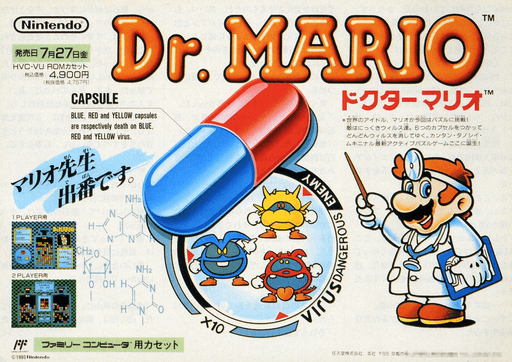
Dr. Mario
Dr. Mario is a Super Famicom puzzle game released in 1998 developed by Nintendo. It centers on rule recognition, spatial or logical judgment, and successive puzzle solving, with controls, information, and pacing arranged around television output, a directional pad, shoulder buttons, and a six-button controller.
- AI score · out of 10
- 8.1 / 10
About this game
Dr. Mario is a Super Famicom puzzle release centered on rule recognition, spatial or logical judgment, and successive puzzle solving. Compact stages add conditions and tighter constraints over time, with progress divided into stages, tasks, matches, or growth milestones that make its immediate goals understandable. Its value depends on whether these rules continue to create judgment and room for mastery rather than on campaign length or series recognition. Short campaigns are judged by repeat-challenge value, while longer ones are judged by variety, pacing, and recovery after failure. Graphics, audio cues, and state feedback need to support decisions directly, while sprite animation, scrolling, color, and chip-based audio jointly carry readability and atmosphere. The main genre-specific friction is that limited explanations, repetition, or abrupt difficulty can stall progress. In addition, password or battery saves, multiplayer accessories, manual dependence, regional language, and cartridge enhancement chips can affect original-hardware use. This description covers only this release and excludes emulator features, modern-port conveniences, and content from other platforms.
Collected in series
Super Mario is Nintendo’s platform-adventure series, first launched in 1985. Mario and his friends leap through the Mushroom Kingdom and beyond, exploring colorful worlds and tackling playful challenges. Mushrooms, coins, pipes and surprising power-ups make every adventure full of discoveries.
Recommended games
Related game recommendations on this platform
Super Famicom / SNES
AI review
AI reviews are subjective assessments, not player ratings. See each review for its evidence and limitations.Published date:
Clear color design, tightly linked placement and CPU chain battles reward repeated practice, with strict late-level retry limits.
This Dr. Mario edition places two-part capsules among viruses, making every clear a decision about color, space and later pieces. Chains do more than tidy your bottle: they interfere with opponents and buy time, linking careful placement to active pressure. Three CPU strengths, adjustable levels and drop speeds support purposeful practice, while a three-win format and crown markers clarify matches. The strongest opponent clears quickly, although favorable pieces still influence exchanges. Bright colors aid recognition and fuller arrangements retain the music's familiar identity. Solo virus counts rise through level 24, sustaining advanced challenges, but losses from level 21 onward cannot be retried directly. It suits players who enjoy spatial planning, chains and focused contests, with replay rewards rooted in improving technique rather than changing rules.
Strengths
- Placement and chain interference link defensive planning to rewarding attacks.
- Three CPU strengths and adjustable levels and speeds suit different abilities.
- Bright colors and fuller music arrangements provide clear, energetic expression.
Weaknesses
- Losses from level 21 onward cannot be retried directly, making late recovery demanding.
- Strong CPU opponents also chain, so favorable pieces can still sway crucial exchanges.
Who it is for: Players who enjoy color and spatial planning, repeated chain practice and improving puzzle technique through CPU or competitive matches.
Play notes: This assesses the 1998 Japanese Nintendo Power standalone SFC software, not the 1994 compilation or Gateway service edition. Set suitable levels, speeds and CPU strength first; note the late-level loss and retry restriction.
View scoring basis
| Dimension | Review state | Score | Weight |
|---|---|---|---|
| Dimension Increasing virus pressure and three CPU levels sustain mastery, with a focused three-win match goal. Late levels deny direct retries, making recovery from advanced mistakes demanding. Pacing is good and replay purposeful, though late-stage practice is less forgiving. | Reviewed | 7.8 / 10 | Not provided |
| Dimension Color and space planning are tightly linked, while chains connect board management to competitive timing. Choices are clear and deep. Strong CPU opposition rewards practiced handling, although falling-piece opportunities influence exchanges. The excellent core offers distinct skill rewards without eliminating luck. | Reviewed | 8.3 / 10 | Not provided |
| Dimension Bright color choices serve matching decisions, while fuller arrangements preserve a recognizable musical identity. Presentation works closely with the puzzle's goals. Clear colors and layered music give focused decision-making a distinctive style. | Reviewed | 8.1 / 10 | Not provided |
| Dimension Separate level and speed settings, clear CPU selection and crown win markers make challenge arrangement and match status explicit. Software usability is excellent: sessions can be organized around player ability rather than one fixed challenge condition. | Reviewed | 8.0 / 10 | Not provided |
Review sources
Not provided
Core information
- Developer
- Nintendo
- Publisher
- Nintendo
- Release date
- 1998
- Platforms
- Super Famicom / SNES
- Content kind
- Game
- Release state
- Released
- Region
- Worldwide
- Official website
- Not provided
- Offline minimum players
- Not provided
- Offline maximum players
- Not provided
- Online minimum players
- Not provided
- Online maximum players
- Not provided
- Categories
- Puzzle · Primary genre
- Tags
- Solo-friendlyMain Story Under 10 HoursFixed CameraSlow BurnShort Sessions2D GraphicsPuzzle SolvingPick-up and PlayLow Entry BarrierReplayable
- Supported game languages
- Not provided
- Requires base game
- Not provided
- Standalone
- Not provided
- Age ratings
- Not provided
- Play modes
- Not provided
- Perspectives
- Not provided
Release editions
- Super Famicom / SNESWorldwide1998
Game gallery
Sources
Not provided