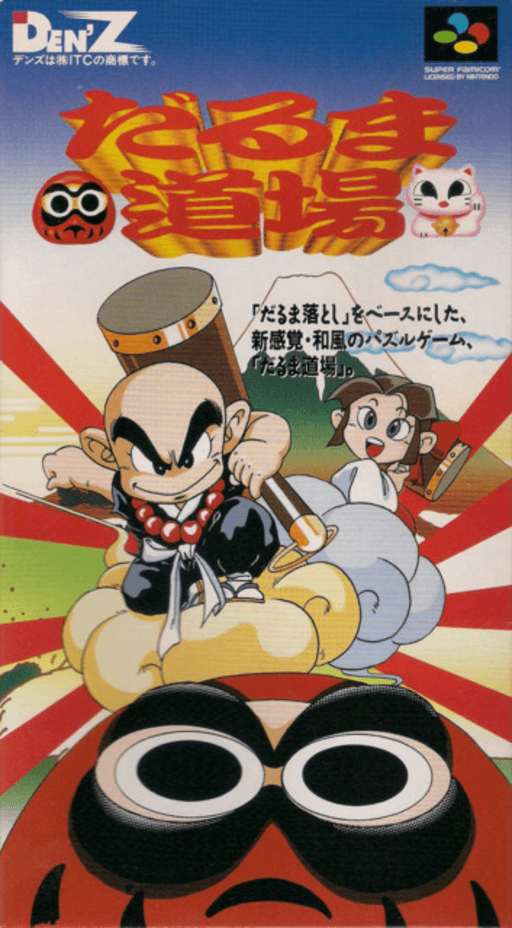
Dharma Doujou
Dharma Doujou is a Super Famicom puzzle game released in 1995 developed by Metro 3D. It centers on puzzle, maze, or device solving, rule recognition, and spatial or logical judgment, with controls, information, and pacing arranged around television output, a directional pad, shoulder buttons, and a six-button controller.
- AI score · out of 10
- 7.7 / 10
About this game
Dharma Doujou is a Super Famicom puzzle release centered on puzzle, maze, or device solving, rule recognition, and spatial or logical judgment. Compact stages add conditions and tighter constraints over time, with progress divided into stages, tasks, matches, or growth milestones that make its immediate goals understandable. Its value depends on whether these rules continue to create judgment and room for mastery rather than on campaign length or series recognition. Short campaigns are judged by repeat-challenge value, while longer ones are judged by variety, pacing, and recovery after failure. Graphics, audio cues, and state feedback need to support decisions directly, while sprite animation, scrolling, color, and chip-based audio jointly carry readability and atmosphere. The main genre-specific friction is that limited explanations, repetition, or abrupt difficulty can stall progress. In addition, password or battery saves, multiplayer accessories, manual dependence, regional language, and cartridge enhancement chips can affect original-hardware use. This description covers only this release and excludes emulator features, modern-port conveniences, and content from other platforms.
Recommended games
Related game recommendations on this platform
Super Famicom / SNES
AI review
AI reviews are subjective assessments, not player ratings. See each review for its evidence and limitations.Published date:
A smart and charming Super Famicom puzzler, with late-stage visual and difficulty barriers.
Dharma Doujou turns knocking blocks from a stack into a planning problem. Each struck piece enters a lower queue; completing a matching set clears it, while a poor sequence can return blocks and push the field upward. One choice therefore has several consequences: can the next colour be completed, is the yokai approaching, and how much headroom remains? The Super Famicom adaptation improves flow by automatically aligning the character with the edge block. Unlike the arcade original, players need not spend an extra movement on horizontal positioning and can concentrate on selection and timing. The home edition adds a story route, endless play and fixed puzzles, while its two characters apply pressure in different ways. There is room either to practise quick decisions or to plan more patiently. Japanese yokai, inter-stage illustrations and lively music give an abstract matching exercise an appealing journey-like personality. Later boards become denser, however, and smaller block symbols can be difficult to read. Its mechanics do not continually reinvent themselves, but the few rules support rewarding mastery. This score belongs specifically to the SFC conversion; arcade controls and its different visual presentation are not carried over. Fans of sorting and predictive puzzle games have a clear reason to try it, while players sensitive to tiny pieces or steep escalation should start with the gentler character and puzzle options.
Strengths
- Simple rules with satisfying planning depth
- Streamlined Super Famicom alignment
- Story, endless and fixed-puzzle variety
Weaknesses
- Demanding late stages
- Small late-game pieces
- Limited fundamental rule changes
Who it is for: Fans of Japanese Super Famicom puzzle games and compact ordering challenges.
Play notes: The score is for the SFC conversion; late-stage piece size may impair readability.
View scoring basis
| Dimension | Review state | Score | Weight |
|---|---|---|---|
| Dimension Story, endless and fixed puzzles add breadth, with a steep but purposeful late-game climb. | Reviewed | 7.7 / 10 | Not provided |
| Dimension Matching knocked-out blocks rewards planning, and the SFC auto-alignment keeps decisions brisk. | Reviewed | 7.9 / 10 | Not provided |
| Dimension Yokai art and music add charm, though smaller late-stage blocks reduce readability. | Reviewed | 7.2 / 10 | Not provided |
| Dimension Simple vertical input and a gentler character option aid use, offset by tiny late-game pieces. | Reviewed | 7.5 / 10 | Not provided |
Review sources
Not provided
Core information
- Developer
- Metro 3D
- Publisher
- Den'Z
- Release date
- 1995
- Platforms
- Super Famicom / SNES
- Content kind
- Game
- Release state
- Released
- Region
- Worldwide
- Official website
- Not provided
- Offline minimum players
- Not provided
- Offline maximum players
- Not provided
- Online minimum players
- Not provided
- Online maximum players
- Not provided
- Categories
- Puzzle · Primary genre
- Tags
- ReplayableMain Story Under 10 HoursPick-up and Play2D GraphicsSlow BurnSolo-friendlyLow Entry BarrierShort SessionsPuzzle SolvingFixed Camera
- Supported game languages
- Not provided
- Requires base game
- Not provided
- Standalone
- Not provided
- Age ratings
- Not provided
- Play modes
- Not provided
- Perspectives
- Not provided
Release editions
- Super Famicom / SNESWorldwide1995
Game gallery
Sources
Not provided