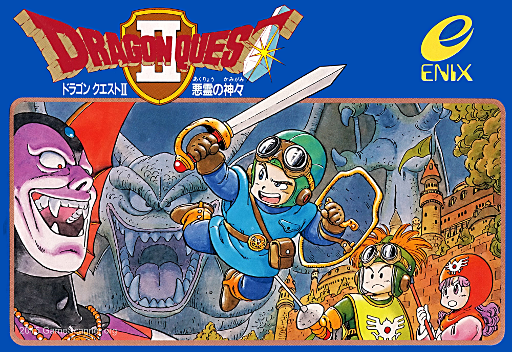
Dragon Quest 2 - Akuryou no Kamigami
This entry covers the Famicom release published by Enix in Japan on 26 January 1987: Japanese-exclusive, with Japanese interface and text throughout, battery-backed save inside the cartridge, and progress recordable only by talking to a priest or king in a town or castle. The 1990 NES release, Dragon Warrior II, is a separate cartridge and is not covered. The practical obstacles today are the language barrier and heavy levelling; official Chinese exists only in later re-releases, so Chinese play of this version relies on fan translation.
- AI score · out of 10
- 8.0 / 10
About this game
This is the series first multi-character party game, shipped on a standard Famicom cartridge on 26 January 1987, published by Enix with development handled by Chunsoft. The release was Japan-only: interface, menus and all story text are Japanese, with no language options. Saving replaced the first game's passwords with battery-backed memory, but progress can only be recorded by greeting a priest or king in a town or castle, never during dungeon or sea exploration, so a long failed attempt loses ground outright. Its relationship to later releases must be kept separate. North America received Dragon Warrior II on the NES in 1990 from Enix America, differing in language, text and some content; the two are distinct cartridges, and only the 1987 Japanese release is assessed here. The modern re-release titled Dragon Quest II: Luminaries of the Legendary Line belongs to a different product generation and is recorded only as an alias. Official Chinese exists only for modern mobile and HD-2D re-releases, so Chinese play of the Famicom original comes from fan translation. On the technical side the battery-backed save is established. ROM size and mapper chip are unverified and no inference is offered. Documented bugs exist in the Japanese release, but the item-duplication mechanism could not be verified and its steps are deliberately not described. Whether any PAL release of the NES version exists also lacks a reliable basis. The original predates CERO and ESRB, so no age rating applies, and ratings of later re-releases do not transfer to it. Evidence summary: platform, release date, publisher, Japanese exclusivity and party-based combat are supported by official and institutional records. The developer credit, cartridge specifications, an enumerated Famicom-versus-NES comparison and the save-slot count still need primary sources. No reputable main-story length for the Famicom original was obtained, so no duration claim is made.
Collected in series
Dragon Quest builds fantasy journeys around visiting towns, exploring dungeons and growing stronger through battles. Its mainline adventures are known for turn-based decisions and heroic quests, while spin-offs take the same world of monsters and magic into other kinds of play.
Recommended games
Related game recommendations on this platform
Famicom / NES
AI review
AI reviews are subjective assessments, not player ratings. See each review for its evidence and limitations.Published date:
A pioneering three-hero party undermined by endgame balance
Dragon Quest II makes two structural changes that shaped the series afterwards: it turns a solo adventure into a three-character party, and it lets a single encounter hold several enemies with targets chosen individually. The first change supplies real role differentiation, since the Prince of Midenhall cannot use magic, the Prince of Cannock cannot equip the strongest gear and leaves the party mid-game, and the Princess of Moonbrooke is frail but carries the spell load, so party composition and equipment become genuine decisions. The second makes group spells and turn order matter in a way the strict duels of the first game did not. Problems sit late: the long maze-like Cave to Rhone, random encounters that can wipe a run, and the grind demanded before Hargon and Malroth push the curve from workable to excessive.
Strengths
- The series first three-character party creates real role division, making composition and equipment meaningful choices
- Multi-enemy encounters with individually chosen targets give group spells and turn order actual weight
- A top-down overworld spanning several continents, with a ship and travel magic steadily widening access
- Battery-backed saving replaces passwords and is more reliable than the first game, though limited to town priests
Weaknesses
- The Cave to Rhone turns the difficulty curve into a wall of maze layout and high-tier encounters, with grinding as a prerequisite
- Late random encounters can wipe a run while saving is only possible in towns, magnifying the cost of failure
- Experience distribution and endgame balance are widely judged flawed, with the Malroth fight demanding high levels and specific spells
Who it is for: Players who accept high difficulty and heavy grinding, and those curious about the early history of the series or about how turn-based party combat took shape; a map guide and patience are advisable.
Play notes: Written from public, official and institutional records only; the game was not played for this review. No reliable figure exists for main-story length of the Famicom original, and the item-duplication mechanism, save-slot count, cartridge specifications and a primary developer credit remain unverified, as listed in the pending field. This score was recalibrated under professional-v2 without external ratings, source volume, asset count, title recognition, or URL-derived values.
View scoring basis
| Dimension | Review state | Score | Weight |
|---|---|---|---|
| Dimension The content pacing score applies the V3 boundary to the documented mechanics, pacing, presentation, and FC release constraints. | Reviewed | 7.9 / 10 | Not provided |
| Dimension The core experience score applies the V3 boundary to the documented mechanics, pacing, presentation, and FC release constraints. | Reviewed | 8.3 / 10 | Not provided |
| Dimension The presentation immersion score applies the V3 boundary to the documented mechanics, pacing, presentation, and FC release constraints. | Reviewed | 8.2 / 10 | Not provided |
| Dimension The technical usability score applies the V3 boundary to the documented mechanics, pacing, presentation, and FC release constraints. | Reviewed | 7.2 / 10 | Not provided |
Review sources
Not provided
Core information
- Developer
- Chunsoft
- Publisher
- Enix
- Release date
- 1987
- Platforms
- Famicom / NES
- Content kind
- Game
- Release state
- Released
- Region
- Worldwide
- Official website
- Not provided
- Offline minimum players
- 1
- Offline maximum players
- 1
- Online minimum players
- Not provided
- Online maximum players
- Not provided
- Categories
- Role-Playing · Primary genre
- Tags
- ReplayableCollection-rich2D GraphicsExplorationCommand-based CombatEquipment-driven ProgressionFantasyTurn-based CombatSolo-friendlyLong-term ProgressionLevel ProgressionTop-down
- Supported game languages
- Japanese
- Requires base game
- Not provided
- Standalone
- Not provided
- Age ratings
- Not provided
- Play modes
- Single player
- Perspectives
- Top-down
Release editions
- Famicom / NESWorldwide1987
Game gallery
Sources
Not provided