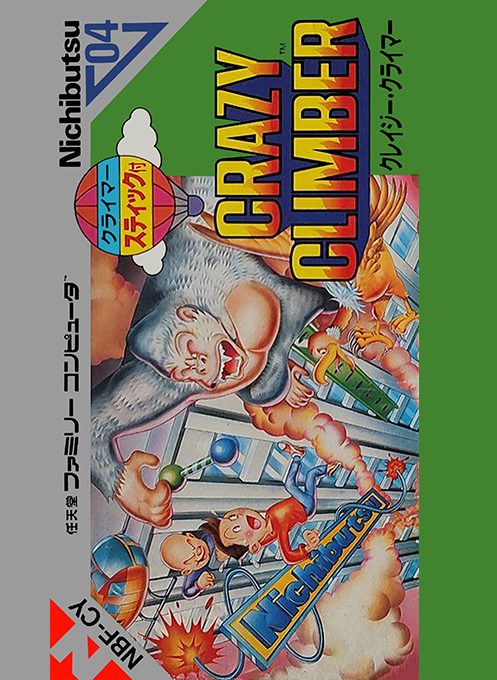
Crazy Climber
In Crazy Climber the player assumes the role of a daredevil who is attempting to climb to the top of four skyscrapers. There are a number of obstacles and dangers to avoid including: Windows that open and close (the most common danger). Bald-headed residents (a.k.a. Mad Doctors), who throw objects such as flower pots, buckets of water and fruit in an effort to knock the climber off the building (with larger objects appearing by more aggressive Mad Doctors in later levels). A giant condor, who drops eggs and excrement aimed at the climber (two at a time in the early stages, four in later levels). A giant ape (styled like King Kong), whose punch can prove deadly (he becomes more aggressive in later levels). Falling steel girders and iron dumbbells (more numerous in the later levels). Live wires, which protrude off electric signs. Falling 'Crazy Climber' signs. Some of these dangers appear at every level of the game; others make appearances only in later stages. Should the climber succumb to any one of these dangers, a new climber takes his place at the exact point where he fell; the last major danger is eliminated. One ally the climber has is a pink "Lucky Balloon"; if he is able to grab it, the climber is transported up 8 stories to a window. The window onto which it drops the climber may be about to close. If the window that the climber is dropped onto is fully closed, the balloon pauses there until the window opens up again. The player does not actually earn bonus points for catching the balloon, but he is awarded the normal 'step value' for each of the eight floors that he passes while holding the balloon. If the climber is able to ascend to the top of a skyscraper and grabs the runner of a waiting helicopter, he earns a bonus and is transported to another skyscraper, which presents more dangers than the past. The helicopter would only wait about 30 seconds, then fly off. If the player completes all four skyscrapers, he is taken back to the first skyscraper and the game restarts from the beginning, but the player keeps his score.
- AI score · out of 10
- 7.9 / 10
About this game
In Crazy Climber the player assumes the role of a daredevil who is attempting to climb to the top of four skyscrapers. There are a number of obstacles and dangers to avoid including: Windows that open and close (the most common danger). Bald-headed residents (a.k.a. Mad Doctors), who throw objects such as flower pots, buckets of water and fruit in an effort to knock the climber off the building (with larger objects appearing by more aggressive Mad Doctors in later levels). A giant condor, who drops eggs and excrement aimed at the climber (two at a time in the early stages, four in later levels). A giant ape (styled like King Kong), whose punch can prove deadly (he becomes more aggressive in later levels). Falling steel girders and iron dumbbells (more numerous in the later levels). Live wires, which protrude off electric signs. Falling 'Crazy Climber' signs. Some of these dangers appear at every level of the game; others make appearances only in later stages. Should the climber succumb to any one of these dangers, a new climber takes his place at the exact point where he fell; the last major danger is eliminated. One ally the climber has is a pink "Lucky Balloon"; if he is able to grab it, the climber is transported up 8 stories to a window. The window onto which it drops the climber may be about to close. If the window that the climber is dropped onto is fully closed, the balloon pauses there until the window opens up again. The player does not actually earn bonus points for catching the balloon, but he is awarded the normal 'step value' for each of the eight floors that he passes while holding the balloon. If the climber is able to ascend to the top of a skyscraper and grabs the runner of a waiting helicopter, he earns a bonus and is transported to another skyscraper, which presents more dangers than the past. The helicopter would only wait about 30 seconds, then fly off. If the player completes all four skyscrapers, he is taken back to the first skyscraper and the game restarts from the beginning, but the player keeps his score.
Recommended games
Related game recommendations on this platform
Famicom / NES
AI review
AI reviews are subjective assessments, not player ratings. See each review for its evidence and limitations.Published date:
Crazy Climber is assessed here as a specific FC/NES release with its documented strengths and practical limits kept in view.
In Crazy Climber the player assumes the role of a daredevil who is attempting to climb to the top of four skyscrapers. There are a number of obstacles and dangers to avoid including: Windows that open and close (the most common danger). Bald-headed residents (a.k.a. Mad Doctors), who throw objects such as flower pots, buckets of water and fruit in an effort to knock the climber off the building (with larger objects appearing by more aggressive Mad Doctors in later levels). A giant condor, who drops eggs and excrement aimed at the climber (two at a time in the early stages, four in later levels). This assessment focuses on the specific FC or NES release and on the play actions, goals, and progression documented for Crazy Climber. Its value comes from how clearly the central rules create decisions and feedback across a session. Pacing is judged by the variety of situations, the learning curve, recovery after failure, and the reason to replay. Presentation is considered through readability, animation, sound, and the consistency of the game's style rather than by modern resolution. Practical limits such as period controls, guidance, saving, or required accessories are included only when they affect this release. Players who enjoy learning compact systems and improving through repeated attempts are the clearest audience, while anyone seeking modern convenience
Strengths
- The documented central loop gives Crazy Climber a clear identity and a learnable set of goals.
- Progress rewards understanding the rules and applying them more consistently across repeated situations.
Weaknesses
- The original release can create friction through its documented difficulty, guidance, control, or recovery limits.
Who it is for: Players interested in the original FC/NES design and willing to learn its period-specific rules.
Play notes: Check the documented language, saving, accessory, and recovery conditions for this exact release.
View scoring basis
| Dimension | Review state | Score | Weight |
|---|---|---|---|
| Dimension The content pacing score applies the V3 boundary to the documented mechanics, pacing, presentation, and FC release constraints. | Reviewed | 7.7 / 10 | Not provided |
| Dimension The core experience score applies the V3 boundary to the documented mechanics, pacing, presentation, and FC release constraints. | Reviewed | 7.9 / 10 | Not provided |
| Dimension The presentation immersion score applies the V3 boundary to the documented mechanics, pacing, presentation, and FC release constraints. | Reviewed | 8.1 / 10 | Not provided |
| Dimension The technical usability score applies the V3 boundary to the documented mechanics, pacing, presentation, and FC release constraints. | Reviewed | 7.8 / 10 | Not provided |
Review sources
Not provided
Core information
- Developer
- Nihon
- Publisher
- Nihon
- Release date
- 1986
- Platforms
- Famicom / NES
- Content kind
- Game
- Release state
- Released
- Region
- Worldwide
- Official website
- Not provided
- Offline minimum players
- Not provided
- Offline maximum players
- Not provided
- Online minimum players
- Not provided
- Online maximum players
- Not provided
- Categories
- Action · Primary genre
- Tags
- High DifficultyArcade Style2D GraphicsPlatformingFixed CameraSteep Learning Curve
- Supported game languages
- Not provided
- Requires base game
- Not provided
- Standalone
- Not provided
- Age ratings
- Not provided
- Play modes
- Not provided
- Perspectives
- Side view
Release editions
- Famicom / NESWorldwide1986
Game gallery
Sources
Not provided