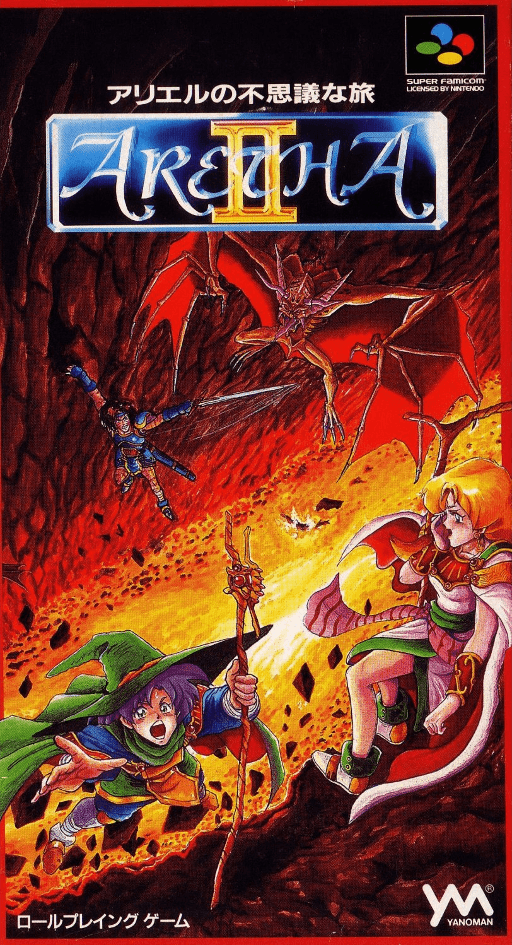
Aretha 2 - Ariel no Fushigi na Tabi
Aretha 2 - Ariel no Fushigi na Tabi is a Super Famicom role-playing game released in 1994 developed by Yanoman. It centers on combat encounters, turn-based tactical decisions, and story, case, or mission progress, with controls, information, and pacing arranged around television output, a directional pad, shoulder buttons, and a six-button controller.
- AI score · out of 10
- 7.1 / 10
About this game
Aretha 2 - Ariel no Fushigi na Tabi is a Super Famicom role-playing release centered on combat encounters, turn-based tactical decisions, and story, case, or mission progress. Story beats, exploration, and progression resources support a longer campaign, with progress divided into stages, tasks, matches, or growth milestones that make its immediate goals understandable. Its value depends on whether these rules continue to create judgment and room for mastery rather than on campaign length or series recognition. Short campaigns are judged by repeat-challenge value, while longer ones are judged by variety, pacing, and recovery after failure. Characters, world building, maps, and music carry most of the atmosphere, while sprite animation, scrolling, color, and chip-based audio jointly carry readability and atmosphere. The main genre-specific friction is that dense text, menu layers, repeated battles, and language dependence can slow progress. In addition, password or battery saves, multiplayer accessories, manual dependence, regional language, and cartridge enhancement chips can affect original-hardware use. This description covers only this release and excludes emulator features, modern-port conveniences, and content from other platforms.
Recommended games
Related game recommendations on this platform
Super Famicom / SNES
AI review
AI reviews are subjective assessments, not player ratings. See each review for its evidence and limitations.Published date:
A traditional sequel with helpful navigation and brisk pacing
Aretha II makes the journey's conveniences more distinctive than its underlying systems. Fast walking avoids obstacles, party consultation helps identify destinations, and damage numbers with colored enemy outlines clarify combat results. Encounter-free walking on the world map keeps exploration moving. Frequent mandatory roster changes nevertheless interrupt attachment, and occasional underleveled arrivals require adjustment. Higher MP or EP costs do not reliably mean stronger attacks, while spirit forging often provides disappointingly small equipment improvements. Colorful towns, imposing enemy sprites and the opening music make a strong impression, but some dungeons and the frequently heard battle track are less memorable. Fans of conventional turn-based adventures and returning characters should find a comfortable continuation; players seeking freely assembled parties or extensive customization may be less satisfied.
Strengths
- Clear combat feedback
- Convenient movement and consultation
- Strong opening music and town art
Weaknesses
- Frequent mandatory roster changes
- Modest forging rewards
- Some dull dungeons
Who it is for: Traditional RPG fans comfortable with Japanese, especially players familiar with the first game
Play notes: The original is Japanese; costly skills are not always stronger and party membership is not freely fixed.
View scoring basis
| Dimension | Review state | Score | Weight |
|---|---|---|---|
| Dimension Brisk exploration and encounter-free overland walking help pacing, while frequent roster changes interrupt continuity. | Reviewed | 7.1 / 10 | Not provided |
| Dimension Accessible resource management is weakened by inconsistent attack costs and modest crafting rewards. | Reviewed | 6.8 / 10 | Not provided |
| Dimension Opening music, towns and imposing enemies create atmosphere, though ordinary battle music and dull dungeons limit consistency. | Reviewed | 7.4 / 10 | Not provided |
| Dimension Fast movement, consultation and clear damage feedback make exploration and combat easier to manage. | Reviewed | 7.7 / 10 | Not provided |
Review sources
Not provided
Core information
- Developer
- Yanoman
- Publisher
- Japan Art Media
- Release date
- 1994
- Platforms
- Super Famicom / SNES
- Content kind
- Game
- Release state
- Released
- Region
- Worldwide
- Official website
- Not provided
- Offline minimum players
- Not provided
- Offline maximum players
- Not provided
- Online minimum players
- Not provided
- Online maximum players
- Not provided
- Categories
- Role-Playing · Primary genre
- Tags
- Main Story 20–50 HoursTurn-based CombatReal-time CombatFantasyStory-drivenLevel ProgressionExplorationLong-term Progression2D GraphicsSolo-friendlyTop-downCommand-based Combat
- Supported game languages
- Not provided
- Requires base game
- Not provided
- Standalone
- Not provided
- Age ratings
- Not provided
- Play modes
- Not provided
- Perspectives
- Not provided
Release editions
- Super Famicom / SNESWorldwide1994
Game gallery
Sources
Not provided