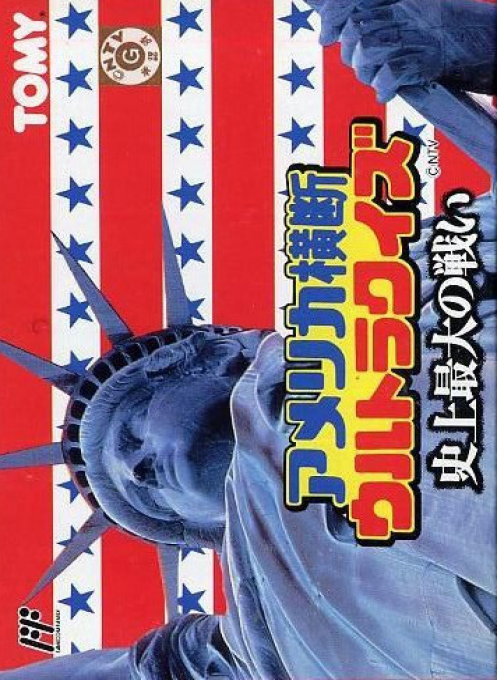
America Oudan Ultra Quiz - Shijou Saidai no Tatakai
This game has two modes: story and tournament. Tournament mode is the simpler one: you compete against seven opponents in a quiz that concerns various historical, geographical, social, and cultural aspects of United States of America. Some questions require you to choose "yes" or "no", while others present you a short list of possible answers, of which you should choose the correct one. The participants' responses are timed. In the story mode, you can navigate the character you created (male or female) in a top-down city. Avoiding getting hit by the numerous cars in the area, you must make your way to competition halls and participate in quiz shows. More areas will be unlocked as you win the tournaments. This time, giving the correct answer is more than just quickly choosing a word. Giving an answer is presented each time with a mini-game. For example, in one of the competitions answering a question involves running through a football field and making it to the correct part of the touchdown area, which is divided into large "yes" and "no" sections.
- AI score · out of 10
- 7.8 / 10
About this game
This game has two modes: story and tournament. Tournament mode is the simpler one: you compete against seven opponents in a quiz that concerns various historical, geographical, social, and cultural aspects of United States of America. Some questions require you to choose "yes" or "no", while others present you a short list of possible answers, of which you should choose the correct one. The participants' responses are timed. In the story mode, you can navigate the character you created (male or female) in a top-down city. Avoiding getting hit by the numerous cars in the area, you must make your way to competition halls and participate in quiz shows. More areas will be unlocked as you win the tournaments. This time, giving the correct answer is more than just quickly choosing a word. Giving an answer is presented each time with a mini-game. For example, in one of the competitions answering a question involves running through a football field and making it to the correct part of the touchdown area, which is divided into large "yes" and "no" sections.
Recommended games
Related game recommendations on this platform
Famicom / NES
AI review
AI reviews are subjective assessments, not player ratings. See each review for its evidence and limitations.Published date:
America Oudan Ultra Quiz - Shijou Saidai no Tatakai is assessed here as a specific FC/NES release with its documented strengths and practical limits kept in view.
This game has two modes: story and tournament. Tournament mode is the simpler one: you compete against seven opponents in a quiz that concerns various historical, geographical, social, and cultural aspects of United States of America. Some questions require you to choose "yes" or "no", while others present you a short list of possible answers, of which you should choose the correct one. The participants' responses are timed. In the story mode, you can navigate the character you created (male or female) in a top-down city. Avoiding getting hit by the numerous cars in the area, you must make your way to competition halls and This assessment focuses on the specific FC or NES release and on the play actions, goals, and progression documented for America Oudan Ultra Quiz - Shijou Saidai no Tatakai. Its value comes from how clearly the central rules create decisions and feedback across a session. Pacing is judged by the variety of situations, the learning curve, recovery after failure, and the reason to replay. Presentation is considered through readability, animation, sound, and the consistency of the game's style rather than by modern resolution. Practical limits such as period controls, guidance, saving, or required accessories are included only when they affect this release. Players who enjoy learning compact systems and improving through repeated attempts are the
Strengths
- The documented central loop gives America Oudan Ultra Quiz - Shijou Saidai no Tatakai a clear identity and a learnable set of goals.
- Progress rewards understanding the rules and applying them more consistently across repeated situations.
Weaknesses
- The original release can create friction through its documented difficulty, guidance, control, or recovery limits.
Who it is for: Players interested in the original FC/NES design and willing to learn its period-specific rules.
Play notes: Check the documented language, saving, accessory, and recovery conditions for this exact release.
View scoring basis
| Dimension | Review state | Score | Weight |
|---|---|---|---|
| Dimension The content pacing score applies the V3 boundary to the documented mechanics, pacing, presentation, and FC release constraints. | Reviewed | 7.8 / 10 | Not provided |
| Dimension The core experience score applies the V3 boundary to the documented mechanics, pacing, presentation, and FC release constraints. | Reviewed | 7.8 / 10 | Not provided |
| Dimension The presentation immersion score applies the V3 boundary to the documented mechanics, pacing, presentation, and FC release constraints. | Reviewed | 8.1 / 10 | Not provided |
| Dimension The technical usability score applies the V3 boundary to the documented mechanics, pacing, presentation, and FC release constraints. | Reviewed | 7.3 / 10 | Not provided |
Review sources
Not provided
Core information
- Developer
- Pixel
- Publisher
- Takara Tomy
- Release date
- 1991
- Platforms
- Famicom / NES
- Content kind
- Game
- Release state
- Released
- Region
- Worldwide
- Official website
- Not provided
- Offline minimum players
- Not provided
- Offline maximum players
- Not provided
- Online minimum players
- Not provided
- Online maximum players
- Not provided
- Categories
- Puzzle · Primary genre
- Tags
- Story-driven2D GraphicsSolo-friendlyTriviaShort SessionsPick-up and PlayTop-downReplayable
- Supported game languages
- Not provided
- Requires base game
- Not provided
- Standalone
- Not provided
- Age ratings
- Not provided
- Play modes
- Not provided
- Perspectives
- Not provided
Release editions
- Famicom / NESWorldwide1991
Game gallery
Sources
Not provided