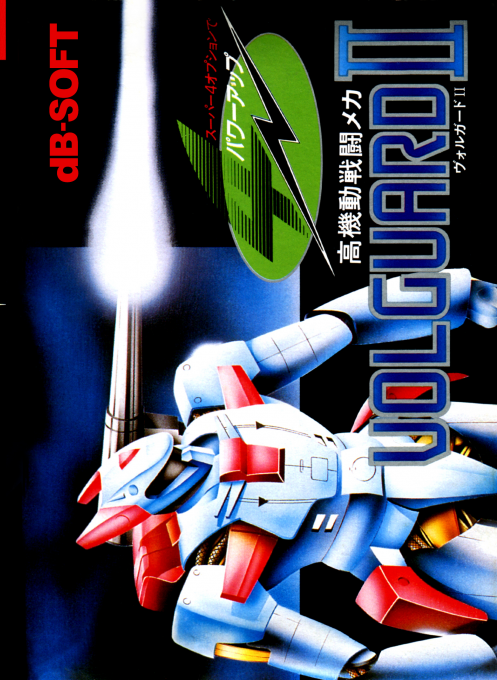
Volguard 2
This entry covers the Japanese Famicom cartridge released on 7 December 1985, developed and published by dB-SOFT on a Nintendo-produced HVC-NROM-256K-02 board with mapper 0, 40 KB of ROM and no battery. The cartridge is Japanese-only and single-player, and offers no save, password or battery backup, so a registered high score disappears when the console is switched off; the title screen holds four difficulty levels.
- AI score · out of 10
- 7.7 / 10
About this game
Region and release: Japan only. No North American, European or Brazilian release exists, and there is no official English edition. The cartridge is a licensed Nintendo NTSC board using Sharp mask ROMs, HVC-NROM-256K-02 with mapper 0 and 40 KB in total, and it carries neither battery nor save chip, so there is no save and no password and the high score is lost on power-off. Language and naming: in-game text and the title screen are Japanese, and the logo only borrows Latin lettering; the game was never localised. Chinese renderings such as 高机动战斗 2 and 高机动战斗机械 沃鲁加德 II are community or unofficial labels, and no official Chinese version exists. Play conditions: no special peripherals are required beyond a Famicom controller, and the game is single-player with no versus or co-operative mode. The only adjustable option inside this version is the four-step LEVEL 1 to 4 difficulty setting on the title screen. The game was re-released on Wii Virtual Console in 2008; apart from emulated and re-released versions, the 1985 cartridge is the reference. Open items: two release-day claims circulate, 6 December and 7 December; cartridge mirroring records disagree across databases; and whether a continue system exists, along with boss and enemy durability figures and the scoring formula, remain unverified, so this version text makes no claim about them.
Recommended games
Related game recommendations on this platform
Famicom / NES
AI review
AI reviews are subjective assessments, not player ratings. See each review for its evidence and limitations.Published date:
A resource-driven shooter whose systems outrun its content.
Volguard II replaces the one-hit deaths of its contemporaries with a damage meter and a power gauge that talk to each other: collisions add damage in small increments, firing spends power, destroying enemies or ramming them restores it, and remaining power decides which option the transport ship grants, whether the two units can combine, and even the tempo of the music. That turns how much you shoot into a running decision, and robot form's slow damage regeneration gives the loop a second rhythm. The content does not keep pace: 25 areas reuse a limited set of enemies, the area number appears only on the pause screen, and clearing area 25 simply loops to AREA 12 with no ending. Robot form is slow with very short punch reach and is only required against Tarkas. The four options each swap in a dedicated music track, which Japanese sources describe as carrying officially attached lyrics. Absent saves and unresolved questions about continues and scoring keep the assessment measured.
Strengths
- Remaining power gates options and transformation, turning how much you fire into a running decision.
- The damage meter replaces lives, so small collisions are survivable and mistakes rarely end a run outright.
- Combining with Unit 2 unlocks robot form, which regenerates damage slowly and punches without spending energy.
- Each of the four options swaps in its own music track, so upgrades give an immediate audible reward.
Weaknesses
- Robot form is slow with very short punch reach, and beyond the shot-immune Tarkas it has almost no use.
- Twenty-five areas share a small enemy roster while the area number is visible only on the pause screen.
- Clearing area 25 loops straight back to AREA 12 with no ending sequence or on-screen acknowledgement.
- Without a battery, save or password, a registered high score vanishes once the console is switched off.
Who it is for: Players who enjoy early Famicom side-scrolling shooters and are willing to manage energy and damage trade-offs, and who accept repeated stages without an ending sequence.
Play notes: Japanese-only text, no save or password, and a limited role for robot form; sources also disagree on the release day, cartridge mirroring, continues and scoring, so confirm details before buying. This score was recalibrated under professional-v2 without external ratings, source volume, asset count, title recognition, or URL-derived values.
View scoring basis
| Dimension | Review state | Score | Weight |
|---|---|---|---|
| Dimension The content pacing score applies the V3 boundary to the documented mechanics, pacing, presentation, and FC release constraints. | Reviewed | 7.6 / 10 | Not provided |
| Dimension The core experience score applies the V3 boundary to the documented mechanics, pacing, presentation, and FC release constraints. | Reviewed | 7.7 / 10 | Not provided |
| Dimension The presentation immersion score applies the V3 boundary to the documented mechanics, pacing, presentation, and FC release constraints. | Reviewed | 8.1 / 10 | Not provided |
| Dimension The technical usability score applies the V3 boundary to the documented mechanics, pacing, presentation, and FC release constraints. | Reviewed | 7.4 / 10 | Not provided |
Review sources
Not provided
Core information
- Developer
- DB Soft
- Publisher
- DB Soft
- Release date
- 1985
- Platforms
- Famicom / NES
- Content kind
- Game
- Release state
- Released
- Region
- Worldwide
- Official website
- Not provided
- Offline minimum players
- 1
- Offline maximum players
- 1
- Online minimum players
- Not provided
- Online maximum players
- Not provided
- Categories
- Shooter · Primary genre
- Tags
- ShootingReplayableReal-time CombatSolo-friendly2D GraphicsFast-paced
- Supported game languages
- Japanese
- Requires base game
- Not provided
- Standalone
- Not provided
- Age ratings
- Not provided
- Play modes
- Single player
- Perspectives
- Side view
Release editions
- Famicom / NESWorldwide1985
Game gallery
Sources
Not provided