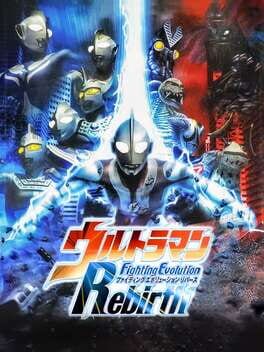
Ultraman Fighting Evolution Rebirth
Ultraman Fighting Evolution Rebirth is a PlayStation 2 fighting game released in 2005 developed by Banpresto. It centers on combat encounters, story, case, or mission progress, and move inputs, with controls and information arranged around the DualShock 2 twin analog sticks, directional pad, shoulder and face buttons, with a dedicated peripheral only where explicitly required.
- AI score · out of 10
- 7.7 / 10
About this game
Ultraman Fighting Evolution Rebirth is a PlayStation 2 fighting game centered on combat encounters, story, case, or mission progress, and move inputs. Short bouts use character differences and rising difficulty for variety, with progress divided into stages, tasks, matches, or growth milestones that make immediate goals understandable. Its value depends on whether these rules continue to create judgment and room for mastery rather than on length, sales, or series recognition. Short campaigns are judged by repeat-challenge value, while longer ones are judged by variety, pacing, and recovery after failure. Animation, hit feedback, and readable arenas create match tension, while 3D scenes, streamed data, cinematics, surround audio, and interlaced television output need to preserve action and state readability together. The genre-specific limitation is that button mapping, move recognition, multiplayer accessories, and cpu behavior can affect balance. Platform conditions also include DVD loading, the 8MB Memory Card, analog sticks and pressure-sensitive buttons, Multitap, Network Adapter, dedicated peripherals, and retired online services affect present-day use. This description covers only this platform release and does not import features or conveniences from remasters, emulators, or other console editions.
Collected in series
Ultraman Fighting Evolution turns the television franchise’s giant battles into 3D fighting games. Players choose Ultra heroes or monsters, trade close-range blows and look for openings to unleash the spectacular special attacks associated with their characters.
Recommended games
Related game recommendations on this platform
PlayStation 2


AI review
AI reviews are subjective assessments, not player ratings. See each review for its evidence and limitations.Published date:
Spectacular finishers and timed combos capture tokusatsu appeal, although lengthy repeated sequences slow matches.
Ultraman Fighting Evolution Rebirth turns giant-monster duels into playable tokusatsu spectacle. Ordinary attacks, throws and charged specials are joined by Nebula Combos, whose flashing prompts reward timing with a brief offensive and defensive boost. Simple commands make it approachable, while evading beams and completing combinations demand more than passively watching finishers. Thirteen story missions use fixed characters and special conditions, with rankings and unlocks encouraging another attempt. Versus, practice and destruction modes offer other directions. Elaborate special animations and familiar series music are central attractions, but repeated lengthy sequences can turn spectacle into waiting, and the roster is narrower than the previous instalment's. The original PS2 edition supplies tutorials, optional automatic saving, difficulty choices and sound controls. It best suits series fans who enjoy dramatic combat rituals and timing practice rather than uninterrupted fast exchanges.
Strengths
- Nebula Combos and special-move evasion add meaningful timing.
- Elaborate finishers and series music reinforce the giant-battle atmosphere.
- Tutorials, practice and saving options support gradual learning.
Weaknesses
- Repeated lengthy special animations interrupt exchanges, story missions fix character choices and the roster is narrower than in the previous game.
Who it is for: Ultraman fans willing to practise combos and evasion while enjoying elaborate finishers.
Play notes: This is the original Japanese PS2 edition. Menu comprehension may require a guide, and story missions use assigned characters.
View scoring basis
| Dimension | Review state | Score | Weight |
|---|---|---|---|
| Dimension Missions and unlocks give reasons to replay, while assigned fighters restrict freedom within the story mode. | Reviewed | 7.4 / 10 | Not provided |
| Dimension Simple fundamentals combined with timing and charging decisions turn tokusatsu spectacle into active duelling. | Reviewed | 7.8 / 10 | Not provided |
| Dimension The finishers convey strong tokusatsu spectacle, but lengthy repeated sequences increasingly slow sustained play. | Reviewed | 7.7 / 10 | Not provided |
| Dimension Tutorials, configurable practice and saving make learning and returning convenient without implying unmeasured frame-rate quality. | Reviewed | 8.0 / 10 | Not provided |
Review sources
Not provided
Core information
- Developer
- Banpresto
- Publisher
- Banpresto
- Release date
- 2005
- Platforms
- PlayStation 2
- Content kind
- Game
- Release state
- Released
- Region
- Worldwide
- Official website
- Not provided
- Offline minimum players
- Not provided
- Offline maximum players
- Not provided
- Online minimum players
- Not provided
- Online maximum players
- Not provided
- Categories
- Fighting · Primary genre
- Tags
- ReplayableReal-time CombatFast-pacedPlayer versus PlayerStory-driven3D GraphicsCombosMain Story Under 10 HoursShort SessionsMelee CombatSolo-friendly
- Supported game languages
- Not provided
- Requires base game
- Not provided
- Standalone
- Not provided
- Age ratings
- Not provided
- Play modes
- MultiplayerSingle player
- Perspectives
- Side view
Release editions
- PlayStation 2Worldwide2005
Game gallery
Sources
Not provided