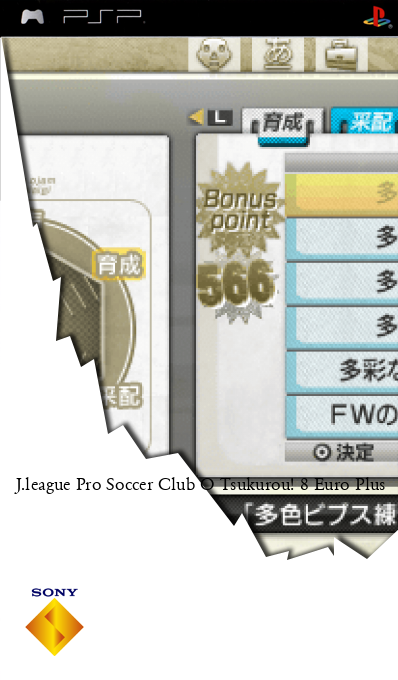
J.League Pro Soccer Club o Tsukurou! 8 Euro Plus
J.League Pro Soccer Club o Tsukurou! 8 Euro Plus is a PSP sports game released in 2013 developed by SEGA. It centers on competitive sport controls, sport controls, and shifts between attack and defense, with controls and information arranged around the directional pad, single analog nub, shoulder and face buttons, with a camera or another accessory only where required.
- AI score · out of 10
- 7.7 / 10
About this game
J.League Pro Soccer Club o Tsukurou! 8 Euro Plus is a PSP sports game centered on competitive sport controls, sport controls, and shifts between attack and defense. Matches, challenges, and tournament goals give sessions clear boundaries, with progress divided into stages, tasks, matches, or growth milestones that make immediate goals understandable. Its value depends on whether these rules continue to create judgment and room for mastery rather than on length, sales, or series recognition. Short campaigns are judged by repeat-challenge value, while longer ones are judged by variety, pacing, and recovery after failure. Players, venues, animation, and score feedback establish the match atmosphere, while the portable widescreen, UMD streaming, compressed audio, and handheld-scale interface need to preserve targets, text, and action readability. The genre-specific limitation is that opponent ai, control precision, multiplayer accessories, and period-specific rosters can affect consistency. Platform conditions also include single-nub camera control, UMD loading and noise, Memory Stick saves, battery life, regional language, ad hoc requirements, and retired online services affect present-day use. This description covers only this platform release and does not import features or conveniences from remasters, emulators, or other console editions.
Recommended games
Related game recommendations on this platform
PlayStation Portable
AI review
AI reviews are subjective assessments, not player ratings. See each review for its evidence and limitations.Published date:
Squad development rewards planning, though later budget pressure weakens.
Sakatsuku 8 puts coaching decisions ahead of direct ball control. Recruitment, development and rest compete for attention, while improving results make investment in players tangible. Recognizable footballers provide a familiar starting point. Seasonal cycles and competitions beyond the domestic leagues give a new club continuing goals. Early finances demand patience, although powerful later skills soften budget trade-offs and make challenge less consistent. Kits, stadium composition and portraits establish a recognizable team. The formation page brings positions, status, captaincy and set-piece duties together, with visible detail and adjustment prompts. It suits players who enjoy nurturing and organizing a squad, rather than those expecting every attack to depend on their own dribbling or shooting.
Strengths
- Recruitment, development and rest interact, with results providing tangible rewards for cultivation.
- Seasonal cycles and successive competitions give long-term club building continuing goals.
- Organized squad information and prompts help management, while portraits and kits establish team identity.
Weaknesses
- Powerful later skills enable low-wage contracts that weaken continuing budget pressure.
Who it is for: Football-management players who enjoy long-term cultivation and squad organization, rather than mainly wanting direct control of every attack and defensive action.
Play notes: This covers the original 2013 Japanese PSP game and lawful retained copies, with Japanese interface evidence, not the contemporary PS3/Vita game. SEGA explicitly states there are no internet-connection features. Learn rest and squad duties first; this is management rather than action football.
View scoring basis
| Dimension | Review state | Score | Weight |
|---|---|---|---|
| Dimension Seasonal cycles and successive competition goals sustain development well. Tight early budgets require patience, while powerful later skills soften financial pressure, making challenge less consistent than progression. | Reviewed | 7.4 / 10 | Not provided |
| Dimension Finances, recruitment, rest and match feedback form an excellent management loop. Limited direct match intervention keeps attention on coaching, with tangible returns from developing the squad. | Reviewed | 8.1 / 10 | Not provided |
| Dimension Distinct kits, stands and goal composition establish a good football setting. Portraits and status faces give squad management a human identity, supporting investment in development rather than spectacle. | Reviewed | 7.3 / 10 | Not provided |
| Dimension Formation, player details and set-piece duties occupy distinct areas, with visible routes to details and position adjustment. This provides good tools for checking a dense squad setup. | Reviewed | 7.8 / 10 | Not provided |
Review sources
Not provided
Core information
- Developer
- SEGA
- Publisher
- SEGA
- Release date
- 2013
- Platforms
- PlayStation Portable
- Content kind
- Game
- Release state
- Released
- Region
- Worldwide
- Official website
- Not provided
- Offline minimum players
- Not provided
- Offline maximum players
- Not provided
- Online minimum players
- Not provided
- Online maximum players
- Not provided
- Tags
- Slow BurnSolo-friendlyReplayableSports-based Play3D GraphicsResource ManagementLong-term Progression
- Supported game languages
- Not provided
- Requires base game
- Not provided
- Standalone
- Not provided
- Age ratings
- Not provided
- Play modes
- Not provided
- Perspectives
- Not provided
Release editions
- PlayStation PortableWorldwide2013
Game gallery
Sources
Not provided