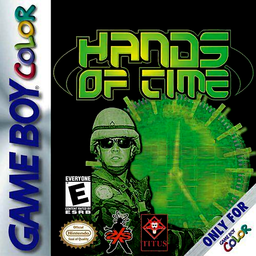
Hands of Time
Hands of Time is a Game Boy Color action game released in 2001 developed by Mirage Media. It centers on movement and immediate actions, enemy and hazard responses, and stage objectives, with controls, information, and pacing arranged around a color handheld screen, a directional pad, and two main action buttons.
- AI score · out of 10
- 6.4 / 10
About this game
Hands of Time is a Game Boy Color action release centered on movement and immediate actions, enemy and hazard responses, and stage objectives. Stages build pressure through routes, enemy patterns, and changing objectives, with progress divided into stages, tasks, matches, or growth milestones that make its immediate goals understandable. Its value depends on whether these rules continue to create judgment and room for mastery rather than on campaign length or series recognition. Short campaigns are judged by repeat-challenge value, while longer ones are judged by variety, pacing, and recovery after failure. Readable animation, hits, and hazards determine whether feedback remains dependable, while color choices need to distinguish characters, objects, and routes rather than serve as decoration alone. The main genre-specific friction is that period-specific collision rules, limited guidance, and repeated ground after failure can raise the entry barrier. In addition, battery saves, link cables, cartridge-specific hardware, the unlit display, and regional language can affect the original experience. This description covers only this release and excludes emulator features, modern-port conveniences, and content from other platforms.
Recommended games
Related game recommendations on this platform
Game Boy Color (GBC)
AI review
AI reviews are subjective assessments, not player ratings. See each review for its evidence and limitations.Published date:
Item-gated exploration has appeal, but backtracking and level-start recovery slow progress.
Hands of Time joins military shooting to item-gated exploration. Its stronger moments involve connecting rods, keys, an ID card and cutters to new routes rather than clearing enemies. The first area's linked surface and underground maps offer optional supplies, while narrow corridors give stronger weapons a purpose. However, the pistol must wait for its single bullet to leave the screen, and generous early Easy tolerance limits combat pressure. Repeated tool-chain backtracking stretches progress. Double-tap running helps, alongside Select's map, Start's inventory and interaction prompts. Distinct road scenery and a separate HUD keep information clear, while villagers, signs and poster dialogue add context. Four-letter passwords support divided sessions but only restart a level, not a midlevel position. It suits patient route-and-item explorers more than brisk-firefight enthusiasts.
Strengths
- Tools, keys and conversations connect item uses to opening routes.
- Optional supplies, avoidance and limited-ammo weapons provide practical trade-offs.
- Maps, inventory, prompts and running help navigate larger exploration areas.
- Observed road scenes and a separate HUD are clear, with textual interactions adding context.
Weaknesses
- The first area's tool chain requires considerable backtracking between objectives.
- Pistol waiting and low early Easy risk limit sustained shooting's payoff.
- Passwords cannot recover midlevel positions, increasing the cost of interruption.
Who it is for: Players who enjoy military-themed exploratory adventures, investigate item uses and routes, and can finish longer level sections before stopping.
Play notes: This covers the original 2001 GBC game. Double-tap directions to run; Start opens inventory or skips dialogue, Select opens the map, A investigates at an exclamation prompt and B uses weapons. Record four-letter passwords: continuation starts the level again. Easy and Hard alter damage and some supplies.
View scoring basis
| Dimension | Review state | Score | Weight |
|---|---|---|---|
| Dimension Connected maps, optional supplies and tool-gated paths provide exploration goals, but repeated first-area backtracking stretches the intervals between rewards. Double-tap running eases travel without removing route repetition. Difficulty changes increase resource pressure without adding an extra ending reward. | Reviewed | 6.0 / 10 | Not provided |
| Dimension Item-gated routes, weapon supplies and enemy avoidance make the exploration-shooting loop functional, with narrow corridors changing weapon choices. Single-shot waiting and limited early combat pressure on Easy constrain shooting's payoff; one observed guard nonresponse also weakens infiltration tension. Item chains are more engaging than sustained firefights. | Reviewed | 6.3 / 10 | Not provided |
| Dimension Static colors and outlines distinguish roads, buildings, vegetation and objects well, while a separate HUD keeps the scene clear. Villager background, signs and poster dialogue add context and small pleasures to exploration. Presentation is coherent and thematically connected, with its appeal centered on scene information and textual details. | Reviewed | 6.8 / 10 | Not provided |
| Dimension Maps, inventory, interaction prompts and running support good basic controls, with a clear password continuation route. Recovery returns to the level start rather than retaining a midlevel position, making long exploration stretches less convenient to interrupt. Usability combines practical aids with a specific recovery cost. | Reviewed | 6.8 / 10 | Not provided |
Review sources
Not provided
Core information
- Developer
- Mirage Media
- Publisher
- Titus
- Release date
- 2001
- Platforms
- Game Boy Color (GBC)
- Content kind
- Game
- Release state
- Released
- Region
- Worldwide
- Official website
- Not provided
- Offline minimum players
- Not provided
- Offline maximum players
- Not provided
- Online minimum players
- Not provided
- Online maximum players
- Not provided
- Categories
- Action · Primary genre
- Tags
- Main Story Under 10 HoursPlatformingSolo-friendlyReplayable2D GraphicsFast-pacedWarDodgeReal-time CombatSide-scrollingLinear Levels
- Supported game languages
- Not provided
- Requires base game
- Not provided
- Standalone
- Not provided
- Age ratings
- Not provided
- Play modes
- Not provided
- Perspectives
- Not provided
Release editions
- Game Boy Color (GBC)Worldwide2001
Game gallery
Sources
Not provided