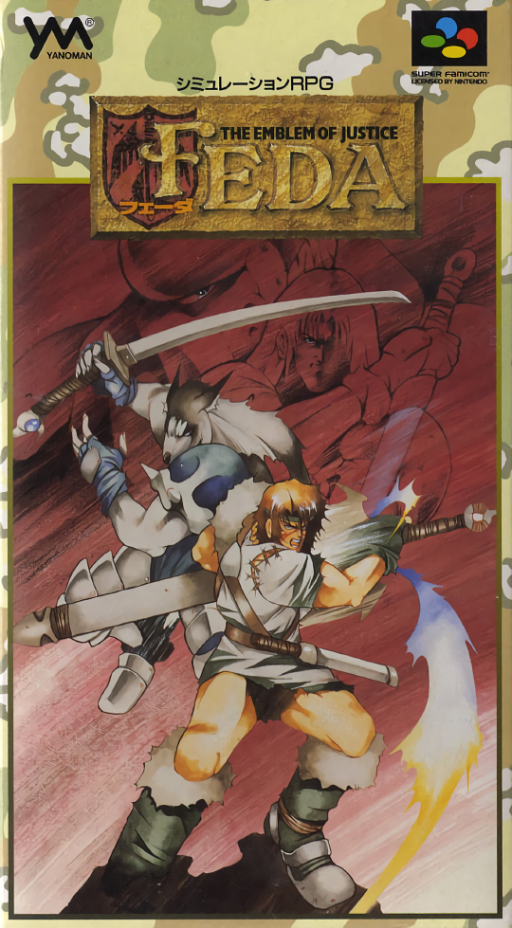
Feda - The Emblem of Justice
Feda - The Emblem of Justice is a Super Famicom role-playing game released in 1994 developed by Max Entertainment. It centers on combat encounters, area and route exploration, and character or equipment growth, with controls, information, and pacing arranged around television output, a directional pad, shoulder buttons, and a six-button controller.
- AI score · out of 10
- 7.1 / 10
About this game
Feda - The Emblem of Justice is a Super Famicom role-playing release centered on combat encounters, area and route exploration, and character or equipment growth. Story beats, exploration, and progression resources support a longer campaign, with progress divided into stages, tasks, matches, or growth milestones that make its immediate goals understandable. Its value depends on whether these rules continue to create judgment and room for mastery rather than on campaign length or series recognition. Short campaigns are judged by repeat-challenge value, while longer ones are judged by variety, pacing, and recovery after failure. Characters, world building, maps, and music carry most of the atmosphere, while sprite animation, scrolling, color, and chip-based audio jointly carry readability and atmosphere. The main genre-specific friction is that dense text, menu layers, repeated battles, and language dependence can slow progress. In addition, password or battery saves, multiplayer accessories, manual dependence, regional language, and cartridge enhancement chips can affect original-hardware use. This description covers only this release and excludes emulator features, modern-port conveniences, and content from other platforms.
Recommended games
Related game recommendations on this platform
Super Famicom / SNES
AI review
AI reviews are subjective assessments, not player ratings. See each review for its evidence and limitations.Published date:
Meaningful alignment choices with management friction
Alternating individual unit actions lets each side respond before an entire army has moved, giving battles a useful tactical rhythm. Mission objectives also matter: following orders or choosing to kill enemies affects alignment, recruits, departures and endings. That makes team composition more interesting than simply collecting every available character. Distinctive designs and attractive combat scenes give new allies personality, although repeated enemies, layouts, music and damage effects reduce the appeal over a long campaign. Basic battle commands are accessible, but checking party status through camp and switching between shopping functions involve extra steps. It suits players who enjoy roster changes and restrictive objectives. Different alignments do not completely transform every mission, and the management interface remains more indirect than the straightforward combat controls.
Strengths
- Alternating actions and objectives
- Alignment affects allies and endings
- Distinctive characters and combat scenes
Weaknesses
- Repeated enemies and layouts
- Indirect status checks and shopping
Who it is for: Tactical RPG players interested in roster changes and objective restrictions
Play notes: The original is Japanese; an alignment change can make existing allies leave permanently.
View scoring basis
| Dimension | Review state | Score | Weight |
|---|---|---|---|
| Dimension Alignment and recruits motivate replay, while repeated battles weaken pacing. | Reviewed | 7.0 / 10 | Not provided |
| Dimension Alternating actions and mission objectives offer tradeoffs beyond extermination. | Reviewed | 7.4 / 10 | Not provided |
| Dimension Distinctive characters and battle animation are offset by repeated music and damage effects. | Reviewed | 7.7 / 10 | Not provided |
| Dimension Readable battle commands contrast with indirect shopping and status checks. | Reviewed | 5.9 / 10 | Not provided |
Review sources
Not provided
Core information
- Developer
- Max
- Publisher
- Yanoman
- Release date
- 1994
- Platforms
- Super Famicom / SNES
- Content kind
- Game
- Release state
- Released
- Region
- Worldwide
- Official website
- Not provided
- Offline minimum players
- Not provided
- Offline maximum players
- Not provided
- Online minimum players
- Not provided
- Online maximum players
- Not provided
- Tags
- Real-time CombatStory-drivenLong-term ProgressionFantasySolo-friendlyResource ManagementTop-downExplorationCommand-based Combat2D GraphicsMain Story 20–50 HoursLevel Progression
- Supported game languages
- Not provided
- Requires base game
- Not provided
- Standalone
- Not provided
- Age ratings
- Not provided
- Play modes
- Not provided
- Perspectives
- Not provided
Release editions
- Super Famicom / SNESWorldwide1994
Game gallery
Sources
Not provided