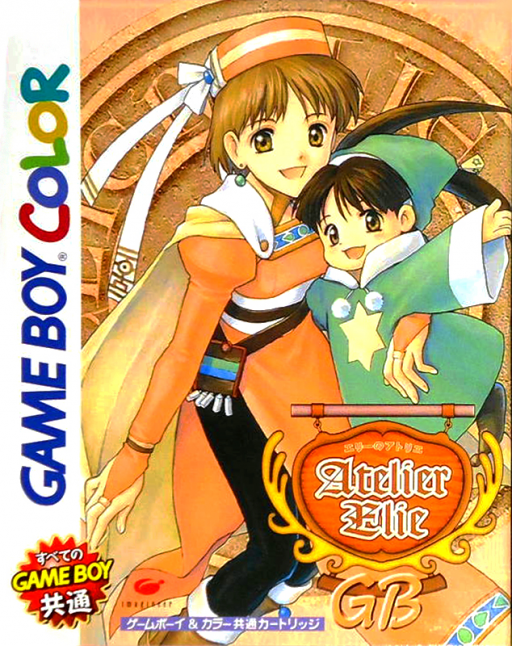
Elie no Atelier GB
Elie no Atelier GB is a Game Boy Color role-playing game released in 2000 developed by Tose Co.. It centers on story, case, or mission progress, resource or business management, and area exploration, with controls, information, and pacing arranged around a color handheld screen, a directional pad, and two main action buttons.
- AI score · out of 10
- 6.7 / 10
About this game
Elie no Atelier GB is a Game Boy Color role-playing release centered on story, case, or mission progress, resource or business management, and area exploration. Story beats, exploration, and progression resources support a longer campaign, with progress divided into stages, tasks, matches, or growth milestones that make its immediate goals understandable. Its value depends on whether these rules continue to create judgment and room for mastery rather than on campaign length or series recognition. Short campaigns are judged by repeat-challenge value, while longer ones are judged by variety, pacing, and recovery after failure. Characters, world building, maps, and music carry most of the atmosphere, while color choices need to distinguish characters, objects, and routes rather than serve as decoration alone. The main genre-specific friction is that dense text, menu layers, repeated battles, and language dependence can slow progress. In addition, battery saves, link cables, cartridge-specific hardware, the unlit display, and regional language can affect the original experience. This description covers only this release and excludes emulator features, modern-port conveniences, and content from other platforms.
Collected in series
Atelier is an RPG series where gathering ingredients and making useful items are central to the adventure. A better recipe can prepare you for the next outing, while friendships and each alchemist’s goals give you reasons to return to the workshop.
Recommended games
Related game recommendations on this platform
Game Boy Color (GBC)
AI review
AI reviews are subjective assessments, not player ratings. See each review for its evidence and limitations.Published date:
Appealing workshop planning and fairy interactions, with awkward event and branching recovery.
Elie no Atelier GB centres on directing a fairy's gathering and fulfilling synthesis requests. Expedition duration, encounter policy and bodyguard costs connect each trip to workshop planning, while exhausted materials or MP can interrupt production. Different development conditions lead to different endings, and alternative synthesis routes soften some missed opportunities. However, obscure early popularity requirements make later event completion cumbersome, and one save makes branching difficult. A distinctive response to dismissing a favoured companion gives the fairy personality, although some ending preparation and continuity cues feel loose. It suits patient players who enjoy resource management and investigating conditions. Those seeking the immediate satisfaction of personally defeating bosses, or freely returning to earlier decisions, may find delegated combat and restrictive saving less rewarding.
Strengths
- Gathering risk, bodyguard costs and synthesis resources form connected planning decisions.
- Development conditions offer different endings, with alternative routes for some missed recipes.
- Companion-specific dialogue gives the fairy a recognizable emotional preference.
Weaknesses
- Obscure early event conditions make later completion cumbersome.
- One save restricts branching, and a particular save history disrupts ending replay.
- Some ending preparation and continuity cues are loose.
Who it is for: For players who enjoy workshop management, resource planning and character development, and accept delegated combat while investigating event requirements.
Play notes: Understanding Japanese event conditions matters. Replay trouble was reported after a specific bad-ending and extended-save sequence, not as a global crash. The original has one save; explore branches cautiously.
View scoring basis
| Dimension | Review state | Score | Weight |
|---|---|---|---|
| Dimension Ending conditions give development and replay a direction, while alternative synthesis routes prevent a missed document from becoming an absolute production barrier. Obscure early popularity requirements nevertheless make event completion cumbersome, leaving worthwhile content with uneven guidance. | Reviewed | 6.6 / 10 | Not provided |
| Dimension Gathering risk, bodyguard costs and synthesis resources create worthwhile workshop decisions. Delegated combat suits management, but boss accomplishments offer weaker direct feedback and exhausted resources interrupt production plans; the loop is good without being consistently smooth. | Reviewed | 7.1 / 10 | Not provided |
| Dimension Contextual management dialogue gives the fairy personal warmth, but the adventurer ending lacks sufficient preparation and continuity cues can confuse readers. Character expression works at a basic level, with noticeably loose narrative connections. | Reviewed | 6.5 / 10 | Not provided |
| Dimension Ending replay avoids some repeated progression, but a single save makes branching and event recovery awkward. The documented bad-ending plus extended-save combination also disrupts replay. These restrictions weaken exploratory usability without establishing that all endings fail or the game cannot be completed. | Reviewed | 5.8 / 10 | Not provided |
Review sources
Not provided
Core information
- Developer
- Tose
- Publisher
- Imagineer
- Release date
- 2000
- Platforms
- Game Boy Color (GBC)
- Content kind
- Game
- Release state
- Released
- Region
- Worldwide
- Official website
- Not provided
- Offline minimum players
- Not provided
- Offline maximum players
- Not provided
- Online minimum players
- Not provided
- Online maximum players
- Not provided
- Categories
- Role-Playing · Primary genre
- Tags
- Top-downFantasyTurn-based CombatLong-term ProgressionSolo-friendlyMain Story 20–50 HoursResource ManagementExplorationStory-driven2D GraphicsLevel Progression
- Supported game languages
- Not provided
- Requires base game
- Not provided
- Standalone
- Not provided
- Age ratings
- Not provided
- Play modes
- Not provided
- Perspectives
- Not provided
Release editions
- Game Boy Color (GBC)Worldwide2000
Game gallery
Sources
Not provided