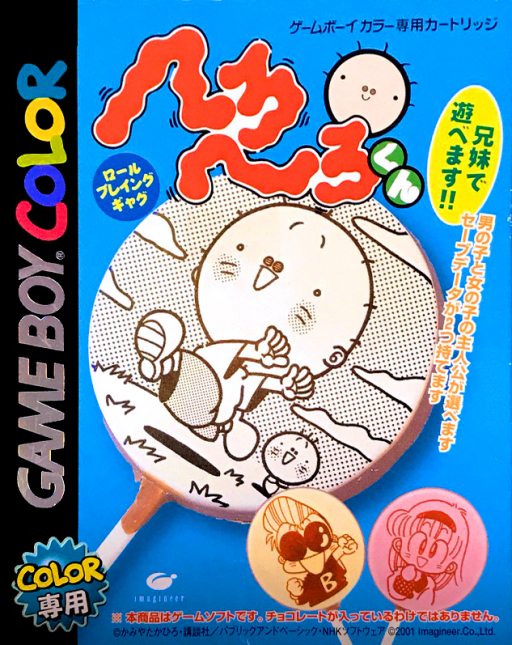
Hero Hero-kun
Hero Hero-kun is a Game Boy Color role-playing game released in 2001 developed by Tose Co.. It centers on character or equipment growth, area exploration, and combat and party setup, with controls, information, and pacing arranged around a color handheld screen, a directional pad, and two main action buttons.
- AI score · out of 10
- 7.8 / 10
About this game
Hero Hero-kun is a Game Boy Color role-playing release centered on character or equipment growth, area exploration, and combat and party setup. Story beats, exploration, and progression resources support a longer campaign, with progress divided into stages, tasks, matches, or growth milestones that make its immediate goals understandable. Its value depends on whether these rules continue to create judgment and room for mastery rather than on campaign length or series recognition. Short campaigns are judged by repeat-challenge value, while longer ones are judged by variety, pacing, and recovery after failure. Characters, world building, maps, and music carry most of the atmosphere, while color choices need to distinguish characters, objects, and routes rather than serve as decoration alone. The main genre-specific friction is that dense text, menu layers, repeated battles, and language dependence can slow progress. In addition, battery saves, link cables, cartridge-specific hardware, the unlit display, and regional language can affect the original experience. This description covers only this release and excludes emulator features, modern-port conveniences, and content from other platforms.
Recommended games
Related game recommendations on this platform
Game Boy Color (GBC)
AI review
AI reviews are subjective assessments, not player ratings. See each review for its evidence and limitations.Published date:
Compact front-line combat and character puzzles complement varied dreams, with some required backtracking.
Hero Hero-kun turns friends' dreams into connected adventures. Only the front fighter acts, so AP spending, replacements and encounter approach work together. Exploration gives companions practical roles through small openings, switches and linked items. Infiltration, the whale interior and separated escapes change the objectives, while detailed battle movements and an appreciated ending add personality. The trade-off is returning to towns, caves and earlier floors to complete clue and item chains, rather than always moving forward. Direct selections, resource indicators, post-battle recovery and NPC save points make the journey manageable. Keep Baribari involved because he later acts alone; one player's difficult final-boss experience suggests preparation, not an uneven difficulty curve throughout. This is a good fit for solo RPG players who enjoy following clues and changing companions to solve problems.
Strengths
- AP, encounter approach and front-line replacement create connected, compact combat decisions.
- Companion abilities, linked items and separated viewpoints keep dream objectives varied.
- Detailed battle movements and an affecting ending give the cast and journey personality.
Weaknesses
- Some item and mechanism chains require revisiting towns, caves or earlier floors, interrupting forward progress.
- One finishing player found the final boss demanding, which lighter-combat players should keep in mind.
Who it is for: Solo RPG players who enjoy following character clues, combining items and companion abilities, and alternating compact front-line combat with dream exploration.
Play notes: This covers the original 2001 Japanese GBC software. Keep Baribari involved for his later solo section. Plan breaks around NPC save points, not unrestricted saving. The demanding final boss is one player's experience; check your cartridge's battery condition.
View scoring basis
| Dimension | Review state | Score | Weight |
|---|---|---|---|
| Dimension Infiltration, the whale interior, divided escapes and rescue sequences vary the dream progression, with linked mechanisms and items giving coherent goals. Pacing is good overall. Returning to towns, caves and earlier floors slows forward progress, favoring players willing to follow clues. Baribari's later solo section supplies a specific reason to cultivate him, not a requirement to grind everyone. The account's difficult final battle remains a local warning. | Reviewed | 7.5 / 10 | Not provided |
| Dimension AP expenditure, encounter approach and front-line replacement create connected choices, while companion abilities and linked items make exploration more than movement between fights. This is a good core. Two moves per character and one active front fighter focus combat on timing and replacement; its strength is compact decisions combined with environmental puzzles rather than simultaneous party offensives. | Reviewed | 7.8 / 10 | Not provided |
| Dimension Detailed battle-character movements and an appealing protagonist design give the cast more identity than statistics alone. Participating in separated viewpoints also strengthens the rescue story. The account's explicit appreciation of the ending supports an emotional conclusion, making expression excellent through character presentation and narrative organization rather than familiarity with the property or visual realism. | Reviewed | 8.0 / 10 | Not provided |
| Dimension Move and party selection offer direct inputs and alternatives, while AP, tension and attack-count displays connect resources to decisions. Post-battle HP1 recovery and an identified save point support continuing the adventure. Together these information and recovery arrangements provide excellent usability; sessions should be planned around the game's saving locations rather than treating a save point as unrestricted suspension. | Reviewed | 8.0 / 10 | Not provided |
Review sources
Not provided
Core information
- Developer
- Tose
- Publisher
- Imagineer
- Release date
- 2001
- Platforms
- Game Boy Color (GBC)
- Content kind
- Game
- Release state
- Released
- Region
- Worldwide
- Official website
- Not provided
- Offline minimum players
- Not provided
- Offline maximum players
- Not provided
- Online minimum players
- Not provided
- Online maximum players
- Not provided
- Categories
- Role-Playing · Primary genre
- Tags
- Turn-based CombatLevel ProgressionExplorationFantasyMain Story 20–50 HoursSolo-friendlyStory-drivenTop-downLong-term ProgressionAnime Style2D Graphics
- Supported game languages
- Not provided
- Requires base game
- Not provided
- Standalone
- Not provided
- Age ratings
- Not provided
- Play modes
- Not provided
- Perspectives
- Side viewTop-down
Release editions
- Game Boy Color (GBC)Worldwide2001
Game gallery
Sources
Not provided