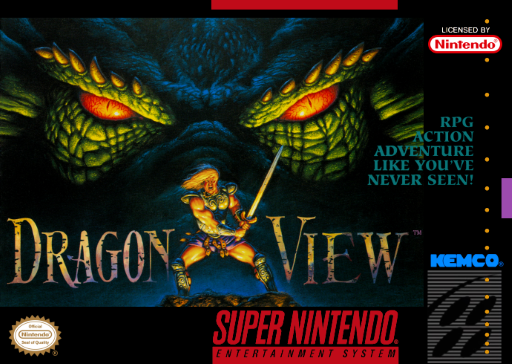
Dragon View
Dragon View is a Super Famicom role-playing game released in 1994 developed by Kemco. It centers on combat encounters, area and route exploration, and character or equipment growth, with controls, information, and pacing arranged around television output, a directional pad, shoulder buttons, and a six-button controller.
- AI score · out of 10
- 7.1 / 10
About this game
Dragon View is a Super Famicom role-playing release centered on combat encounters, area and route exploration, and character or equipment growth. Story beats, exploration, and progression resources support a longer campaign, with progress divided into stages, tasks, matches, or growth milestones that make its immediate goals understandable. Its value depends on whether these rules continue to create judgment and room for mastery rather than on campaign length or series recognition. Short campaigns are judged by repeat-challenge value, while longer ones are judged by variety, pacing, and recovery after failure. Characters, world building, maps, and music carry most of the atmosphere, while sprite animation, scrolling, color, and chip-based audio jointly carry readability and atmosphere. The main genre-specific friction is that dense text, menu layers, repeated battles, and language dependence can slow progress. In addition, password or battery saves, multiplayer accessories, manual dependence, regional language, and cartridge enhancement chips can affect original-hardware use. This description covers only this release and excludes emulator features, modern-port conveniences, and content from other platforms.
Recommended games
Related game recommendations on this platform
Super Famicom / SNES
AI review
AI reviews are subjective assessments, not player ratings. See each review for its evidence and limitations.Published date:
Distinctive action and maze exploration are held back by awkward travel and repetition.
Dragon View connects movement, weapon growth and exploration through battles that allow depth positioning and jumping. Dungeon routes add a puzzle element, and upgrades have practical uses beyond raising statistics. Repeated encounters can nevertheless overlevel the hero and reduce the pressure that makes those systems interesting. Large character sprites and regional music give the journey personality, while environmental detail is less consistent. Native SNES observations distinguish responsive combat buttons from slow overworld turning and terrain snags. A documented correction confirms shoulder-button map access, so the problem is navigation friction rather than a missing map. This assessment covers the original 1994 release through historical retrospectives. It excludes later PC enhancements and emulator conveniences, and best suits patient action-RPG players who enjoy exploring unusual dungeon layouts.
Strengths
- Integrated action and growth
- Inventive dungeon routes
Weaknesses
- Awkward overworld navigation
- Repetition reduces challenge
Who it is for: Retro action-RPG players interested in maze exploration.
Play notes: Original SNES historical scope; no later port enhancements.
View scoring basis
| Dimension | Review state | Score | Weight |
|---|---|---|---|
| Dimension Inventive mazes lose tension through repeated combat. | Reviewed | 6.7 / 10 | Not provided |
| Dimension Depth positioning and jumping give progression practical use. | Reviewed | 7.7 / 10 | Not provided |
| Dimension Characters and regional music stand out more than scenery. | Reviewed | 7.4 / 10 | Not provided |
| Dimension Responsive combat contrasts with awkward overworld navigation. | Reviewed | 5.8 / 10 | Not provided |
Review sources
Not provided
Core information
- Developer
- Kemco
- Publisher
- Piko InteractiveKemcoAtari
- Release date
- 1994
- Platforms
- Super Famicom / SNES
- Content kind
- Game
- Release state
- Released
- Region
- Worldwide
- Official website
- Not provided
- Offline minimum players
- Not provided
- Offline maximum players
- Not provided
- Online minimum players
- Not provided
- Online maximum players
- Not provided
- Categories
- Role-Playing · Primary genre
- Tags
- Long-term ProgressionExploration2D GraphicsSolo-friendlyStory-drivenMain Story 20–50 HoursReal-time CombatFantasyTop-downLevel ProgressionTurn-based Combat
- Supported game languages
- Not provided
- Requires base game
- Not provided
- Standalone
- Not provided
- Age ratings
- Not provided
- Play modes
- Single player
- Perspectives
- Side viewFirst person
Release editions
- Super Famicom / SNESWorldwide1994
Game gallery
Sources
Not provided