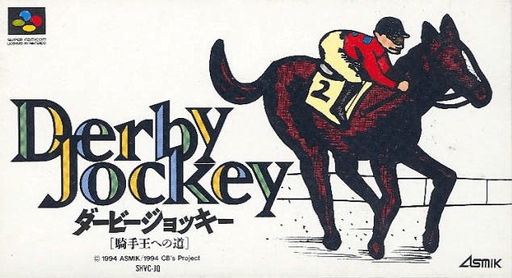
Derby Jockey - Kishu Ou e no Michi
Derby Jockey - Kishu Ou e no Michi is a Super Famicom sports game released in 1994 developed by Graphic Research. It centers on sport controls, shifts between attack and defense, and score or tournament goals, with controls, information, and pacing arranged around television output, a directional pad, shoulder buttons, and a six-button controller.
- AI score · out of 10
- 7.0 / 10
About this game
Derby Jockey - Kishu Ou e no Michi is a Super Famicom sports release centered on sport controls, shifts between attack and defense, and score or tournament goals. Matches, challenges, and tournament goals give sessions clear boundaries, with progress divided into stages, tasks, matches, or growth milestones that make its immediate goals understandable. Its value depends on whether these rules continue to create judgment and room for mastery rather than on campaign length or series recognition. Short campaigns are judged by repeat-challenge value, while longer ones are judged by variety, pacing, and recovery after failure. Players, venues, and score feedback establish the match atmosphere, while sprite animation, scrolling, color, and chip-based audio jointly carry readability and atmosphere. The main genre-specific friction is that opponent ai, control precision, and period-specific rosters can affect consistency. In addition, password or battery saves, multiplayer accessories, manual dependence, regional language, and cartridge enhancement chips can affect original-hardware use. This description covers only this release and excludes emulator features, modern-port conveniences, and content from other platforms.
Recommended games
Related game recommendations on this platform
Super Famicom / SNES

AI review
AI reviews are subjective assessments, not player ratings. See each review for its evidence and limitations.Published date:
Purposeful stamina management meets a drawn-out career conclusion.
Derby Jockey puts you on the horse rather than directing it from the sidelines. Acceleration and lane changes consume stamina, making a saved burst and well-timed positioning matter. Strong late-running horses can sweep past rivals, although leading styles are easier to win with. School results shape early invitations, and racing earns better horses, hidden events and independence, giving the career a coherent goal. Lively fusion music adds a distinct atmosphere, while coloured timing feedback and matching an adjacent horse's pace help explain the rhythm. The weaker stretch comes after the GI achievements: advancing weeks towards retirement can feel like waiting, and different careers receive limited ending variation. It suits racing fans willing to learn horse styles and energy management rather than accelerate constantly.
Strengths
- Stamina costs make lane changes and the final burst meaningful racing decisions.
- Results earn better horses, hidden events and independence through a coherent career.
- Lively fusion music provides character, while coloured timing helps communicate pacing.
Weaknesses
- Easier leading styles make the competitive balance between approaches uneven.
- Advancing weeks to retirement after GI achievements can become tedious waiting.
- Limited ending variation gives different riding careers a restrained conclusion.
Who it is for: Horse-racing fans who enjoy direct control, learning running styles and stamina allocation, and building a rider's record across many races.
Play notes: This covers the 1994 original SFC first game, not sequel systems. Learn the directional controls and coloured timing display; lane changes also consume stamina, and retirement can require further week advancement.
View scoring basis
| Dimension | Review state | Score | Weight |
|---|---|---|---|
| Dimension School results, better riding invitations, hidden races and independence give the career earned progression. After completing the GI goals, however, advancing weeks towards retirement can become tedious, with limited ending variation. The race calendar has purpose, but the concluding stretch is only basically satisfying. | Reviewed | 6.3 / 10 | Not provided |
| Dimension Pacing, lane changes and the final move all draw on stamina, while horse styles and finishing speed support different approaches. Easier front-running makes the balance uneven, but conserving energy and choosing when to break through give the rider a good, purposeful racing loop. | Reviewed | 7.3 / 10 | Not provided |
| Dimension Taut, pop-oriented fusion gives the rider's career a lively musical identity and is a clear expressive strength. Retirement displays achievements and closes the journey, but endings vary little across different histories. The soundtrack supports a good atmosphere while the career's concluding expression remains restrained. | Reviewed | 7.4 / 10 | Not provided |
| Dimension Directional inputs cover acceleration, braking, lane changes and matching another horse, while colour-coded timing gives clear pacing feedback. These original-software conveniences support good usability. Players still need to learn how inputs relate to the direction of travel; few buttons do not remove the learning process. | Reviewed | 7.0 / 10 | Not provided |
Review sources
Not provided
Core information
- Developer
- Graphic Research
- Publisher
- Asmik Ace
- Release date
- 1994
- Platforms
- Super Famicom / SNES
- Content kind
- Game
- Release state
- Released
- Region
- Worldwide
- Official website
- Not provided
- Offline minimum players
- Not provided
- Offline maximum players
- Not provided
- Online minimum players
- Not provided
- Online maximum players
- Not provided
- Categories
- Sports · Primary genre
- Tags
- Main Story Under 10 HoursReplayableShort SessionsLow Entry BarrierPick-up and PlayPlayer versus PlayerSolo-friendlyFast-pacedSports-based Play2D Graphics
- Supported game languages
- Not provided
- Requires base game
- Not provided
- Standalone
- Not provided
- Age ratings
- Not provided
- Play modes
- Not provided
- Perspectives
- Not provided
Release editions
- Super Famicom / SNESWorldwide1994
Game gallery
Sources
Not provided