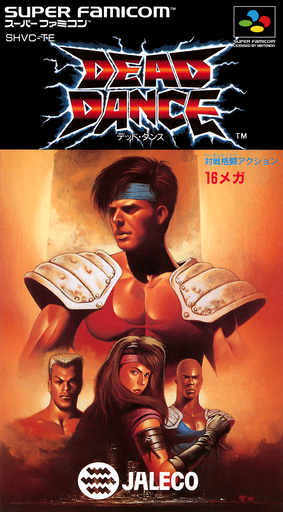
Dead Dance
Dead Dance is a Super Famicom fighting game released in 1993 developed by Jaleco Ltd.. It centers on combat encounters, move inputs, and offense-defense reads, with controls, information, and pacing arranged around television output, a directional pad, shoulder buttons, and a six-button controller.
- AI score · out of 10
- 5.4 / 10
About this game
Dead Dance is a Super Famicom fighting release centered on combat encounters, move inputs, and offense-defense reads. Short bouts use character differences and rising difficulty for variety, with progress divided into stages, tasks, matches, or growth milestones that make its immediate goals understandable. Its value depends on whether these rules continue to create judgment and room for mastery rather than on campaign length or series recognition. Short campaigns are judged by repeat-challenge value, while longer ones are judged by variety, pacing, and recovery after failure. Animation, hit feedback, and readable arenas create match tension, while sprite animation, scrolling, color, and chip-based audio jointly carry readability and atmosphere. The main genre-specific friction is that button mapping, move recognition, and cpu behavior can affect match balance. In addition, password or battery saves, multiplayer accessories, manual dependence, regional language, and cartridge enhancement chips can affect original-hardware use. This description covers only this release and excludes emulator features, modern-port conveniences, and content from other platforms.
Recommended games
Related game recommendations on this platform
Super Famicom / SNES
AI review
AI reviews are subjective assessments, not player ratings. See each review for its evidence and limitations.Published date:
A functional traditional fighter with thin variety and rough presentation.
Dead Dance sends you up a tower using familiar blocking, punch and kick strengths, and directional special commands. Three specials per fighter support basic exchanges, finishing replays let successful attacks linger, and passwords make the solo progression easier to resume. The starting selection is restrictive, however: only four fighters are available, and two play identically. Changing characters therefore produces less discovery than the roster suggests. Its bizarre opponents have memorable B-movie personality, but reused awkward animations, shallow scenery and abrasive melodies weaken the spectacle. The problem is not simply a lack of elaborate systems; the available movesets struggle to sustain varied matchups. Players who enjoy strange characters and older command conventions may find curiosity value, while those seeking a broad roster and polished combat should temper expectations.
Strengths
- Familiar defensive and command structure
- Password continuation and finishing replays
- Memorable outlandish opponents
Weaknesses
- Small initial selection with duplicated movesets
- Awkward reused animation and shallow scenery
- Shrill music and muffled cries
Who it is for: Fans of older command-based fighters and exaggerated B-movie character designs.
Play notes: This assesses Japanese Dead Dance. Eleven opponents do not mean eleven immediately selectable fighters; passwords support solo continuation.
View scoring basis
| Dimension | Review state | Score | Weight |
|---|---|---|---|
| Dimension The tower gives solo play a clear goal, but four initial fighters and repeated moves narrow replay choices. | Reviewed | 4.8 / 10 | Not provided |
| Dimension Familiar blocking and special inputs support functional duels, but duplicated movesets limit variety. | Reviewed | 5.8 / 10 | Not provided |
| Dimension Outlandish fighters are memorable, but awkward animation, thin scenery and abrasive sound weaken the spectacle. | Reviewed | 4.6 / 10 | Not provided |
| Dimension Familiar command conventions, passwords and finishing replays provide practical usability. | Reviewed | 6.5 / 10 | Not provided |
Review sources
Not provided
Core information
- Developer
- Jaleco
- Publisher
- Jaleco
- Release date
- 1993
- Platforms
- Super Famicom / SNES
- Content kind
- Game
- Release state
- Released
- Region
- Worldwide
- Official website
- Not provided
- Offline minimum players
- Not provided
- Offline maximum players
- Not provided
- Online minimum players
- Not provided
- Online maximum players
- Not provided
- Categories
- Fighting · Primary genre
- Tags
- Player versus PlayerMelee CombatFast-pacedReal-time CombatSolo-friendlyMain Story Under 10 HoursShort Sessions2D GraphicsCombosReplayable
- Supported game languages
- Not provided
- Requires base game
- Not provided
- Standalone
- Not provided
- Age ratings
- Not provided
- Play modes
- Not provided
- Perspectives
- Not provided
Release editions
- Super Famicom / SNESWorldwide1993
Game gallery
Sources
Not provided