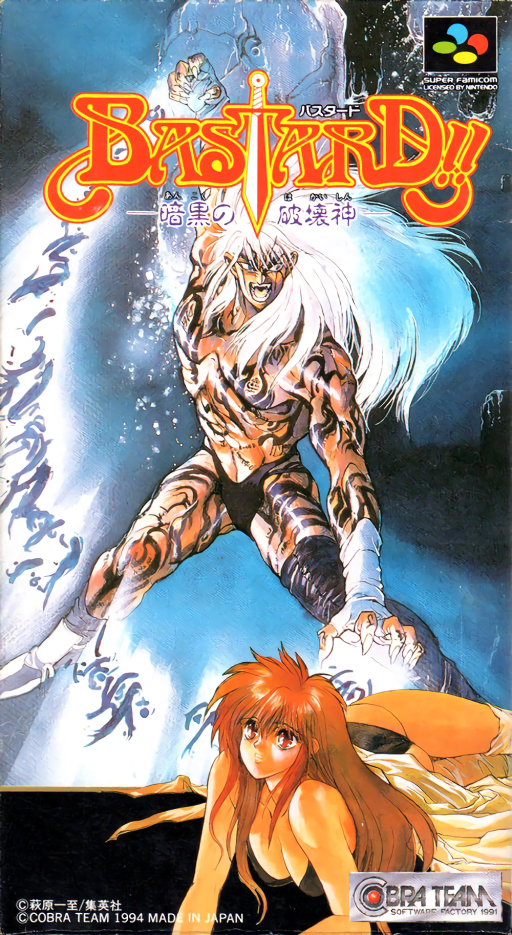
Bastard!! - Ankoku no Hakaishin
Bastard!! - Ankoku no Hakaishin is a Super Famicom fighting game released in 1994 developed by Team Mental Care. It centers on combat encounters, story, case, or mission progress, and local connection or multiplayer interaction, with controls, information, and pacing arranged around television output, a directional pad, shoulder buttons, and a six-button controller.
- AI score · out of 10
- 7.1 / 10
About this game
Bastard!! - Ankoku no Hakaishin is a Super Famicom fighting release centered on combat encounters, story, case, or mission progress, and local connection or multiplayer interaction. Short bouts use character differences and rising difficulty for variety, with progress divided into stages, tasks, matches, or growth milestones that make its immediate goals understandable. Its value depends on whether these rules continue to create judgment and room for mastery rather than on campaign length or series recognition. Short campaigns are judged by repeat-challenge value, while longer ones are judged by variety, pacing, and recovery after failure. Animation, hit feedback, and readable arenas create match tension, while sprite animation, scrolling, color, and chip-based audio jointly carry readability and atmosphere. The main genre-specific friction is that button mapping, move recognition, and cpu behavior can affect match balance. In addition, password or battery saves, multiplayer accessories, manual dependence, regional language, and cartridge enhancement chips can affect original-hardware use. This description covers only this release and excludes emulator features, modern-port conveniences, and content from other platforms.
Recommended games
Related game recommendations on this platform
Super Famicom / SNES
AI review
AI reviews are subjective assessments, not player ratings. See each review for its evidence and limitations.Published date:
A distinctive spell-dueling fighter that asks players to learn its unusual rhythm.
The Super Famicom Bastard!! adaptation avoids ordinary side-view punches. Fighters move through a space with visual depth, evade incoming magic and search for openings to cast their own long-range spells. Holding R while entering a spell-sign sequence makes powerful attacks a small commitment rather than a single instant button press. That system gives the game personality and a real execution challenge, although it can feel clumsy before the commands are learned. Familiar manga characters and the unusual foreground-to-background framing help sell a grand magical duel. Story, character-select VS and team battle modes add ways to practice; a no-continue story clear offers a further mastery target. Yet the actual exchanges remain mostly projectile contests, so mode count does not translate into wide mechanical variety. This is most rewarding for fans who enjoy memorizing spells and choosing casting windows. Sources support its rules and period control impressions, but not detailed performance or audio-quality claims.
Strengths
- Depth movement and spell signs create a unique combat rhythm.
- The roster and perspective evoke the manga's magical clashes.
- Several modes and a true-ending goal support practice.
Weaknesses
- Spell commands take time to learn.
- Combat variety remains concentrated on projectile exchanges.
- Technical performance and music lack independent confirmation.
Who it is for: Manga fans and retro action players willing to master unusual spell commands.
Play notes: Assessment concerns the 1994 SFC game only.
View scoring basis
| Dimension | Review state | Score | Weight |
|---|---|---|---|
| Dimension Story, free character selection and team battles provide several contexts for the roster, with a no-continue clear rewarding mastery. The moment-to-moment play remains a focused exchange of projectiles rather than varied stages. | Reviewed | 6.7 / 10 | Not provided |
| Dimension Depth movement and long-range spell duels distinguish this from a conventional side-view fighter. Holding R to enter spell signs creates a distinctive execution challenge, even if the timing feels awkward at first. | Reviewed | 7.5 / 10 | Not provided |
| Dimension The foreground-versus-background viewpoint and manga roster help evoke the source's outsized magical battles. Specific music or animation quality has little corroboration, so the score rests on style and adaptation rather than unsupported spectacle. | Reviewed | 7.3 / 10 | Not provided |
| Dimension Holding R through a spell-sign sequence takes practice, though a firsthand SFC player considers it manageable once learned. The finding concerns original-controller usability, not an unmeasured claim about response latency, frame rate or stability. | Reviewed | 6.4 / 10 | Not provided |
Review sources
Not provided
Core information
- Developer
- Team Mental Care
- Publisher
- Cobra Team
- Release date
- 1994
- Platforms
- Super Famicom / SNES
- Content kind
- Game
- Release state
- Released
- Region
- Worldwide
- Official website
- Not provided
- Offline minimum players
- Not provided
- Offline maximum players
- Not provided
- Online minimum players
- Not provided
- Online maximum players
- Not provided
- Categories
- Fighting · Primary genre
- Tags
- Main Story Under 10 HoursFast-paced2D GraphicsMelee CombatStory-drivenReal-time CombatPlayer versus PlayerCombosFantasyReplayableSolo-friendlyShort Sessions
- Supported game languages
- Not provided
- Requires base game
- Not provided
- Standalone
- Not provided
- Age ratings
- Not provided
- Play modes
- Not provided
- Perspectives
- Not provided
Release editions
- Super Famicom / SNESWorldwide1994
Game gallery
Sources
Not provided