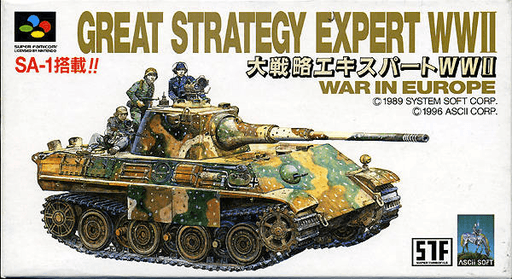
Daisenryaku Expert WWII - War in Europe
Daisenryaku Expert WWII - War in Europe is a Super Famicom strategy game released in 1996 developed by Systemsoft. It centers on combat encounters, turn-based tactical decisions, and battlefield assessment, with controls, information, and pacing arranged around television output, a directional pad, shoulder buttons, and a six-button controller.
- AI score · out of 10
- 7.1 / 10
About this game
Daisenryaku Expert WWII - War in Europe is a Super Famicom strategy release centered on combat encounters, turn-based tactical decisions, and battlefield assessment. Missions add map constraints, new rules, and tougher opposition, with progress divided into stages, tasks, matches, or growth milestones that make its immediate goals understandable. Its value depends on whether these rules continue to create judgment and room for mastery rather than on campaign length or series recognition. Short campaigns are judged by repeat-challenge value, while longer ones are judged by variety, pacing, and recovery after failure. Maps, unit states, and action feedback determine whether complex situations remain readable, while sprite animation, scrolling, color, and chip-based audio jointly carry readability and atmosphere. The main genre-specific friction is that brief tutorials, dense menus, and long scenarios increase the learning curve. In addition, password or battery saves, multiplayer accessories, manual dependence, regional language, and cartridge enhancement chips can affect original-hardware use. This description covers only this release and excludes emulator features, modern-port conveniences, and content from other platforms.
Collected in series
Daisenryaku is a military strategy franchise about coordinating units, producing reinforcements and controlling a battlefield map. Its branches explore different eras and rules, with both turn-based and real-time entries asking you to think beyond a single exchange of fire.
Recommended games
Related game recommendations on this platform
Super Famicom / SNES
AI review
AI reviews are subjective assessments, not player ratings. See each review for its evidence and limitations.Published date:
Meaningful deployment decisions are interrupted by lengthy computer turns.
Daisenryaku Expert WWII builds its strategy around unit roles, terrain and supply. Vulnerable infantry remains essential for occupation, while aircraft, armour and anti-aircraft units offer different strengths. When frontal firepower struggles, a route around the enemy can still secure the capital. Scenario objectives and changing fronts give sustained planning direction, although individual maps demand patience rather than quick-session rewards. The inspected hex terrain, unit silhouettes and selection outlines communicate spatial relationships; the scenario page separates factions and turn limits. Native shortcuts help locate unacted units, check ammunition and view the wider map. The serious limitation is lengthy computer-turn processing that interrupts active command. It remains rewarding for players interested in coordinated forces and capture routes, but less appealing when fast alternation and uninterrupted decisions are priorities.
Strengths
- Unit roles, terrain, fuel and capture create meaningful deployment and route choices.
- Different fronts and scenario objectives support sustained tactical planning.
- Recognisable map and scenario information is complemented by native checking and navigation shortcuts.
Weaknesses
- Lengthy computer-turn processing interrupts active command.
- Individual maps demand substantial commitment rather than quick-session payoff.
Who it is for: Patient turn-based war-strategy players interested in coordinating forces and planning capture routes despite slow turn alternation.
Play notes: This covers the original1996 SFC software, not the PC editions or1992 predecessor. The default German perspective includes associated historical symbols. Use overview, unacted-unit and ammunition shortcuts and allow ample time. The account's waiting analogy is not a measured fixed duration for every turn.
View scoring basis
| Dimension | Review state | Score | Weight |
|---|---|---|---|
| Dimension Scenario objectives and the two fronts give progression different contexts, with changing pressure sustaining longer planning. Individual maps demand substantial commitment rather than quick-session rewards. The content supports that investment, but the cadence suits patient players. | Reviewed | 7.0 / 10 | Not provided |
| Dimension Unit counters, terrain, fuel and infantry capture create interdependent decisions. Outflanking to take a capital can change the outcome when frontal firepower struggles. Deployment and route selection provide a strong, tangible tactical payoff. | Reviewed | 7.8 / 10 | Not provided |
| Dimension Hex terrain, unit silhouettes and selection outlines convey deployment relationships in the inspected battlefield regions. A separate scenario page groups limits and named factions. These scenes provide useful tactical context and information, without supporting an audio or animation judgment. | Reviewed | 7.0 / 10 | Not provided |
| Dimension Shortcuts for unacted units, the overview map, the capital and ammunition make checking and navigation workable. Reported lengthy computer turns nevertheless interrupt active command. Helpful inputs do not offset that substantial processing friction, leaving usability a clear weakness. | Reviewed | 5.8 / 10 | Not provided |
Review sources
Not provided
Core information
- Developer
- SystemSoft
- Publisher
- ASCII
- Release date
- 1996
- Platforms
- Super Famicom / SNES
- Content kind
- Game
- Release state
- Released
- Region
- Worldwide
- Official website
- Not provided
- Offline minimum players
- Not provided
- Offline maximum players
- Not provided
- Online minimum players
- Not provided
- Online maximum players
- Not provided
- Categories
- Strategy & Tactics · Primary genre
- Tags
- Command-based CombatWarResource ManagementLong-term ProgressionMain Story 20–50 HoursReal-time CombatTurn-based TacticsReplayableTop-downSolo-friendly2D GraphicsSlow Burn
- Supported game languages
- Not provided
- Requires base game
- Not provided
- Standalone
- Not provided
- Age ratings
- Not provided
- Play modes
- Not provided
- Perspectives
- Not provided
Release editions
- Super Famicom / SNESWorldwide1996
Game gallery
Sources
Not provided