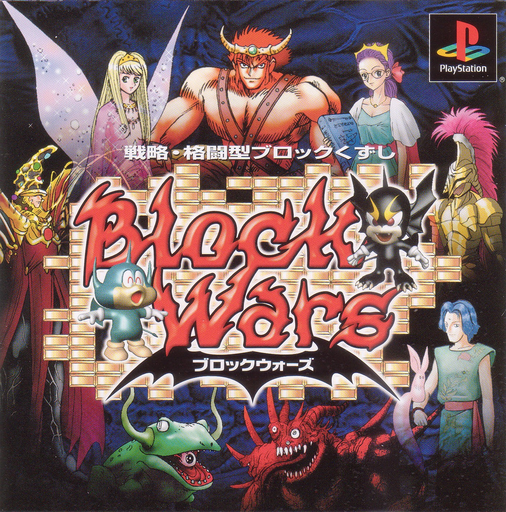
Block Wars
Block Wars is a PlayStation action game released in 2001 developed by Pony Canyon. It centers on aiming, shooting, and weapon use, puzzle, maze, or device solving, and story, case, or mission progress, with controls and information arranged around the directional pad, shoulder and face buttons, plus DualShock twin analog sticks and vibration where supported.
- AI score · out of 10
- 6.9 / 10
About this game
Block Wars is a PlayStation action game centered on aiming, shooting, and weapon use, puzzle, maze, or device solving, and story, case, or mission progress. Stages build pressure through routes, enemy patterns, and changing objectives, with progress divided into stages, tasks, matches, or growth milestones that make immediate goals understandable. Its value depends on whether these rules continue to create judgment and room for mastery rather than on length, sales, or series recognition. Short campaigns are judged by repeat-challenge value, while longer ones are judged by variety, pacing, and recovery after failure. Animation, hits, camera behavior, and readable hazards determine whether feedback remains dependable, while early 3D graphics, pre-rendered backgrounds, CD audio, and full-motion video need to preserve targets and interface readability on a television. The genre-specific limitation is that camera behavior, collision rules, input mapping, and repeated ground after failure can raise the entry barrier. Platform conditions also include disc loading, Memory Card saves, regional video standards, digital or analog control support, vibration, and dedicated peripherals affect original-hardware use. This description covers only this platform release and does not import features or conveniences from remasters, emulators, or other console editions.
Recommended games
Related game recommendations on this platform
PlayStation
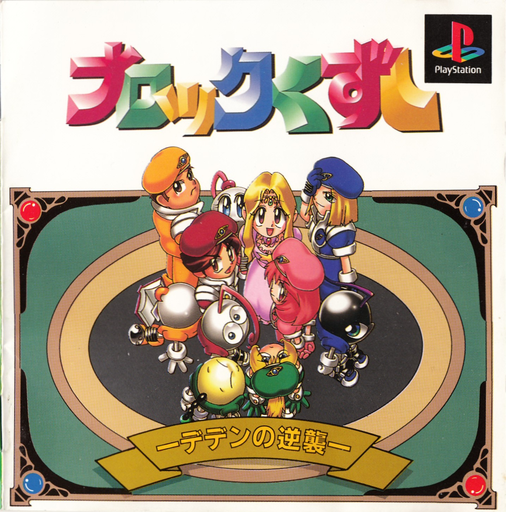
AI review
AI reviews are subjective assessments, not player ratings. See each review for its evidence and limitations.Published date:
Clever territory battles slowed by prolonged solo last-brick stalemates.
Block Wars turns brick-breaking into a contest between opposite ends of the field. Clearing your bricks wins, but pushing the central barrier until an opponent's brick reaches their back wall is another route. Missing the ball reverses that pressure, giving paddle placement an attack-defense purpose. Eight characters, story routes, Tokoton and Versus offer different ways to play, though solo matches can stall when both sides chase one elusive brick while the barrier moves back and forth. Colored bricks, a green barrier, golden paddles and fixed numeric regions separate the playing space; dense branches make the background busy. A serious creation-of-the-world story contrasts with the direct action. D-pad or left-stick control and Start pause are straightforward, while menus and story are Japanese. It suits players curious about territory pressure who tolerate slow solo endings and want to explore local competition.
Strengths
- Brick clearing and territory pressure give paddle placement meaningful tactical choices.
- Colored bricks, the central barrier and side paddles clearly separate static playing regions.
- D-pad and left-stick control offer alternatives with a clear pause command.
Weaknesses
- Elusive final bricks can produce prolonged stalemates in solo matches.
- Dense background details make the field's composition somewhat busy.
Who it is for: Players who like combining paddle placement with territory pressure, tolerate slow solo endings and want to try local competition with a friend.
Play notes: This covers Japanese 2001 PS1 SLPS-03219, with Japanese menus and story. Solo last-brick standoffs may take time. Versus supports human or computer opponents; missing the ball pushes the barrier back toward you, so watch both brick clearing and territory pressure.
View scoring basis
| Dimension | Review state | Score | Weight |
|---|---|---|---|
| Dimension Character routes and three modes offer real ways to play, but frequent last-brick stalemates stretch otherwise compact competition and substantially undermine solo progression. Content and pacing are weak for this specific end-of-round drag, not because brick-breaking is inherently repetitive. | Reviewed | 5.8 / 10 | Not provided |
| Dimension Two win conditions connect brick-clearing speed, placement and territory pressure, while barrier reversals after a miss create meaningful attack-defense trade-offs. The core is good because the same paddle interaction serves different goals, not merely because it demands faster reflexes. | Reviewed | 7.4 / 10 | Not provided |
| Dimension Colored brick columns, a green barrier and side paddles communicate spatial competition clearly, while the serious fantasy narrative adds a distinctive contrast. Static presentation is good overall; dense branches make the scene busy, with clarity relying chiefly on object colors and spatial separation. | Reviewed | 7.1 / 10 | Not provided |
| Dimension D-pad and left-stick alternatives, a clear pause command and an individual player's positive analogue-input experience support good basic usability. Japanese menus and story require appropriate reading ability; direct paddle control does not remove the practice needed to handle fast balls. | Reviewed | 7.2 / 10 | Not provided |
Review sources
Not provided
Core information
- Developer
- Pony Canyon
- Publisher
- Pony Canyon
- Release date
- 2001
- Platforms
- PlayStation
- Content kind
- Game
- Release state
- Released
- Region
- Worldwide
- Official website
- Not provided
- Offline minimum players
- Not provided
- Offline maximum players
- Not provided
- Online minimum players
- Not provided
- Online maximum players
- Not provided
- Categories
- Action · Primary genre
- Tags
- Solo-friendlyReplayableFast-pacedLinear LevelsWarPlatforming3D GraphicsShootingReal-time CombatPuzzle SolvingStory-drivenThird Person
- Supported game languages
- Not provided
- Requires base game
- Not provided
- Standalone
- Not provided
- Age ratings
- Not provided
- Play modes
- Not provided
- Perspectives
- Not provided
Release editions
- PlayStationWorldwide2001
Game gallery
Sources
Not provided