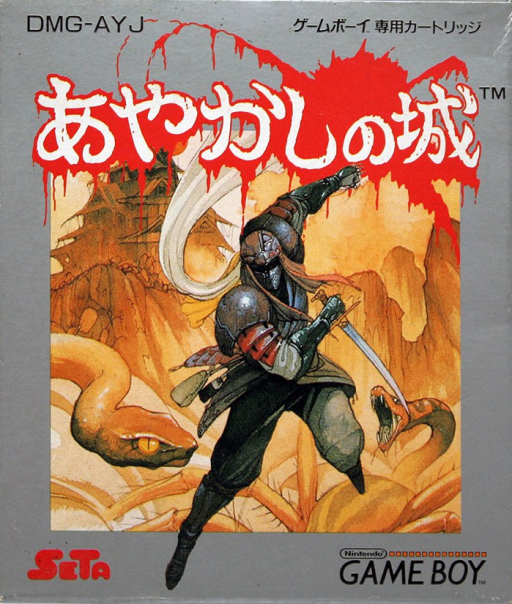
Ayakashi no Shiro
Ayakashi no Shiro is a Game Boy role-playing game released in 1990 developed by SETA Corporation. It centers on combat encounters, area and route exploration, and character or equipment growth, with controls, information, and pacing arranged around a monochrome small screen, a directional pad, and two main action buttons.
- AI score · out of 10
- 7.2 / 10
About this game
Ayakashi no Shiro is a Game Boy role-playing release centered on combat encounters, area and route exploration, and character or equipment growth. Story beats, exploration, and progression resources support a longer campaign, with progress divided into stages, tasks, matches, or growth milestones that make its immediate goals understandable. Its value depends on whether these rules continue to create judgment and room for mastery rather than on campaign length or series recognition. Short campaigns are judged by repeat-challenge value, while longer ones are judged by variety, pacing, and recovery after failure. Characters, world building, maps, and music carry most of the atmosphere, while silhouettes, contrast, and audio cues need to remain clear on the monochrome display. The main genre-specific friction is that dense text, menu layers, repeated battles, and language dependence can slow progress. In addition, password or battery saves, link-cable requirements, display blur, manual dependence, and regional language can affect use of the original cartridge today. This description covers only this release and excludes emulator features, modern-port conveniences, and content from other platforms.
Recommended games
Related game recommendations on this platform
Game Boy (GB)
AI review
AI reviews are subjective assessments, not player ratings. See each review for its evidence and limitations.Published date:
A tactical dungeon adventure with uneven grinding thresholds.
Ayakashi no Shiro puts its strongest ideas in the decisions made by a lone ninja facing groups of enemies. Spell strengths, weaknesses and retreat opportunities give encounters more texture than a routine attack loop. Its five castles gradually open into larger mazes, and returning to an earlier location serves a new objective rather than merely retracing footsteps. Progress is less convincing when a new castle demands grinding, then becomes much easier once a level threshold is crossed. Large, varied monsters provide character, but similar corridors and recurring tunes wear thin. Saving and free healing at entrances, supported by coordinates and maps, make exploration easier to organize. It suits patient dungeon explorers who enjoy mapping and spell choices more than a smoothly paced journey.
Strengths
- Tactical spell choices
- Purposeful maze expansion
- Practical saves and recovery
Weaknesses
- Uneven grinding thresholds
- Repeated scenery and music
Who it is for: Patient dungeon explorers
Play notes: Japanese original; new castles can require grinding.
View scoring basis
| Dimension | Review state | Score | Weight |
|---|---|---|---|
| Dimension Expanding routes and purposeful revisits suffer from abrupt grinding thresholds. | Reviewed | 6.5 / 10 | Not provided |
| Dimension Spell strength, weaknesses and retreat support thoughtful solo combat. | Reviewed | 7.6 / 10 | Not provided |
| Dimension Varied monsters give personality, but maps and tunes repeat. | Reviewed | 6.7 / 10 | Not provided |
| Dimension Entrance saves, free healing and mapping make exploration practical. | Reviewed | 7.8 / 10 | Not provided |
Review sources
Not provided
Core information
- Developer
- SETA
- Publisher
- SETA
- Release date
- 1990
- Platforms
- Game Boy (GB)
- Content kind
- Game
- Release state
- Released
- Region
- Worldwide
- Official website
- Not provided
- Offline minimum players
- Not provided
- Offline maximum players
- Not provided
- Online minimum players
- Not provided
- Online maximum players
- Not provided
- Categories
- Role-Playing · Primary genre
- Tags
- Real-time CombatTop-downMain Story 20–50 HoursCommand-based CombatFantasyExplorationLong-term ProgressionTurn-based CombatSolo-friendly2D GraphicsStory-drivenLevel Progression
- Supported game languages
- Not provided
- Requires base game
- Not provided
- Standalone
- Not provided
- Age ratings
- Not provided
- Play modes
- Single player
- Perspectives
- First person
Release editions
- Game Boy (GB)Worldwide1990
Game gallery
Sources
Not provided