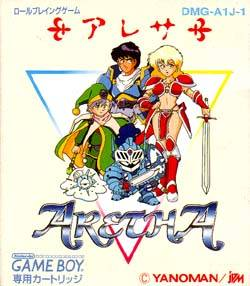
Aretha
Aretha is a Game Boy role-playing game released in 1990 developed by Japan Art Media. It centers on area exploration, combat and party setup, and character progression, with controls, information, and pacing arranged around a monochrome small screen, a directional pad, and two main action buttons.
- AI score · out of 10
- 7.1 / 10
About this game
Aretha is a Game Boy role-playing release centered on area exploration, combat and party setup, and character progression. Story beats, exploration, and progression resources support a longer campaign, with progress divided into stages, tasks, matches, or growth milestones that make its immediate goals understandable. Its value depends on whether these rules continue to create judgment and room for mastery rather than on campaign length or series recognition. Short campaigns are judged by repeat-challenge value, while longer ones are judged by variety, pacing, and recovery after failure. Characters, world building, maps, and music carry most of the atmosphere, while silhouettes, contrast, and audio cues need to remain clear on the monochrome display. The main genre-specific friction is that dense text, menu layers, repeated battles, and language dependence can slow progress. In addition, password or battery saves, link-cable requirements, display blur, manual dependence, and regional language can affect use of the original cartridge today. This description covers only this release and excludes emulator features, modern-port conveniences, and content from other platforms.
Recommended games
Related game recommendations on this platform
Game Boy (GB)
AI review
AI reviews are subjective assessments, not player ratings. See each review for its evidence and limitations.Published date:
Distinctive resource-driven RPG exploration, held back by uneven pacing and guidance.
Original Game Boy Aretha gives money and HP unusual importance: borrowing, buying progression items and paying HP for spells make resource planning central to its adventure. Weak encounters disappear as you grow stronger, while later treasure and healing ease early scarcity; financial pressure is not a demonstrated permanent softlock. Overspending can nevertheless force additional battles, and party changes make difficulty uneven. Important events sustain interest amid repetitive errands. Music and visual effort add charm, although repeated faces weaken character distinction and important guidance is insufficient. Diagonal movement helps exploration without resolving those communication problems. It suits patient traditional RPG players who enjoy resource management.
Strengths
- Distinctive money and HP decisions
- Less obstructed exploration after growth
- Appealing music and events
Weaknesses
- Early spending can force grinding
- Uneven difficulty after party changes
- Insufficient progression guidance
Who it is for: Patient traditional RPG players interested in resource management
Play notes: Japanese GB original only. Reserve money for progression items; SFC collection conveniences are not included.
View scoring basis
| Dimension | Review state | Score | Weight |
|---|---|---|---|
| Dimension Events motivate progress, but repeated errands and early financial pressure slow the pacing. | Reviewed | 6.6 / 10 | Not provided |
| Dimension Money and HP create distinctive decisions, though party changes make difficulty uneven. | Reviewed | 7.6 / 10 | Not provided |
| Dimension Music and visual effort add charm, while repeated faces reduce character distinction. | Reviewed | 6.9 / 10 | Not provided |
| Dimension Diagonal movement aids exploration, but important guidance is insufficient. | Reviewed | 6.7 / 10 | Not provided |
Review sources
Not provided
Core information
- Developer
- Japan Art Media
- Publisher
- Yanoman
- Release date
- 1990
- Platforms
- Game Boy (GB)
- Content kind
- Game
- Release state
- Released
- Region
- Worldwide
- Official website
- Not provided
- Offline minimum players
- Not provided
- Offline maximum players
- Not provided
- Online minimum players
- Not provided
- Online maximum players
- Not provided
- Categories
- Role-Playing · Primary genre
- Tags
- ExplorationTurn-based Combat2D GraphicsSolo-friendlyMain Story 20–50 HoursLong-term ProgressionStory-drivenLevel ProgressionTop-downFantasy
- Supported game languages
- Not provided
- Requires base game
- Not provided
- Standalone
- Not provided
- Age ratings
- Not provided
- Play modes
- Single player
- Perspectives
- Top-downSide view
Release editions
- Game Boy (GB)Worldwide1990
Game gallery
Sources
Not provided