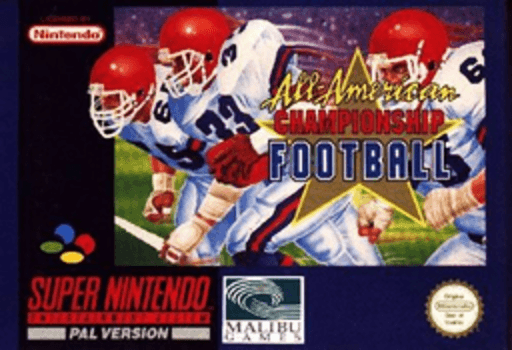
All-American Championship Football
All-American Championship Football is a Super Famicom sports game released in 1994 developed by Malibu Games. It centers on competitive sport play, sport controls, and shifts between attack and defense, with controls, information, and pacing arranged around television output, a directional pad, shoulder buttons, and a six-button controller.
- AI score · out of 10
- 5.3 / 10
About this game
All-American Championship Football is a Super Famicom sports release centered on competitive sport play, sport controls, and shifts between attack and defense. Matches, challenges, and tournament goals give sessions clear boundaries, with progress divided into stages, tasks, matches, or growth milestones that make its immediate goals understandable. Its value depends on whether these rules continue to create judgment and room for mastery rather than on campaign length or series recognition. Short campaigns are judged by repeat-challenge value, while longer ones are judged by variety, pacing, and recovery after failure. Players, venues, and score feedback establish the match atmosphere, while sprite animation, scrolling, color, and chip-based audio jointly carry readability and atmosphere. The main genre-specific friction is that opponent ai, control precision, and period-specific rosters can affect consistency. In addition, password or battery saves, multiplayer accessories, manual dependence, regional language, and cartridge enhancement chips can affect original-hardware use. This description covers only this release and excludes emulator features, modern-port conveniences, and content from other platforms.
Recommended games
Related game recommendations on this platform
Super Famicom / SNES
AI review
AI reviews are subjective assessments, not player ratings. See each review for its evidence and limitations.Published date:
An operating football framework undermined by field-reading and presentation problems.
All-American Championship Football has more than an isolated match: exhibition and season play include standings and fixture information before games. The player steers one footballer while the computer handles the others, with three reviewed button-assigned tactics at stoppages. There is therefore direct and tactical participation, while the fixed view makes match information difficult to follow. The fixed diagonal view makes distant receivers hard to follow, and players are difficult to distinguish. Tiny sprites, plain scenery and chopped animation leave the spectacle rough, while repeated first-down calls disrupt the rhythm instead of adding useful atmosphere. It is better suited to curiosity about this particular retro football implementation than to clear passing play or substantial simulation. This judgment covers representative matches and the season interface, not every season outcome. Reviewers' dislike of the sport itself and their numerical ratings are not treated as facts about quality.
Strengths
- Exhibition and season structures give explicit match goals.
- Native movement, kickoff and tactic commands are identifiable.
Weaknesses
- The view and indistinct players obstruct field reading.
- Rough animation and repetitive audio weaken the match atmosphere.
- The representative account documents modest tactical breadth.
Who it is for: Players curious about this specific retro football implementation.
Play notes: Representative match and interface evidence is not a full-season balance test. Other-platform versions, unverified saving and performance claims are excluded.
View scoring basis
| Dimension | Review state | Score | Weight |
|---|---|---|---|
| Dimension Exhibition and a documented season interface establish successive goals. The content strength is primarily that framework, while the match shortcomings constrain its appeal; this does not imply a full-season test. | Reviewed | 5.8 / 10 | Not provided |
| Dimension Button-assigned tactics followed by direct play establish a basic decision loop. The representative account documents modest tactical breadth, not extensive depth; controlling one player while AI handles the others is not itself a defect. | Reviewed | 6.0 / 10 | Not provided |
| Dimension Tiny players, plain scenery, chopped animation and repeated calls make the match atmosphere notably rough. The weakness is documented execution and repetition, not the age of the hardware or the absence of a story. | Reviewed | 3.8 / 10 | Not provided |
| Dimension The native kickoff, movement and tactic commands are identifiable, so a broken input system is not established. The fixed view and ambiguous players still obstruct target identification; unverified response-speed or frame-rate defects are not added. | Reviewed | 4.6 / 10 | Not provided |
Review sources
Not provided
Core information
- Developer
- Malibu Games
- Publisher
- Malibu Games
- Release date
- 1994
- Platforms
- Super Famicom / SNES
- Content kind
- Game
- Release state
- Released
- Region
- Worldwide
- Official website
- Not provided
- Offline minimum players
- Not provided
- Offline maximum players
- Not provided
- Online minimum players
- Not provided
- Online maximum players
- Not provided
- Categories
- Sports · Primary genre
- Tags
- Fast-pacedSolo-friendlyMain Story Under 10 HoursShort SessionsPick-up and PlayPlayer versus PlayerLow Entry BarrierReplayableSports-based Play2D Graphics
- Supported game languages
- Not provided
- Requires base game
- Not provided
- Standalone
- Not provided
- Age ratings
- Not provided
- Play modes
- Not provided
- Perspectives
- Not provided
Release editions
- Super Famicom / SNESWorldwide1994
Game gallery
Sources
Not provided