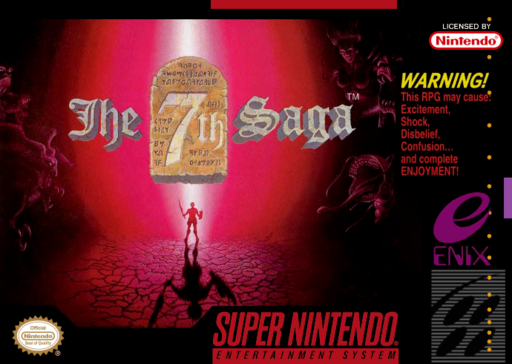
The 7th Saga
The 7th Saga is a Super Famicom role-playing game released in 1993 developed by Produce!. It centers on area and route exploration, area exploration, and combat and party setup, with controls, information, and pacing arranged around television output, a directional pad, shoulder buttons, and a six-button controller.
- AI score · out of 10
- 6.8 / 10
About this game
The 7th Saga is a Super Famicom role-playing release centered on area and route exploration, area exploration, and combat and party setup. Story beats, exploration, and progression resources support a longer campaign, with progress divided into stages, tasks, matches, or growth milestones that make its immediate goals understandable. Its value depends on whether these rules continue to create judgment and room for mastery rather than on campaign length or series recognition. Short campaigns are judged by repeat-challenge value, while longer ones are judged by variety, pacing, and recovery after failure. Characters, world building, maps, and music carry most of the atmosphere, while sprite animation, scrolling, color, and chip-based audio jointly carry readability and atmosphere. The main genre-specific friction is that dense text, menu layers, repeated battles, and language dependence can slow progress. In addition, password or battery saves, multiplayer accessories, manual dependence, regional language, and cartridge enhancement chips can affect original-hardware use. This description covers only this release and excludes emulator features, modern-port conveniences, and content from other platforms.
Recommended games
Related game recommendations on this platform
Super Famicom / SNES
AI review
AI reviews are subjective assessments, not player ratings. See each review for its evidence and limitations.Published date:
A distinctive RPG whose US balance makes its best ideas hard to recommend broadly.
The 7th Saga begins with a useful choice: one of seven apprentices with sharply different physical and magical strengths must seek the world's runes. Later, another apprentice may join, so a complementary partner changes equipment, healing and battle preparation. A crystal radar marks towns, runes and moving enemies, while defending makes the next attack stronger. Together these systems give a familiar turn-based quest its own identity. Battles shift to an over-the-shoulder view with striking monsters, and the music lends towns and wilderness more character than the spare central story does. The North American cartridge is also notably uneven. Player level gains are lower than in the Japanese Elnard release, while ordinary enemies and rival apprentices remain punishing. Frequent encounters consume healing, and a required one-on-one rival fight can block progress despite preparation. Losing to a rival may even cost the runes already collected. Seven starting heroes and possible pairings offer real replay interest, but that variety does not erase the time spent grinding through the US balance. This score is explicitly for the North American SNES game named The 7th Saga; the catalog's combined worldwide platform row must not imply that the differently balanced Japanese Elnard receives the same judgment.
Strengths
- Distinct heroes and partner combinations
- Useful radar and defend-then-attack tactics
- Memorable battle art and music
Weaknesses
- Unbalanced US growth and rival duels
- Frequent combat turns progress into grinding
- Thin main story and limited character development
Who it is for: Retro RPG players willing to study party combinations and tolerate a severe challenge.
Play notes: This is a North American The 7th Saga assessment, not an Elnard score. Difficulty here includes uneven numbers and mandatory duels, not just demanding tactics.
View scoring basis
| Dimension | Review state | Score | Weight |
|---|---|---|---|
| Dimension Rune hunting and varied heroes support replay, but thin storytelling and US-specific rival spikes turn much of the journey into grinding. | Reviewed | 5.5 / 10 | Not provided |
| Dimension Seven distinct heroes, recruitable partners and a useful radar distinguish the journey, while frequent battles wear down its tactical appeal. | Reviewed | 7.0 / 10 | Not provided |
| Dimension Expressive battle art and atmospheric music are memorable, even though overworld scenes and narrative staging are plainer. | Reviewed | 8.0 / 10 | Not provided |
| Dimension Radar and town clues support navigation, but the US cartridge's balance creates avoidable friction; performance is not judged without evidence. | Reviewed | 6.5 / 10 | Not provided |
Review sources
Not provided
Core information
- Developer
- Produce!
- Publisher
- Square EnixGameplan21
- Release date
- 1993
- Platforms
- Super Famicom / SNES
- Content kind
- Game
- Release state
- Released
- Region
- Worldwide
- Official website
- Not provided
- Offline minimum players
- Not provided
- Offline maximum players
- Not provided
- Online minimum players
- Not provided
- Online maximum players
- Not provided
- Categories
- Role-Playing · Primary genre
- Tags
- Turn-based CombatSolo-friendlyExplorationFantasyStory-driven2D GraphicsLevel ProgressionLong-term ProgressionTop-downMain Story 20–50 Hours
- Supported game languages
- Not provided
- Requires base game
- Not provided
- Standalone
- Not provided
- Age ratings
- Not provided
- Play modes
- Single player
- Perspectives
- Top-down
Release editions
- Super Famicom / SNESWorldwide1993
Game gallery
Sources
Not provided