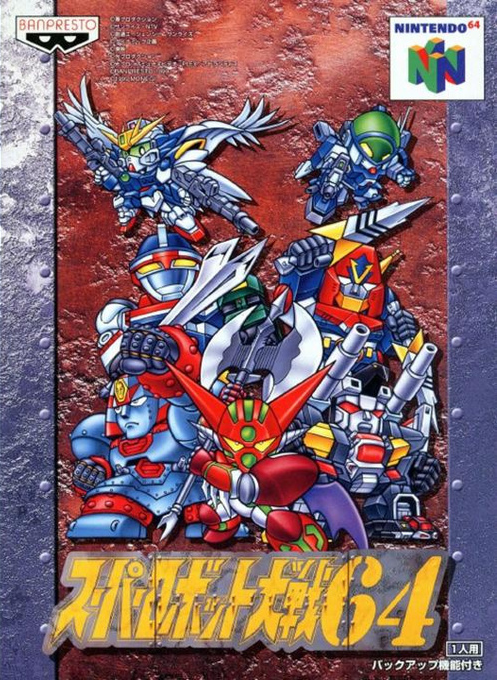
Super Robot Taisen 64
Super Robot Taisen 64 is a Nintendo 64 role-playing game released in 1999 developed by Banpresto. It centers on combat encounters, character or equipment growth, and turn-based tactical decisions, with controls, information, and pacing arranged around the analog stick, directional pad, A/B buttons, C buttons, and Z trigger.
- AI score · out of 10
- 7.6 / 10
About this game
Super Robot Taisen 64 is a Nintendo 64 role-playing game centered on combat encounters, character or equipment growth, and turn-based tactical decisions. Story beats, exploration, and progression resources support a longer campaign, with progress divided into stages, tasks, matches, or growth milestones that make its immediate goals understandable. Its value depends on whether these rules continue to create judgment and room for mastery rather than on length, sales, or series recognition. Short campaigns are judged by repeat-challenge value, while longer ones are judged by variety, pacing, and recovery after failure. Characters, world building, environments, and music carry most of the atmosphere, while 3D scenes, fog, textures, and cartridge audio need to preserve target readability within limited memory and television output. The genre-specific limitation is that dense text, menu layers, repeated battles, loading, or language dependence can slow progress. Platform conditions also include camera control, stick precision, Controller Pak saves, Rumble Pak support, Expansion Pak requirements, and four-player setup can affect original-hardware use. This description covers only this platform release and does not import features from other editions.
Recommended games
Related game recommendations on this platform
Nintendo 64
AI review
AI reviews are subjective assessments, not player ratings. See each review for its evidence and limitations.Published date:
Rich routes and team building outweigh restrained battles and uneven difficulty.
Route selection is this game's strongest reason to return: different protagonists and branches change the pilots and machines available, rather than merely replacing a few conversations. Protecting allied units, recruiting opponents, managing spirit commands and arranging combination attacks give deployment meaningful layers. The earlier stages are comparatively forgiving, but a pronounced late difficulty rise can expose careless preparation. Large mech images and appealing background music convey the crossover's atmosphere, while static sprites provide less spectacle than players expecting elaborate attack animation might want. Selecting units, moving and attacking is straightforward; the absence of pilot, robot and event reference lists makes learning the cast less convenient. This is most rewarding for experienced strategy players willing to read Japanese, plan their team and replay alternative routes.
Strengths
- Route changes give team building and replay a concrete purpose.
- Protection, recruitment and spirit commands add distinct tactical considerations.
Weaknesses
- A late difficulty rise, missing reference lists and static battle sprites limit accessibility and spectacle.
Who it is for: For experienced SRW players who enjoy team planning and replaying Japanese-language routes.
Play notes: This covers the Japanese original N64 software; Japanese commands and static battle sprites differ from later animated SRW entries.
View scoring basis
| Dimension | Review state | Score | Weight |
|---|---|---|---|
| Dimension Routes change the available team and reward replay, while a late difficulty rise makes preparation important and the progression less even. | Reviewed | 8.2 / 10 | Not provided |
| Dimension Positioning, spirit resources and recruitment conditions provide substantial tactics, though the lack of ally-blocking support requires careful deployment. | Reviewed | 8.0 / 10 | Not provided |
| Dimension Large mech images and atmospheric music preserve the crossover's appeal, but static sprites limit dramatic battle movement. | Reviewed | 6.9 / 10 | Not provided |
| Dimension Straightforward unit commands and music playback are useful, but missing reference lists make the experience more dependent on prior knowledge. | Reviewed | 6.7 / 10 | Not provided |
Review sources
Not provided
Core information
- Developer
- Banpresto
- Publisher
- Banpresto
- Release date
- 1999
- Platforms
- Nintendo 64
- Content kind
- Game
- Release state
- Released
- Region
- Worldwide
- Official website
- Not provided
- Offline minimum players
- Not provided
- Offline maximum players
- Not provided
- Online minimum players
- Not provided
- Online maximum players
- Not provided
- Tags
- Command-based CombatSolo-friendlyReal-time CombatFantasyExplorationThird PersonStory-drivenLevel Progression3D GraphicsLong-term ProgressionMain Story 20–50 HoursTurn-based Combat
- Supported game languages
- Not provided
- Requires base game
- Not provided
- Standalone
- Not provided
- Age ratings
- Not provided
- Play modes
- Single player
- Perspectives
- Top-down
Release editions
- Nintendo 64Worldwide1999
Game gallery
Sources
Not provided