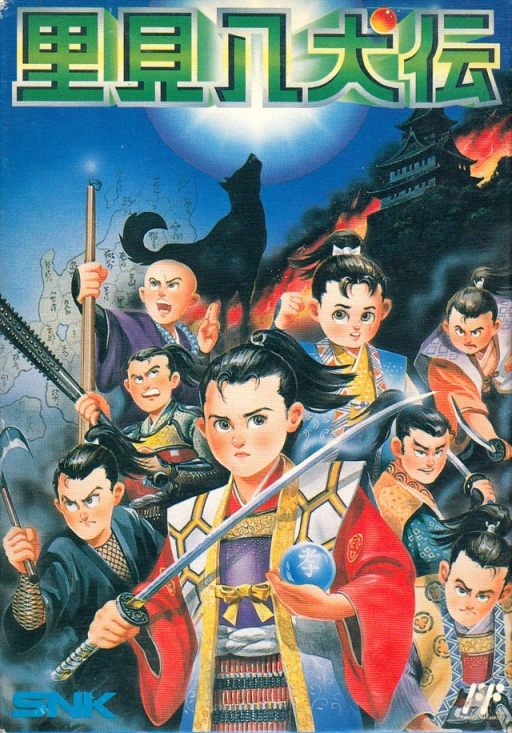
Satomi Hakkenden
Satomi Hakkenden (usually translated as "The Eight Dog Chronicles") was a long-running 19th century novel series about eight samurais from the Sengoku period and their various adventures. It was in some ways partly inspired by the ancient Chinese epic The Water Margin, which has itself seen video game adaptations in the form of the Suikoden games. Receiving numerous TV and film adaptations, including the 1983 film known in the west as Legend of the Eight Samurai, Satomi Hakkenden would be its first video game adaptation. The game itself plays much like Dragon Quest: a common source of inspiration for 8-bit RPGs. The player can walk around towns conversing with NPCs, equipping themselves with weapons and armor and receiving quests and directions to new areas before leaving the safety of the town to fight random encounters on the overworld map that links locations together. Combat follows the tactical turn-based pattern, allowing the player input their characters' desired actions before watching each turn play out. Most of the enemies in the game are based on classical Japanese monsters, usually youkai.
- AI score · out of 10
- 7.5 / 10
About this game
Satomi Hakkenden (usually translated as "The Eight Dog Chronicles") was a long-running 19th century novel series about eight samurais from the Sengoku period and their various adventures. It was in some ways partly inspired by the ancient Chinese epic The Water Margin, which has itself seen video game adaptations in the form of the Suikoden games. Receiving numerous TV and film adaptations, including the 1983 film known in the west as Legend of the Eight Samurai, Satomi Hakkenden would be its first video game adaptation. The game itself plays much like Dragon Quest: a common source of inspiration for 8-bit RPGs. The player can walk around towns conversing with NPCs, equipping themselves with weapons and armor and receiving quests and directions to new areas before leaving the safety of the town to fight random encounters on the overworld map that links locations together. Combat follows the tactical turn-based pattern, allowing the player input their characters' desired actions before watching each turn play out. Most of the enemies in the game are based on classical Japanese monsters, usually youkai.
Recommended games
Related game recommendations on this platform
Famicom / NES
AI review
AI reviews are subjective assessments, not player ratings. See each review for its evidence and limitations.Published date:
Satomi Hakkenden is assessed here as a specific FC/NES release with its documented strengths and practical limits kept in view.
Satomi Hakkenden (usually translated as "The Eight Dog Chronicles") was a long-running 19th century novel series about eight samurais from the Sengoku period and their various adventures. It was in some ways partly inspired by the ancient Chinese epic The Water Margin, which has itself seen video game adaptations in the form of the Suikoden games. Receiving numerous TV and film adaptations, including the 1983 film known in the west as Legend of the Eight Samurai, Satomi Hakkenden would be its first video game adaptation. The game itself plays much like Dragon Quest: a common source of inspiration for 8-bit RPGs. The player can walk This assessment focuses on the specific FC or NES release and on the play actions, goals, and progression documented for Satomi Hakkenden. Its value comes from how clearly the central rules create decisions and feedback across a session. Pacing is judged by the variety of situations, the learning curve, recovery after failure, and the reason to replay. Presentation is considered through readability, animation, sound, and the consistency of the game's style rather than by modern resolution. Practical limits such as period controls, guidance, saving, or required accessories are included only when they affect this release. Players who enjoy learning compact systems and improving through repeated attempts are the clearest audience, while anyone seeking modern convenience
Strengths
- The documented central loop gives Satomi Hakkenden a clear identity and a learnable set of goals.
- Progress rewards understanding the rules and applying them more consistently across repeated situations.
Weaknesses
- The original release can create friction through its documented difficulty, guidance, control, or recovery limits.
Who it is for: Players interested in the original FC/NES design and willing to learn its period-specific rules.
Play notes: Check the documented language, saving, accessory, and recovery conditions for this exact release.
View scoring basis
| Dimension | Review state | Score | Weight |
|---|---|---|---|
| Dimension The content pacing score applies the V3 boundary to the documented mechanics, pacing, presentation, and FC release constraints. | Reviewed | 7.6 / 10 | Not provided |
| Dimension The core experience score applies the V3 boundary to the documented mechanics, pacing, presentation, and FC release constraints. | Reviewed | 7.5 / 10 | Not provided |
| Dimension The presentation immersion score applies the V3 boundary to the documented mechanics, pacing, presentation, and FC release constraints. | Reviewed | 8.0 / 10 | Not provided |
| Dimension The technical usability score applies the V3 boundary to the documented mechanics, pacing, presentation, and FC release constraints. | Reviewed | 6.8 / 10 | Not provided |
Review sources
Not provided
Core information
- Developer
- ADK
- Publisher
- SNK
- Release date
- 1989
- Platforms
- Famicom / NES
- Content kind
- Game
- Release state
- Released
- Region
- Worldwide
- Official website
- Not provided
- Offline minimum players
- Not provided
- Offline maximum players
- Not provided
- Online minimum players
- Not provided
- Online maximum players
- Not provided
- Categories
- Role-Playing · Primary genre
- Tags
- HistoricalRetro StyleJapanese-inspired StyleSolo-friendlyLevel Progression2D GraphicsPixel ArtFantasy
- Supported game languages
- Not provided
- Requires base game
- Not provided
- Standalone
- Not provided
- Age ratings
- Not provided
- Play modes
- Not provided
- Perspectives
- Not provided
Release editions
- Famicom / NESWorldwide1989
Game gallery
Sources
Not provided