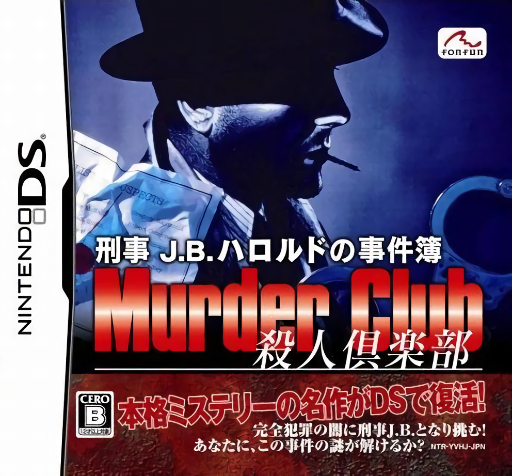
Keiji J.B. Harold no Jikenbo - Murder Club
Keiji J.B. Harold no Jikenbo - Murder Club is a Nintendo DS adventure game released in 2008. It centers on area exploration, story, case, or mission progress, and location exploration and arranges its main commands and information around the handheld's dual screens, touch input, and physical buttons.
- AI score · out of 10
- 7.0 / 10
About this game
The mystery begins with a stream of blood runninng down Bil Robbins' back. Now its up to you, J.B., to track down the culprit whose hand twisted the knife. Enemies? The victim had so many, they must have been standing in line to bump him off. But the murderer will never get away because the amazing technology of TurboGrafx-CD will make all suspects answer to you as you grill them and dig up clues. Unravel a dark world of chilling secrets, hidden mysteries, sultry dames and deceit to crack the case. Yeah, J.B., everyone has something to hide. Don't let them hide it from you! In this Nintendo DS release, area exploration, story, case, or mission progress, and location exploration form the main playable structure. Locations, objectives, and clues gradually open the main chapters. The dual screens, stylus, and buttons divide commands from status information where the design calls for it. Atmosphere, character expression, and dual-screen information matter more than raw intensity, while sparse guidance, opaque triggers, or dense text can create search and comprehension costs. This description applies to the Nintendo DS edition and does not import modes, presentation upgrades, or convenience features from home-console versions, mobile adaptations, later ports, or remakes.
Recommended games
Related game recommendations on this platform
Nintendo DS
AI review
AI reviews are subjective assessments, not player ratings. See each review for its evidence and limitations.Published date:
良好 Nintendo DS adventure experience
Keiji J.B. Harold no Jikenbo - Murder Club centers on area exploration, story, case, or mission progress, and location exploration. Locations, objectives, and clues gradually open the main chapters, giving the Nintendo DS release recognizable goals and a coherent portable rhythm. Atmosphere, character expression, and dual-screen information matter more than raw intensity. Its value comes from how the main rules work with the handheld interface, while variety and room for mastery determine the longer-term appeal. Sparse guidance, opaque triggers, or dense text can create search and comprehension costs, which is the principal limitation on original hardware. GameNavo scores this concrete release across four independently judged dimensions and does not use press aggregates, user ratings, source length, media count, title recognition, or features from another platform.
Strengths
- area exploration, and story, case, or mission progress provide a readable mechanical foundation.
- Progress is divided into understandable stages, tasks, matches, or chapters.
- Presentation and interface feedback support the main rules.
Weaknesses
- Sparse guidance, opaque triggers, or dense text can create search and comprehension costs.
- Original language, multiplayer hardware, or touch conditions may affect present-day use.
Who it is for: Players who enjoy adventure games, accept Nintendo DS-era interface conventions, and want to assess the original handheld release on its own terms.
Play notes: This review covers the Nintendo DS release without emulator save states, speed-up, or later-port features and does not represent a complete playthrough.
View scoring basis
| Dimension | Review state | Score | Weight |
|---|---|---|---|
| Dimension Locations, objectives, and clues gradually open the main chapters. The 6.8 score weighs variety, repetition, difficulty progression, recovery after failure, and replay value rather than nominal length or source volume. | Reviewed | 6.8 / 10 | Not provided |
| Dimension The core loop is assessed through area exploration, story, case, or mission progress, and location exploration, including rule depth, control feedback, and room for mastery. The 7.1 score applies to this DS release and excludes title recognition and external ratings. | Reviewed | 7.1 / 10 | Not provided |
| Dimension Atmosphere, character expression, and dual-screen information matter more than raw intensity. The 7.5 score judges art, sound, interface, dual-screen use, and touch presentation against Nintendo DS-era conditions. | Reviewed | 7.5 / 10 | Not provided |
| Dimension Sparse guidance, opaque triggers, or dense text can create search and comprehension costs. The 6.6 score covers original-hardware response, information clarity, saving, language, and accessory requirements without emulator conveniences. | Reviewed | 6.6 / 10 | Not provided |
Review sources
Not provided
Core information
- Developer
- Riverhillsoft
- Release date
- 2008
- Platforms
- Nintendo DS
- Content kind
- Game
- Release state
- Released
- Region
- Worldwide
- Official website
- Not provided
- Offline minimum players
- Not provided
- Offline maximum players
- Not provided
- Online minimum players
- Not provided
- Online maximum players
- Not provided
- Tags
- Linear LevelsThird PersonPuzzle SolvingSlow BurnInvestigationSolo-friendly3D GraphicsMain Story 10–20 HoursExplorationStory-driven
- Supported game languages
- Not provided
- Requires base game
- Not provided
- Standalone
- Not provided
- Age ratings
- Not provided
- Play modes
- Single player
- Perspectives
- First person
Release editions
- Nintendo DSWorldwide2008
Game gallery
Sources
Not provided