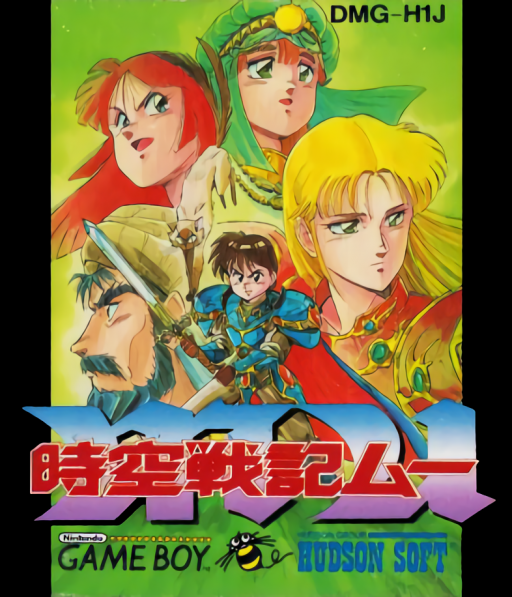
Jikuu Senki Mu
Jikuu Senki Mu is a Game Boy role-playing game released in 1991 developed by Hudson Soft. It centers on area exploration, combat and party setup, and character progression, with controls, information, and pacing arranged around a monochrome small screen, a directional pad, and two main action buttons.
- AI score · out of 10
- 6.5 / 10
About this game
Jikuu Senki Mu is a Game Boy role-playing release centered on area exploration, combat and party setup, and character progression. Story beats, exploration, and progression resources support a longer campaign, with progress divided into stages, tasks, matches, or growth milestones that make its immediate goals understandable. Its value depends on whether these rules continue to create judgment and room for mastery rather than on campaign length or series recognition. Short campaigns are judged by repeat-challenge value, while longer ones are judged by variety, pacing, and recovery after failure. Characters, world building, maps, and music carry most of the atmosphere, while silhouettes, contrast, and audio cues need to remain clear on the monochrome display. The main genre-specific friction is that dense text, menu layers, repeated battles, and language dependence can slow progress. In addition, password or battery saves, link-cable requirements, display blur, manual dependence, and regional language can affect use of the original cartridge today. This description covers only this release and excludes emulator features, modern-port conveniences, and content from other platforms.
Recommended games
Related game recommendations on this platform
Game Boy (GB)

AI review
AI reviews are subjective assessments, not player ratings. See each review for its evidence and limitations.Published date:
Inventive shared growth and character events constrained by encounters and inventory friction.
Mu's appeal lies less in its large roster than in character events that intersect, unlock class changes and sometimes alter appearance. Shared levels let new recruits contribute immediately, making four-person party composition and distributed teams worth experimenting with. Distinctive boss artwork, music and conditional dialogue add personality. Managing that ambition is harder: each party holds only eight items, transfers require a storage facility, and event objects crowd out recovery supplies. Reaching an occupied town does not provide rest until its boss is defeated. Frequent encounters and sequential enemy entrances repeatedly slow the journey despite dash movement and saving. The companion stories offer warmth, but the main antagonists and religious mystery receive weaker explanations. Patient Japanese-language RPG players may appreciate the ideas while accepting substantial inventory and travel friction.
Strengths
- Shared levels make new recruits immediately useful.
- Linked character events, class changes and conditional dialogue give parties personality.
Weaknesses
- Eight-item inventories and storage transfers restrict coordination; locked town services, frequent encounters and entrance waits slow exploration, with weak main-story explanations.
Who it is for: Japanese-language RPG players who enjoy party and character-event planning despite repeated battles.
Play notes: This is the Japanese original GB game with one save. Occupied towns do not immediately unlock healing or travel registration; prepare supplies before exploring.
View scoring basis
| Dimension | Review state | Score | Weight |
|---|---|---|---|
| Dimension Linked character events and town liberation provide purpose, but arriving at a town without access to recovery makes exploration demanding. | Reviewed | 6.7 / 10 | Not provided |
| Dimension Shared levels ease recruitment and party composition has value, but tight inventories and storage-mediated transfers complicate coordination. | Reviewed | 6.6 / 10 | Not provided |
| Dimension Enemy entrances, final-boss artwork, boss themes and conditional dialogue add identity, but repetitive battle music and thin main-story explanations weaken immersion. | Reviewed | 6.6 / 10 | Not provided |
| Dimension Dash movement and saving support exploration, but repeated encounter introductions substantially erode that convenience. | Reviewed | 5.8 / 10 | Not provided |
Review sources
Not provided
Core information
- Developer
- Hudson Soft
- Publisher
- Hudson Soft
- Release date
- 1991
- Platforms
- Game Boy (GB)
- Content kind
- Game
- Release state
- Released
- Region
- Worldwide
- Official website
- Not provided
- Offline minimum players
- Not provided
- Offline maximum players
- Not provided
- Online minimum players
- Not provided
- Online maximum players
- Not provided
- Categories
- Role-Playing · Primary genre
- Tags
- FantasyMain Story 20–50 HoursLevel ProgressionTop-downTurn-based CombatExplorationLong-term ProgressionSolo-friendly2D GraphicsCreature Collection and TrainingStory-driven
- Supported game languages
- Not provided
- Requires base game
- Not provided
- Standalone
- Not provided
- Age ratings
- Not provided
- Play modes
- Single player
- Perspectives
- Not provided
Release editions
- Game Boy (GB)Worldwide1991
Game gallery
Sources
Not provided