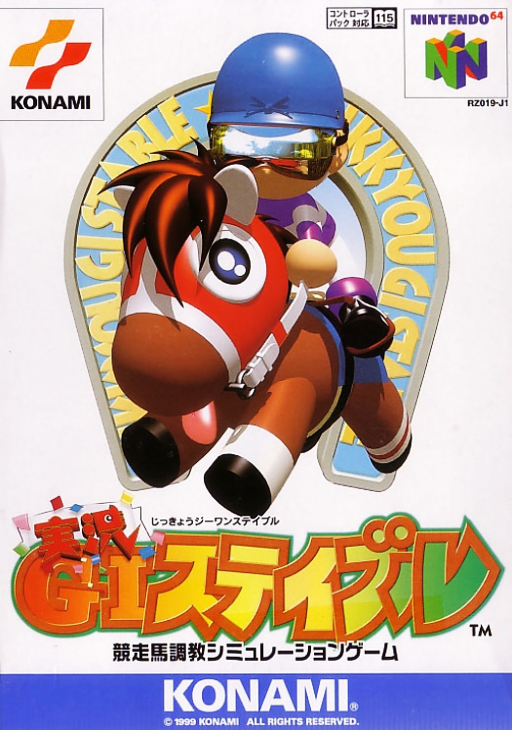
Jikkyou G1 Stable
Jikkyou G1 Stable is a Nintendo 64 sports game released in 1999 developed by Konami. It centers on sport controls, shifts between attack and defense, and score or tournament goals, with controls, information, and pacing arranged around the analog stick, directional pad, A/B buttons, C buttons, and Z trigger.
- AI score · out of 10
- 6.8 / 10
About this game
Jikkyou G1 Stable is a Nintendo 64 sports game centered on sport controls, shifts between attack and defense, and score or tournament goals. Matches, challenges, and tournament goals give sessions clear boundaries, with progress divided into stages, tasks, matches, or growth milestones that make its immediate goals understandable. Its value depends on whether these rules continue to create judgment and room for mastery rather than on length, sales, or series recognition. Short campaigns are judged by repeat-challenge value, while longer ones are judged by variety, pacing, and recovery after failure. Players, venues, motion recognition, and score feedback establish the match atmosphere, while 3D scenes, fog, textures, and cartridge audio need to preserve target readability within limited memory and television output. The genre-specific limitation is that opponent ai, control precision, motion recognition, and period-specific rosters can affect consistency. Platform conditions also include camera control, stick precision, Controller Pak saves, Rumble Pak support, Expansion Pak requirements, and four-player setup can affect original-hardware use. This description covers only this platform release and does not import features from other editions.
Recommended games
Related game recommendations on this platform
Nintendo 64
AI review
AI reviews are subjective assessments, not player ratings. See each review for its evidence and limitations.Published date:
Horse and staff development offer meaningful management choices, but scheduling friction and race feedback limit sustained returns.
Jikkyou G1 Stable connects horse development with staff management. Breeding, auctions and training are joined by compatibility and entrusted-horse care, making success about more than choosing the strongest prospect. Staff growth and overseas G1 ambitions give management a continuing direction. Status checks, training adjustments, race selection and jockey choices provide concrete tools for planning. However, reported early fatigue can disrupt schedules, while poorly explained defeats and overly effective late charges weaken the connection between preparation and results. The refined quarter-view stable and cute horses create an approachable style, but number-based calls and repeated commentary during runaway leads make races less distinctive. It suits players willing to learn the management relationships and accept uncertainty; those seeking transparent competitive feedback and vivid race tension may find it less satisfying.
Strengths
- Horse, staff and entrusted-horse trust systems create interconnected management decisions.
- Development, auctions and overseas ambitions give continued management direction.
- Status, training, entry and jockey tools are solid, with an approachable stable setting.
Weaknesses
- Early fatigue and staff compatibility can interrupt planned schedules.
- Poorly explained defeats and strong late charges weaken transparent strategic feedback.
- Number-based and repeated commentary limit race individuality and tension.
Who it is for: Players who enjoy horse development and staff management, will learn compatibility and entry rules, and can accept imperfectly transparent race results.
Play notes: The original Japanese 1999 N64 release requires a Controller Pak for saving. Choose eligible races yourself and consider horse condition and staff compatibility when planning training and entries.
View scoring basis
| Dimension | Review state | Score | Weight |
|---|---|---|---|
| Dimension Horse, staff and overseas objectives sustain management, with breeding and auctions providing varied preparation. Reported early fatigue and compatibility constraints interrupt scheduling, however. The loop supports sustained involvement, but planned progression is not consistently smooth. | Reviewed | 6.4 / 10 | Not provided |
| Dimension Breeding, training, staff compatibility and entrusted-horse trust create substantial management decisions. Strong late-charge tactics and poorly explained defeats weaken the transparency of strategic returns. The core systems are solid, but race feedback and balance have noticeable limitations. | Reviewed | 6.8 / 10 | Not provided |
| Dimension The refined quarter-view stable and cute horses establish an approachable style, without realism being a requirement. Number-based calls and repeated commentary during runaway leads weaken race individuality and tension. Expression works overall, but races are less evocative than the management setting. | Reviewed | 6.8 / 10 | Not provided |
| Dimension Native commands cover status checks, training adjustments, race entries and jockey choice, with staff inquiries supporting management. The player's solid-command assessment supports good usability. Players still need to understand eligibility and prepare a Controller Pak to retain progress. | Reviewed | 7.3 / 10 | Not provided |
Review sources
Not provided
Core information
- Developer
- Konami
- Publisher
- Konami
- Release date
- 1999
- Platforms
- Nintendo 64
- Content kind
- Game
- Release state
- Released
- Region
- Worldwide
- Official website
- Not provided
- Offline minimum players
- Not provided
- Offline maximum players
- Not provided
- Online minimum players
- Not provided
- Online maximum players
- Not provided
- Categories
- Sports · Primary genre
- Tags
- Low Entry BarrierPlayer versus PlayerMain Story Under 10 HoursSolo-friendlyShort SessionsPick-up and Play3D GraphicsReplayableFast-pacedSports-based Play
- Supported game languages
- Not provided
- Requires base game
- Not provided
- Standalone
- Not provided
- Age ratings
- Not provided
- Play modes
- Not provided
- Perspectives
- Not provided
Release editions
- Nintendo 64Worldwide1999
Game gallery
Sources
Not provided