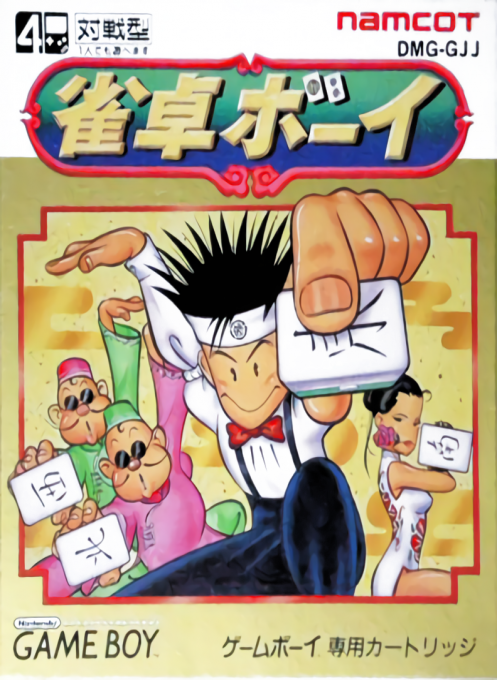
Jantaku Boy
Jantaku Boy is a Game Boy puzzle game released in 1992 developed by Bandai Namco Entertainment. It centers on card or board-game rules, rule recognition, and spatial or logical judgment, with controls, information, and pacing arranged around a monochrome small screen, a directional pad, and two main action buttons.
- AI score · out of 10
- 6.8 / 10
About this game
Jantaku Boy is a Game Boy puzzle release centered on card or board-game rules, rule recognition, and spatial or logical judgment. Compact stages add conditions and tighter constraints over time, with progress divided into stages, tasks, matches, or growth milestones that make its immediate goals understandable. Its value depends on whether these rules continue to create judgment and room for mastery rather than on campaign length or series recognition. Short campaigns are judged by repeat-challenge value, while longer ones are judged by variety, pacing, and recovery after failure. Graphics, audio cues, and state feedback need to support decisions directly, while silhouettes, contrast, and audio cues need to remain clear on the monochrome display. The main genre-specific friction is that limited explanations, repetition, or abrupt difficulty can stall progress. In addition, password or battery saves, link-cable requirements, display blur, manual dependence, and regional language can affect use of the original cartridge today. This description covers only this release and excludes emulator features, modern-port conveniences, and content from other platforms.
Recommended games
Related game recommendations on this platform
Game Boy (GB)
AI review
AI reviews are subjective assessments, not player ratings. See each review for its evidence and limitations.Published date:
Straightforward portable mahjong with limited modes.
Jantaku Boy on Game Boy aims to provide orthodox four-player Japanese mahjong rather than a story or a special-rule variation. An owner’s account of the cartridge and its manual describes reasonably readable tiles, responsive basic controls and light music that helps long table sessions. A winning tournament extends across four half-games, giving a session a definite goal and meaningful time commitment. The mode selection is small, however, so most long-term enjoyment depends on the underlying mahjong decisions rather than inventive software additions. Human four-player play is supported under the original hardware arrangement, but the account specifies four Game Boys and four copies of the cartridge. That is a significant practical barrier for a spontaneous gathering today. This judgment concerns the 1992 Japanese Game Boy release. The available direct evidence does not establish detailed computer-opponent strength or any modern emulator networking behavior, and those claims are deliberately excluded. Players already comfortable with Japanese mahjong have more reason to value this clean portable table than newcomers seeking extensive teaching or many modes.
Strengths
- Readable tiles, simple control and a tournament goal.
Weaknesses
- Few modes and demanding original multiplayer hardware.
Who it is for: Mahjong players who want traditional handheld sessions.
Play notes: Japanese GB cartridge account; opponent AI details unverified.
View scoring basis
| Dimension | Review state | Score | Weight |
|---|---|---|---|
| Dimension A tournament goal is tempered by a slim mode list. | Reviewed | 6.5 / 10 | Not provided |
| Dimension Traditional table play works without much invention. | Reviewed | 7.0 / 10 | Not provided |
| Dimension Legible tiles and light music suit portable mahjong. | Reviewed | 6.9 / 10 | Not provided |
| Dimension Handheld controls are simple; multiplayer setup is costly. | Reviewed | 6.8 / 10 | Not provided |
Review sources
Not provided
Core information
- Developer
- Bandai Namco
- Publisher
- Bandai Namco
- Release date
- 1992
- Platforms
- Game Boy (GB)
- Content kind
- Game
- Release state
- Released
- Region
- Worldwide
- Official website
- Not provided
- Offline minimum players
- Not provided
- Offline maximum players
- Not provided
- Online minimum players
- Not provided
- Online maximum players
- Not provided
- Categories
- Puzzle · Primary genre
- Tags
- Player versus PlayerBoard and Tabletop PlayTop-downReplayablePuzzle SolvingSolo-friendlyTurn-based Combat
- Supported game languages
- Not provided
- Requires base game
- Not provided
- Standalone
- Not provided
- Age ratings
- Not provided
- Play modes
- Single playerMultiplayer
- Perspectives
- Top-down
Release editions
- Game Boy (GB)Worldwide1992
Game gallery
Sources
Not provided