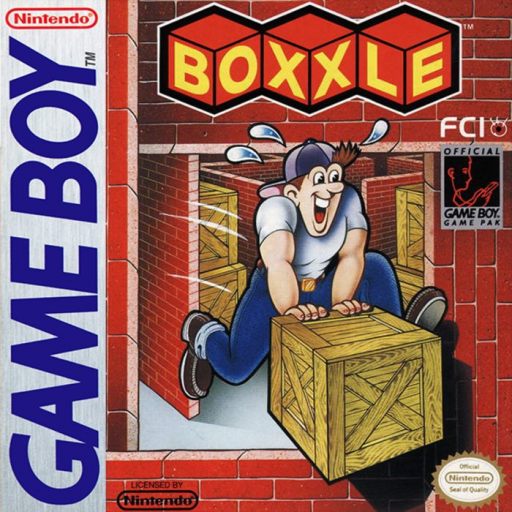
Boxxle
Boxxle is a Game Boy puzzle game released in 1989 developed by Thinking Rabbit. It centers on rule recognition, spatial or logical judgment, and successive puzzle solving, with controls, information, and pacing arranged around a monochrome small screen, a directional pad, and two main action buttons.
- AI score · out of 10
- 7.1 / 10
About this game
Boxxle is a Game Boy puzzle release centered on rule recognition, spatial or logical judgment, and successive puzzle solving. Compact stages add conditions and tighter constraints over time, with progress divided into stages, tasks, matches, or growth milestones that make its immediate goals understandable. Its value depends on whether these rules continue to create judgment and room for mastery rather than on campaign length or series recognition. Short campaigns are judged by repeat-challenge value, while longer ones are judged by variety, pacing, and recovery after failure. Graphics, audio cues, and state feedback need to support decisions directly, while silhouettes, contrast, and audio cues need to remain clear on the monochrome display. The main genre-specific friction is that limited explanations, repetition, or abrupt difficulty can stall progress. In addition, password or battery saves, link-cable requirements, display blur, manual dependence, and regional language can affect use of the original cartridge today. This description covers only this release and excludes emulator features, modern-port conveniences, and content from other platforms.
Recommended games
Related game recommendations on this platform
Game Boy (GB)

AI review
AI reviews are subjective assessments, not player ratings. See each review for its evidence and limitations.Published date:
Solid box-pushing puzzles that can become monotonous.
Boxxle keeps its rules economical: boxes can only be pushed, marked destinations are visible, and a wrong move may block the entire route. Those restrictions turn ordinary warehouses into spatial problems that reward careful ordering, while the step counter encourages finding cleaner solutions. The large puzzle collection provides plenty to practise. You can switch between stages within a group when stuck, and the Start menu and passwords support restarts and separate sessions. An editor gives enthusiastic players another outlet. Variety primarily comes from layouts rather than new mechanics, however, and completing every puzzle in a group is required to advance. Basic graphics are usable but larger views look coarse, while repeated music is tiring during long sittings. Patient puzzle fans should take it at their own pace and check whether their custom creations are actually solvable.
Strengths
- Meaningful push-order reasoning
- Large collection and editor
Weaknesses
- Repetitive loop and music
- No custom-level solvability check
Who it is for: Patient box-puzzle players interested in optimising layouts.
Play notes: Presentation observations cover37 played puzzles; group completion and manual passwords apply.
View scoring basis
| Dimension | Review state | Score | Weight |
|---|---|---|---|
| Dimension A large collection and editor help, though group gates and one objective limit variety. | Reviewed | 7.6 / 10 | Not provided |
| Dimension Push-only boxes create meaningful spatial reasoning. | Reviewed | 7.8 / 10 | Not provided |
| Dimension Functional pieces are let down by coarse large views and repetitive music. | Reviewed | 4.9 / 10 | Not provided |
| Dimension Practical controls and restarts help, though custom levels lack solvability checks. | Reviewed | 7.4 / 10 | Not provided |
Review sources
Not provided
Core information
- Developer
- Thinking Rabbit
- Publisher
- Atelier DoubleFCIRiverhillsoft
- Release date
- 1989
- Platforms
- Game Boy (GB)
- Content kind
- Game
- Release state
- Released
- Region
- Worldwide
- Official website
- Not provided
- Offline minimum players
- Not provided
- Offline maximum players
- Not provided
- Online minimum players
- Not provided
- Online maximum players
- Not provided
- Categories
- Puzzle · Primary genre
- Tags
- Low Entry BarrierPuzzle SolvingShort SessionsResource ManagementPick-up and PlaySolo-friendly2D GraphicsTop-downReplayableSlow Burn
- Supported game languages
- Not provided
- Requires base game
- Not provided
- Standalone
- Not provided
- Age ratings
- Not provided
- Play modes
- Single player
- Perspectives
- Top-down
Release editions
- Game Boy (GB)Worldwide1989
Game gallery
Sources
Not provided