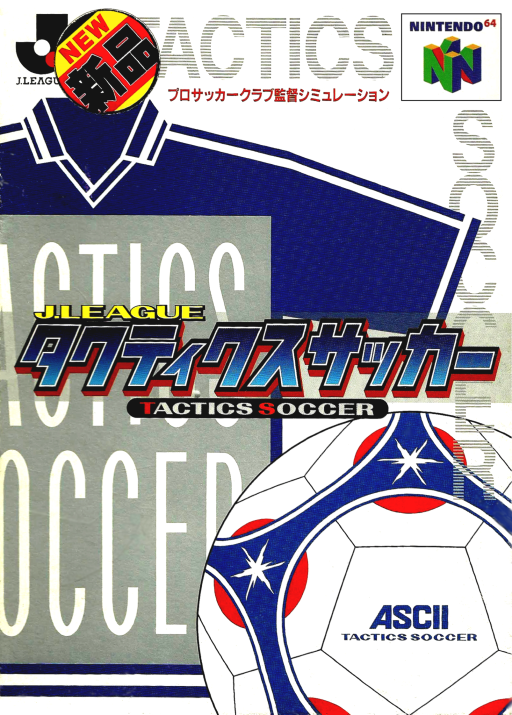
J.League Tactics Soccer
J.League Tactics Soccer is a Nintendo 64 sports game released in 1999 developed by ASCII Corporation. It centers on competitive sport or physical training, sport controls, and shifts between attack and defense, with controls, information, and pacing arranged around the analog stick, directional pad, A/B buttons, C buttons, and Z trigger.
- AI score · out of 10
- 6.9 / 10
About this game
J.League Tactics Soccer is a Nintendo 64 sports game centered on competitive sport or physical training, sport controls, and shifts between attack and defense. Matches, challenges, and tournament goals give sessions clear boundaries, with progress divided into stages, tasks, matches, or growth milestones that make its immediate goals understandable. Its value depends on whether these rules continue to create judgment and room for mastery rather than on length, sales, or series recognition. Short campaigns are judged by repeat-challenge value, while longer ones are judged by variety, pacing, and recovery after failure. Players, venues, motion recognition, and score feedback establish the match atmosphere, while 3D scenes, fog, textures, and cartridge audio need to preserve target readability within limited memory and television output. The genre-specific limitation is that opponent ai, control precision, motion recognition, and period-specific rosters can affect consistency. Platform conditions also include camera control, stick precision, Controller Pak saves, Rumble Pak support, Expansion Pak requirements, and four-player setup can affect original-hardware use. This description covers only this platform release and does not import features from other editions.
Recommended games
Related game recommendations on this platform
Nintendo 64
AI review
AI reviews are subjective assessments, not player ratings. See each review for its evidence and limitations.Published date:
Detailed opening management offers involvement, with rough portraits and demanding preparation.
J.League Tactics Soccer builds involvement around decisions from the touchline. Creating up to three players, distributing attributes and replacing squad members gives the opening a personal stake. Specific training and mental preparation add choices before a practice match, with weather also affecting that process. Matches run automatically, but attacking areas, passing tempo and substitutions remain available to the manager. The documented opening therefore offers a coherent preparation-and-observation loop, although its dense duties demand patience. Rough player faces make the squad less appealing; observed match movement is serviceable. One penalty displays a different foot from the created player's setting, an isolated feedback concern rather than proof of a universal fault. Concrete native menu use is documented, and saving requires a separate Controller Pak. This assessment uses an N64 hardware account covering three weeks and one practice match, not a verified judgement of full-season balance.
Strengths
- Player creation and layered training make preparation involving.
- Automatic matches retain meaningful managerial commands.
Weaknesses
- Dense preparation requires patience before matches.
- Rough portraits and one attribute-display mismatch reduce clarity.
Who it is for: Players who prefer squad building, training and touchline management to direct football action.
Play notes: Controller Pak needed for saves; long-season balance is outside the documented opening sample.
View scoring basis
| Dimension | Review state | Score | Weight |
|---|---|---|---|
| Dimension Player customization and layered training give the opening a useful progression toward a match. Dense preparation demands patience, while the evidence does not establish either repetitive seasons or broken balance. | Reviewed | 7.0 / 10 | Not provided |
| Dimension Preparation and in-match instructions create a coherent manager's loop without requiring direct football execution. The opening sample supports good involvement, not a guarantee of long-season numerical balance. | Reviewed | 7.2 / 10 | Not provided |
| Dimension Rough player portraits weaken attachment to a customized squad, while the observed match movement remains serviceable. The expression is adequate rather than a distinctive attraction; unseen opening footage and music are not assessed. | Reviewed | 6.2 / 10 | Not provided |
| Dimension Documented menus and match commands provide functional use, while saving requires a separate Controller Pak. One displayed-foot mismatch clouds feedback but does not establish a systemic AI, input or hardware defect. | Reviewed | 6.6 / 10 | Not provided |
Review sources
Not provided
Core information
- Developer
- ASCII
- Publisher
- ASCII
- Release date
- 1999
- Platforms
- Nintendo 64
- Content kind
- Game
- Release state
- Released
- Region
- Worldwide
- Official website
- Not provided
- Offline minimum players
- Not provided
- Offline maximum players
- Not provided
- Online minimum players
- Not provided
- Online maximum players
- Not provided
- Categories
- Sports · Primary genre
- Tags
- Sports-based Play3D GraphicsLow Entry BarrierReplayableSolo-friendlyFast-pacedShort SessionsPlayer versus PlayerMain Story Under 10 HoursPick-up and Play
- Supported game languages
- Not provided
- Requires base game
- Not provided
- Standalone
- Not provided
- Age ratings
- Not provided
- Play modes
- Single player
- Perspectives
- Not provided
Release editions
- Nintendo 64Worldwide1999
Game gallery
Sources
Not provided