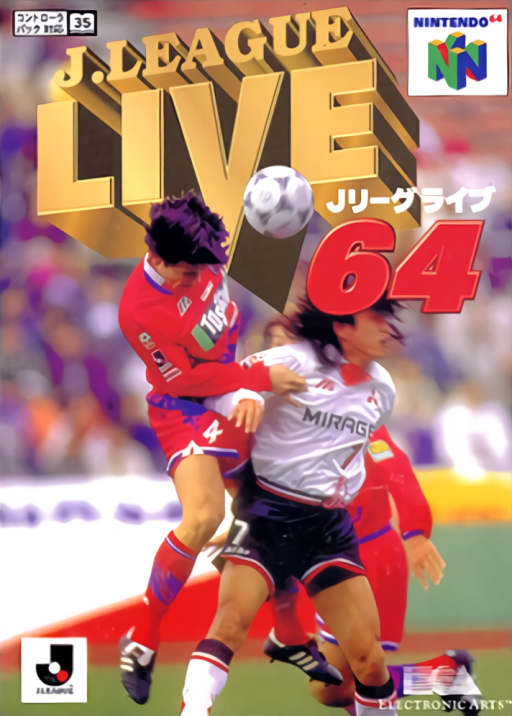
J.League Live 64
J.League Live 64 is a Nintendo 64 sports game released in 1997 developed by Electronic Arts. It centers on competitive sport or physical training, sport controls, and shifts between attack and defense, with controls, information, and pacing arranged around the analog stick, directional pad, A/B buttons, C buttons, and Z trigger.
- AI score · out of 10
- 5.9 / 10
About this game
J.League Live 64 is a Nintendo 64 sports game centered on competitive sport or physical training, sport controls, and shifts between attack and defense. Matches, challenges, and tournament goals give sessions clear boundaries, with progress divided into stages, tasks, matches, or growth milestones that make its immediate goals understandable. Its value depends on whether these rules continue to create judgment and room for mastery rather than on length, sales, or series recognition. Short campaigns are judged by repeat-challenge value, while longer ones are judged by variety, pacing, and recovery after failure. Players, venues, motion recognition, and score feedback establish the match atmosphere, while 3D scenes, fog, textures, and cartridge audio need to preserve target readability within limited memory and television output. The genre-specific limitation is that opponent ai, control precision, motion recognition, and period-specific rosters can affect consistency. Platform conditions also include camera control, stick precision, Controller Pak saves, Rumble Pak support, Expansion Pak requirements, and four-player setup can affect original-hardware use. This description covers only this platform release and does not import features from other editions.
Recommended games
Related game recommendations on this platform
Nintendo 64
AI review
AI reviews are subjective assessments, not player ratings. See each review for its evidence and limitations.Published date:
Match organization, lineup choices and replay provide a framework, but passing, opponent behavior and handling friction weaken the football.
J.League Live 64 offers single matches, tournaments, full or half seasons and penalties, with lineup changes, substitutions and tactics supporting different commitments. Movement and deliberate directional passing receive praise, but another player encounters passes behind the player or into space and opponents supplying chances inside their own box. Attacks therefore do not reliably unfold as planned. Score, player names and colorful goal text help follow matches; recognizable Japanese crowd calls lose naturalness through flat delivery. Pause supports camera changes and reviewing recent action forward or backward. Many views nevertheless suit play poorly, while complex inputs and repeated-button dashing add burden. Choosing television view and a suitable mapping helps, but it is better suited to adaptable J.League enthusiasts than players seeking smooth, convincing football exchanges.
Strengths
- Single matches, season-length choices and tournaments support different time commitments.
- Lineup changes, substitutions and tactics provide match-planning choices.
- Pause replay, score and player information help follow the action.
Weaknesses
- Misplaced passes and poor opponent decisions weaken credible exchanges.
- Complex inputs, repeated-button dashing and unsuitable views create friction.
- Distinctive crowd calls sound flat rather than natural.
Who it is for: Players interested in the original J.League atmosphere who will adapt mappings and views and tolerate rougher attacking and defensive behavior.
Play notes: This assesses the 1997 Japanese N64 software, not Western FIFA 64 or another J.League game. Beginner uses the D-pad rather than analog movement; check controls and camera first. The original owner lists a 35-page Controller Pak requirement, so prepare appropriate storage for continued play.
View scoring basis
| Dimension | Review state | Score | Weight |
|---|---|---|---|
| Dimension Single matches, season lengths and knockout play offer different commitments, with lineup changes and substitutions supporting continuing competition. Penalties provide focused contests. Content is sound enough through clear match structures, allowing players to organize competitions and teams around their available commitment. | Reviewed | 6.8 / 10 | Not provided |
| Dimension Directional passing, tactics and appreciated movement give attack construction a foundation. Observed misplaced passes and poor opponent decisions nevertheless undermine credible exchanges. The weak core does not link plans to outcomes reliably enough, rather than merely being complex or simulation-oriented. | Reviewed | 5.2 / 10 | Not provided |
| Dimension Explicit score and player-name information helps follow matches, while Japanese crowd calls establish a distinctive stadium feel. Flat vocal delivery weakens naturalness. Expression is sound enough, with information and atmosphere highlights rather than especially convincing performance. | Reviewed | 6.7 / 10 | Not provided |
| Dimension Pause replay, television view and three mappings offer useful choices. Complex inputs, repeated-button dashing and unsuitable camera options nevertheless create substantial friction, while Beginner requires awareness that analog movement is unavailable. Usability is weak: practical aids do not sufficiently offset routine handling burdens. | Reviewed | 5.4 / 10 | Not provided |
Review sources
Not provided
Core information
- Developer
- Electronic Arts
- Publisher
- Electronic Arts
- Release date
- 1997
- Platforms
- Nintendo 64
- Content kind
- Game
- Release state
- Released
- Region
- Worldwide
- Official website
- Not provided
- Offline minimum players
- Not provided
- Offline maximum players
- Not provided
- Online minimum players
- Not provided
- Online maximum players
- Not provided
- Categories
- Sports · Primary genre
- Tags
- Solo-friendlyPlayer versus PlayerFast-pacedPick-up and PlayReplayableLow Entry Barrier3D GraphicsShort SessionsMain Story Under 10 HoursSports-based Play
- Supported game languages
- Not provided
- Requires base game
- Not provided
- Standalone
- Not provided
- Age ratings
- Not provided
- Play modes
- MultiplayerSingle player
- Perspectives
- Top-down
Release editions
- Nintendo 64Worldwide1997
Game gallery
Sources
Not provided