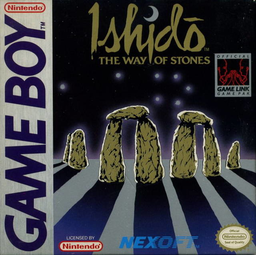
Ishido - The Way of Stones
Ishido - The Way of Stones is a Game Boy strategy game released in 1990 developed by Publishing International. It centers on turn-based tactical decisions, battlefield assessment, and unit or resource management, with controls, information, and pacing arranged around a monochrome small screen, a directional pad, and two main action buttons.
- AI score · out of 10
- 6.8 / 10
About this game
Ishido - The Way of Stones is a Game Boy strategy release centered on turn-based tactical decisions, battlefield assessment, and unit or resource management. Missions add map constraints, new rules, and tougher opposition, with progress divided into stages, tasks, matches, or growth milestones that make its immediate goals understandable. Its value depends on whether these rules continue to create judgment and room for mastery rather than on campaign length or series recognition. Short campaigns are judged by repeat-challenge value, while longer ones are judged by variety, pacing, and recovery after failure. Maps, unit states, and action feedback determine whether complex situations remain readable, while silhouettes, contrast, and audio cues need to remain clear on the monochrome display. The main genre-specific friction is that brief tutorials, dense menus, and long scenarios increase the learning curve. In addition, password or battery saves, link-cable requirements, display blur, manual dependence, and regional language can affect use of the original cartridge today. This description covers only this release and excludes emulator features, modern-port conveniences, and content from other platforms.
Recommended games
Related game recommendations on this platform
Game Boy (GB)
AI review
AI reviews are subjective assessments, not player ratings. See each review for its evidence and limitations.Published date:
Thoughtful stone placement with limits to competition and presentation.
Ishido asks you to fit seventy-two stones onto a ninety-six-cell board by matching symbols and backgrounds. Its appeal lies beyond finding a legal square: preserving future options competes with preparing valuable multi-sided matches. An awkward draw can force you to abandon an elegant setup, making adaptation part of the strategy. There is no countdown pressure, which suits patient thought, although repeated sessions revolve around the same focused loop. Computer and friend play add alternatives, but a shared stone bag leaves competitive results sensitive to draw order. Three stone styles and four music tracks supply personality without consistent comfort; alternate patterns can clutter the small screen and musical reactions vary sharply. Default stones and convenient same-system play are the safer starting point.
Strengths
- Scoring setups compete meaningfully with preserving space.
- Unhurried play and same-system multiplayer are convenient.
Weaknesses
- A focused loop repeats and competitive results depend on draws.
- Alternate stones can clutter the display; music is divisive.
Who it is for: Puzzle players who enjoy unhurried spatial planning and accept random draws.
Play notes: Start with default stones on original GB; alternatives may be cluttered. Shared-bag multiplayer is not fully controllable competition, and lowering volume may suit some listeners.
View scoring basis
| Dimension | Review state | Score | Weight |
|---|---|---|---|
| Dimension Alternative opponents broaden replay, but the focused loop and shared draw luck limit competitive control. | Reviewed | 6.4 / 10 | Not provided |
| Dimension Scoring setups versus open placement options create strong spatial choices, with random draws demanding adaptation. | Reviewed | 7.4 / 10 | Not provided |
| Dimension Stone styles and varied music give personality, but listening comfort is divisive and some sets lack consistent clarity. | Reviewed | 6.3 / 10 | Not provided |
| Dimension Same-system play is convenient and default stones are workable, while alternative patterns can burden small-screen scanning. | Reviewed | 6.7 / 10 | Not provided |
Review sources
Not provided
Core information
- Developer
- Publishing International
- Publisher
- ASCII
- Release date
- 1990
- Platforms
- Game Boy (GB)
- Content kind
- Game
- Release state
- Released
- Region
- Worldwide
- Official website
- Not provided
- Offline minimum players
- Not provided
- Offline maximum players
- Not provided
- Online minimum players
- Not provided
- Online maximum players
- Not provided
- Categories
- Strategy & Tactics · Primary genre
- Tags
- Solo-friendlyTop-downShort SessionsParty-friendlySlow BurnReplayablePuzzle SolvingTurn-based Tactics2D GraphicsPlayer versus PlayerBoard and Tabletop Play
- Supported game languages
- Not provided
- Requires base game
- Not provided
- Standalone
- Not provided
- Age ratings
- Not provided
- Play modes
- MultiplayerSingle player
- Perspectives
- Top-down
Release editions
- Game Boy (GB)Worldwide1990
Game gallery
Sources
Not provided