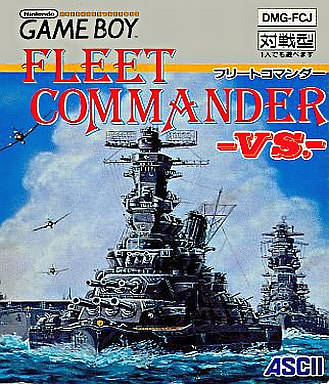
Fleet Commander VS.
Fleet Commander VS. is a Game Boy strategy game released in 1991 developed by ASCII Corporation. It centers on combat encounters, area and route exploration, and turn-based tactical decisions, with controls, information, and pacing arranged around a monochrome small screen, a directional pad, and two main action buttons.
- AI score · out of 10
- 6.7 / 10
About this game
Fleet Commander VS. is a Game Boy strategy release centered on combat encounters, area and route exploration, and turn-based tactical decisions. Missions add map constraints, new rules, and tougher opposition, with progress divided into stages, tasks, matches, or growth milestones that make its immediate goals understandable. Its value depends on whether these rules continue to create judgment and room for mastery rather than on campaign length or series recognition. Short campaigns are judged by repeat-challenge value, while longer ones are judged by variety, pacing, and recovery after failure. Maps, unit states, and action feedback determine whether complex situations remain readable, while silhouettes, contrast, and audio cues need to remain clear on the monochrome display. The main genre-specific friction is that brief tutorials, dense menus, and long scenarios increase the learning curve. In addition, password or battery saves, link-cable requirements, display blur, manual dependence, and regional language can affect use of the original cartridge today. This description covers only this release and excludes emulator features, modern-port conveniences, and content from other platforms.
Recommended games
Related game recommendations on this platform
Game Boy (GB)
AI review
AI reviews are subjective assessments, not player ratings. See each review for its evidence and limitations.Published date:
Useful map-based planning undermined by conspicuous fleet imbalance.
Fleet Commander VS. turns naval combat into alternating decisions about individual units, giving positioning a meaningful role. Its three maps change more than scenery: a beginner-friendly layout, an unfavorable opening and shallow waters create different deployment problems, while two-player play offers an alternative to computer opposition. The weakness is fleet balance. Battleships dominate, aircraft contribute little, and even carriers can be more effective firing their guns, reducing the reward for a varied force. The status screen separates each faction's remaining unit counts and shows the day, while concluding naval scenes and Japanese battle reports give victory some atmosphere. Built-in GB saving makes longer battles practical to resume. It suits deliberate positional play more than expectations of evenly balanced air and surface warfare.
Strengths
- Alternating individual-unit decisions make positioning meaningful.
- Different opening conditions and shallow waters support tactical replay.
- Built-in GB saving makes extended battles easier to resume.
Weaknesses
- Dominant battleships and weak aircraft limit the value of mixed fleets.
Who it is for: Naval strategy players who enjoy deliberate positioning and varied starting conditions, and can accept uneven unit usefulness.
Play notes: This covers the original Japanese GB software, not the NES edition. Use the original link setup for two-player play; single-player saving does not require a NES Turbo File. Unit names and battle reports use Japanese.
View scoring basis
| Dimension | Review state | Score | Weight |
|---|---|---|---|
| Dimension Three maps vary opening circumstances or shallow-water constraints, giving repeat play concrete deployment problems. Two-player play broadens opponent choice; the content's value lies in changed tactical situations rather than map quantity alone. | Reviewed | 7.1 / 10 | Not provided |
| Dimension Alternating individual-unit actions and different starting layouts support positional planning. Dominant battleships and weak aircraft narrow useful fleet choices, producing a functional tactical loop with conspicuous balance limitations. | Reviewed | 6.2 / 10 | Not provided |
| Dimension Separated faction counts make current forces easy to compare in the inspected status screen, and naval vignettes lend the ending a battle-report atmosphere. Its strengths are orderly information and concise scenes rather than elaborate spectacle. | Reviewed | 6.8 / 10 | Not provided |
| Dimension Built-in saving makes extended battles easier to resume without the NES storage peripheral. This is a meaningful convenience of the original GB software, with two-player sessions still needing their original setup. | Reviewed | 7.4 / 10 | Not provided |
Review sources
Not provided
Core information
- Developer
- ASCII
- Publisher
- ASCII
- Release date
- 1991
- Platforms
- Game Boy (GB)
- Content kind
- Game
- Release state
- Released
- Region
- Worldwide
- Official website
- Not provided
- Offline minimum players
- Not provided
- Offline maximum players
- Not provided
- Online minimum players
- Not provided
- Online maximum players
- Not provided
- Categories
- Strategy & Tactics · Primary genre
- Tags
- WarSlow Burn2D GraphicsLong-term ProgressionCommand-based CombatExplorationReplayableSolo-friendlyReal-time CombatResource ManagementTurn-based TacticsTop-down
- Supported game languages
- Not provided
- Requires base game
- Not provided
- Standalone
- Not provided
- Age ratings
- Not provided
- Play modes
- Not provided
- Perspectives
- Not provided
Release editions
- Game Boy (GB)Worldwide1991
Game gallery
Sources
Not provided