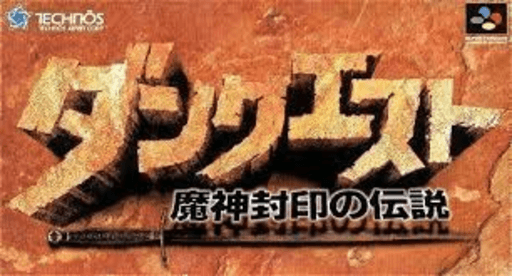
Dun Quest - Majin Fuuin no Densetsu
Dun Quest - Majin Fuuin no Densetsu is a Super Famicom role-playing game released in 1995 developed by Technōs Japan. It centers on area and route exploration, area exploration, and combat and party setup, with controls, information, and pacing arranged around television output, a directional pad, shoulder buttons, and a six-button controller.
- AI score · out of 10
- 5.8 / 10
About this game
Dun Quest - Majin Fuuin no Densetsu is a Super Famicom role-playing release centered on area and route exploration, area exploration, and combat and party setup. Story beats, exploration, and progression resources support a longer campaign, with progress divided into stages, tasks, matches, or growth milestones that make its immediate goals understandable. Its value depends on whether these rules continue to create judgment and room for mastery rather than on campaign length or series recognition. Short campaigns are judged by repeat-challenge value, while longer ones are judged by variety, pacing, and recovery after failure. Characters, world building, maps, and music carry most of the atmosphere, while sprite animation, scrolling, color, and chip-based audio jointly carry readability and atmosphere. The main genre-specific friction is that dense text, menu layers, repeated battles, and language dependence can slow progress. In addition, password or battery saves, multiplayer accessories, manual dependence, regional language, and cartridge enhancement chips can affect original-hardware use. This description covers only this release and excludes emulator features, modern-port conveniences, and content from other platforms.
Recommended games
Related game recommendations on this platform
Super Famicom / SNES
AI review
AI reviews are subjective assessments, not player ratings. See each review for its evidence and limitations.Published date:
An engaging town, increasingly routine exploration
Dun Quest advances through real-time combat and growth tied to enemy species and equipment use. Detailed townspeople, object descriptions, and comic side quests are more engaging than its conventional heroic framework, making returns to town worthwhile. Four fixed dungeons support alternating, progressively deeper visits, and the light pace suits players seeking modest pressure. Combat eventually loses tension: repeated attacks after baiting a miss handle many enemies, while an early valuable item can ease resource management considerably. Revisiting unchanged floors and bringing keys for chests gradually turns exploration into routine errands. There are no displayed floor maps, although fixed layouts make hand-drawn notes useful. Players comfortable reading Japanese dialogue and recording routes will find the town more rewarding than the fighting.
Strengths
- Detailed dialogue and comic side quests give the town personality
- Enemy-specific and equipment growth provide continuing rewards
Weaknesses
- Repeatable baiting and some early money routes weaken combat pressure
- Unmapped fixed floors and key preparation add repeated travel
Who it is for: Players who enjoy light action RPGs, Japanese dialogue, and keeping route notes.
Play notes: This is the original SFC four-dungeon version. Bring keys, alternate deeper visits, and keep your own floor maps.
View scoring basis
| Dimension | Review state | Score | Weight |
|---|---|---|---|
| Dimension Town conversations and side quests support the four-dungeon route, and brisk progress helps, though repeated floors and key-related returns become routine. | Reviewed | 5.8 / 10 | Not provided |
| Dimension Enemy-specific growth and equipment practice reward actions, but repeatable baiting and accessible resources limit sustained combat tension. | Reviewed | 5.7 / 10 | Not provided |
| Dimension Detailed dialogue, object text, and comic side events lend warmth to a conventional heroic story; the town's odd personality is its stronger impression. | Reviewed | 6.8 / 10 | Not provided |
| Dimension Missing floor maps make repeated exploration laborious; fixed layouts allow hand-drawn notes, but players must still manage navigation themselves. | Reviewed | 5.0 / 10 | Not provided |
Review sources
Not provided
Core information
- Developer
- Technos
- Publisher
- Technos
- Release date
- 1995
- Platforms
- Super Famicom / SNES
- Content kind
- Game
- Release state
- Released
- Region
- Worldwide
- Official website
- Not provided
- Offline minimum players
- Not provided
- Offline maximum players
- Not provided
- Online minimum players
- Not provided
- Online maximum players
- Not provided
- Categories
- Role-Playing · Primary genre
- Tags
- Long-term ProgressionTurn-based CombatTop-downExplorationLevel ProgressionSolo-friendlyFantasyStory-driven2D GraphicsMain Story 20–50 Hours
- Supported game languages
- Not provided
- Requires base game
- Not provided
- Standalone
- Not provided
- Age ratings
- Not provided
- Play modes
- Not provided
- Perspectives
- Not provided
Release editions
- Super Famicom / SNESWorldwide1995
Game gallery
Sources
Not provided