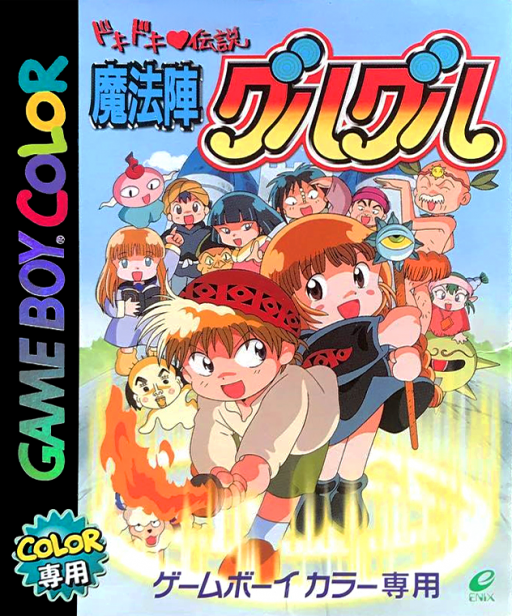
Dokidoki Densetsu - Mahoujin Guruguru
Dokidoki Densetsu - Mahoujin Guruguru is a Game Boy Color role-playing game released in 2000 developed by Square Enix. It centers on character or equipment growth, area exploration, and combat and party setup, with controls, information, and pacing arranged around a color handheld screen, a directional pad, and two main action buttons.
- AI score · out of 10
- 7.2 / 10
About this game
Dokidoki Densetsu - Mahoujin Guruguru is a Game Boy Color role-playing release centered on character or equipment growth, area exploration, and combat and party setup. Story beats, exploration, and progression resources support a longer campaign, with progress divided into stages, tasks, matches, or growth milestones that make its immediate goals understandable. Its value depends on whether these rules continue to create judgment and room for mastery rather than on campaign length or series recognition. Short campaigns are judged by repeat-challenge value, while longer ones are judged by variety, pacing, and recovery after failure. Characters, world building, maps, and music carry most of the atmosphere, while color choices need to distinguish characters, objects, and routes rather than serve as decoration alone. The main genre-specific friction is that dense text, menu layers, repeated battles, and language dependence can slow progress. In addition, battery saves, link cables, cartridge-specific hardware, the unlit display, and regional language can affect the original experience. This description covers only this release and excludes emulator features, modern-port conveniences, and content from other platforms.
Recommended games
Related game recommendations on this platform
Game Boy Color (GBC)
AI review
AI reviews are subjective assessments, not player ratings. See each review for its evidence and limitations.Published date:
Complementary attacks and spell growth work; replay returns to unchanged content.
Dokidoki Densetsu pairs two characters in dungeons, combining sword swings and charging with magic. Attack, trap, recovery and support spells have distinct purposes, while levels and hearts unlock further circles. Stronger effects consume more MP, making progression a resource choice rather than a change of names. Each chapter has one dungeon; clearing it prevents return, without important collectibles identified as missable in the completion account. The inspected event scene distinguishes costumes and poses against a layered forest path. Finishing carries character state into another run, useful for collecting magic, but content stays unchanged and full collection adds no reward. Documented attack and spell inputs support understandable operation. It suits players interested in complementary combat, spell growth and self-directed collection more than new second-run stages.
Strengths
- Distinct sword and spell roles connect stronger effects with MP trade-offs.
- Clear chapter progression avoids important collectible loss when return becomes impossible.
- Costumes and poses distinguish characters within a layered static forest scene.
Weaknesses
- Carryover replay adds no new content, and complete spell collection grants no additional reward.
Who it is for: Japanese-reading handheld RPG players who enjoy combining physical attacks and magic, developing abilities and pursuing spell collection as a self-chosen goal.
Play notes: Covers original Japanese 2000 GBC software. A attacks and charges; B plus directions selects magic. Cleared dungeons cannot be revisited, and second-run content is unchanged. Presentation uses limited static event imagery, not audio, animation or a current hardware test. Japanese rules need to be understood.
View scoring basis
| Dimension | Review state | Score | Weight |
|---|---|---|---|
| Dimension Chapter-based dungeons organize progress clearly, without important collectibles lost when returning becomes impossible. Carryover replay mainly serves magic collection: content remains unchanged and full collection adds no separate reward. Progression is functional, but its later variation is limited. | Reviewed | 6.8 / 10 | Not provided |
| Dimension Sword attacks, charging and distinct offensive, trap, recovery and support spells create complementary roles. Stronger effects cost more MP, connecting growth with resource choices and supporting good core design. This judges specific choices, not spell count as automatic depth or proof that every combination is equally effective. | Reviewed | 7.5 / 10 | Not provided |
| Dimension The inspected event frame differentiates the pair through costume colors, raised-hand and staff-bearing poses, while trees, sky and path form readable layers. Static character and scene expression is good within this observed composition; it does not establish overall cinematic, animation or musical quality. | Reviewed | 7.1 / 10 | Not provided |
| Dimension Distinct A attacks and B-plus-direction magic selection, an explained menu order, increasing MP costs and documented unlock conditions make the software's operation understandable. Usability is good on those specific rules; this does not claim tested performance, saving or surviving-cartridge reliability. | Reviewed | 7.2 / 10 | Not provided |
Review sources
Not provided
Core information
- Developer
- Square Enix
- Publisher
- Square Enix
- Release date
- 2000
- Platforms
- Game Boy Color (GBC)
- Content kind
- Game
- Release state
- Released
- Region
- Worldwide
- Official website
- Not provided
- Offline minimum players
- Not provided
- Offline maximum players
- Not provided
- Online minimum players
- Not provided
- Online maximum players
- Not provided
- Categories
- Role-Playing · Primary genre
- Tags
- Main Story 20–50 HoursLong-term ProgressionStory-drivenTop-downExplorationLevel ProgressionFantasy2D GraphicsTurn-based CombatSolo-friendly
- Supported game languages
- Not provided
- Requires base game
- Not provided
- Standalone
- Not provided
- Age ratings
- Not provided
- Play modes
- Single player
- Perspectives
- Not provided
Release editions
- Game Boy Color (GBC)Worldwide2000
Game gallery
Sources
Not provided