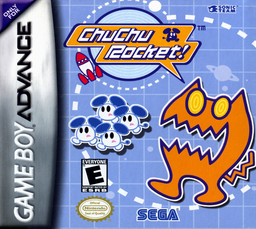
ChuChu Rocket!
The object of the game is to guide one or more mice ("ChuChus") around a board into one or more goals while avoiding cats ("KapuKapus") roaming the board. The mice and cats all move in predictable paths by always turning right when hitting a wall head on, by following corners or by turning around when in a dead end.
- AI score · out of 10
- 8.8 / 10
About this game
The object of the game is to guide one or more mice ("ChuChus") around a board into one or more goals while avoiding cats ("KapuKapus") roaming the board. The mice and cats all move in predictable paths by always turning right when hitting a wall head on, by following corners or by turning around when in a dead end. ChuChu Rocket!'s multiplayer mode revolves around up to four players placing arrows on the level at once, trying to direct mice into their own rockets and cats into other players' rockets (any cat that reaches a rocket removes a percentage of the mice within). Each player can only have three arrows on-screen at a time and cannot place them on other players' arrows or their own arrows. Arrows would disappear over time, or could be removed by a player placing his fourth arrow (which would eliminate the first arrow placed, thus leaving three). Although a simple concept, this quickly becomes frenetic with the relentless speed of the mice and four players fighting over them.
Recommended games
Related game recommendations on this platform
Game Boy Advance
AI review
AI reviews are subjective assessments, not player ratings. See each review for its evidence and limitations.Published date:
Clear puzzle rules suited to short repeatable sessions
ChuChu Rocket! centers on rule recognition, spatial judgment, and repeated puzzle solving, and local multiplayer. Compact stages add conditions and tighter constraints over time, giving the handheld release a recognizable rhythm and a clear set of player goals. Clear graphics, audio cues, and state feedback support decisions, and the best parts connect readable objectives with steady mechanical feedback. Limited explanations and abrupt late difficulty can stall progress, which is the main reason the original cartridge can feel less approachable today. This GameNavo assessment uses the release description, classification, media record, and retained source evidence. It does not import user ratings, press aggregates, emulator conveniences, or features belonging to console versions and later remakes.
Strengths
- The central loop connects rule recognition, spatial judgment, and repeated puzzle solving, and local multiplayer with readable goals.
- Progress has a clear structure and introduces recognizable stage or system changes.
- Presentation supports the rules with useful visual and audio feedback.
Weaknesses
- Limited explanations and abrupt late difficulty can stall progress.
- The original GBA release lacks modern conveniences such as rewind, save states, and expanded tutorials.
Who it is for: Players who enjoy puzzle games, accept period-specific handheld controls, and want to understand the original release on its own terms.
Play notes: This assessment is based on documented release evidence rather than a full playthrough; language, link hardware, and cartridge save condition may affect use.
View scoring basis
| Dimension | Review state | Score | Weight |
|---|---|---|---|
| Dimension The content-and-pacing score weighs progression, repetition, recovery after failure, and meaningful replay value. The judgment is specific to this release and does not reward a longer description or a larger media library. | Reviewed | 9.0 / 10 | Not provided |
| Dimension The core-experience score evaluates the rules, control feedback, and room for mastery in this specific GBA release. It excludes title recognition, source volume, asset count, URL-derived values, and external review averages. | Reviewed | 8.9 / 10 | Not provided |
| Dimension The presentation score considers the actual GBA visuals, sound, readability, atmosphere, and narrative expression. Hardware-aware strengths receive credit, while limitations of this release remain part of the result. | Reviewed | 8.3 / 10 | Not provided |
| Dimension The technical-usability score covers responsiveness, interface clarity, saving, language barriers, and accessory requirements. Emulator conveniences are not credited to the original release, and release-specific friction remains reflected in the score. | Reviewed | 8.8 / 10 | Not provided |
Review sources
Not provided
Core information
- Developer
- SEGA
- Publisher
- SEGA
- Release date
- 2001
- Platforms
- Game Boy Advance
- Content kind
- Game
- Release state
- Released
- Region
- Worldwide
- Official website
- Not provided
- Offline minimum players
- Not provided
- Offline maximum players
- Not provided
- Online minimum players
- Not provided
- Online maximum players
- Not provided
- Categories
- Puzzle · Primary genre
- Tags
- Short SessionsFixed CameraReplayableLocal Co-opMain Story Under 10 HoursSlow BurnPick-up and PlayPuzzle Solving2D GraphicsSolo-friendly
- Supported game languages
- Not provided
- Requires base game
- Not provided
- Standalone
- Not provided
- Age ratings
- Not provided
- Play modes
- Single playerMultiplayer
- Perspectives
- Not provided
Release editions
- Game Boy AdvanceWorldwide2001
- Wii UWorldwide2015
Game gallery
Sources
Not provided