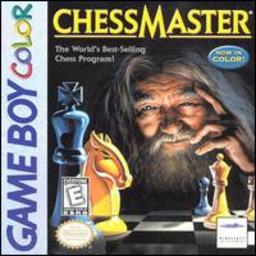
Chessmaster
Chessmaster is a Game Boy Color card and board game released in 1999 developed by Park Place Productions. It centers on card or board-game rules, rules interaction, and board assessment, with controls, information, and pacing arranged around a color handheld screen, a directional pad, and two main action buttons.
- AI score · out of 10
- 6.1 / 10
About this game
Chessmaster is a Game Boy Color card and board release centered on card or board-game rules, rules interaction, and board assessment. Matches, decks, or board objectives create a repeatable strategy loop, with progress divided into stages, tasks, matches, or growth milestones that make its immediate goals understandable. Its value depends on whether these rules continue to create judgment and room for mastery rather than on campaign length or series recognition. Short campaigns are judged by repeat-challenge value, while longer ones are judged by variety, pacing, and recovery after failure. Card, board, and state readability determine usability, while color choices need to distinguish characters, objects, and routes rather than serve as decoration alone. The main genre-specific friction is that rules terminology, opponent pacing, and text density raise the entry barrier. In addition, battery saves, link cables, cartridge-specific hardware, the unlit display, and regional language can affect the original experience. This description covers only this release and excludes emulator features, modern-port conveniences, and content from other platforms.
Collected in series
Chessmaster combines computer chess with tools for understanding your decisions. You can play opponents at different strengths, revisit positions and study guided lessons, with later games giving more space to annotated matches and structured learning.
Recommended games
Related game recommendations on this platform
Game Boy Color (GBC)
AI review
AI reviews are subjective assessments, not player ratings. See each review for its evidence and limitations.Published date:
A substantial pocket chess set whose awkward saving works against its longest matches.
The 1999 Game Boy Color Chessmaster offers standard chess, sixteen computer levels, clock options, move suggestions and two ways to play another person: sharing one system or using a link cable. That is a durable set of tools for a handheld, and contemporary coverage finds moving pieces on the board straightforward. The computer's quality is less settled. One GBC player describes wildly inconsistent opposition, while a dedicated handheld-chess comparison finds enough challenge for ordinary players at higher settings. Visual customization offers several board and piece colors or shapes, but opinions differ on legibility and the chosen settings vanish when power is turned off. Sound is sparse. The decisive portable compromise is resuming a game through a long password rather than a convenient save, particularly troublesome when stronger levels spend longer thinking. This edition can serve as a serious chess companion if a session is finished in one sitting; it is less comfortable as a modern stop-and-start practice tool.
Strengths
- Sixteen computer levels and hints support different abilities.
- Local and link-cable two-player options expand replay.
- Board and piece styles offer some visual flexibility.
Weaknesses
- Long passwords make interrupted games cumbersome.
- Small-screen legibility and AI quality divide reviewers.
- Minimal sound and nonpersistent display settings feel dated.
Who it is for: Chess players willing to finish long matches on period handheld hardware.
Play notes: This is the GBC cartridge, not the earlier monochrome or later GBA edition.
View scoring basis
| Dimension | Review state | Score | Weight |
|---|---|---|---|
| Dimension Same-system and link-cable two-player play complement sixteen solo levels. Chess naturally offers lasting replay without a campaign, but higher computer settings can make individual handheld games slow. | Reviewed | 7.2 / 10 | Not provided |
| Dimension Standard chess, sixteen AI levels, clocks and move suggestions make the cartridge broadly usable. The game of chess remains deep, though a GBC player reports erratic computer strength that can undermine a consistent learning ladder. | Reviewed | 6.8 / 10 | Not provided |
| Dimension Board and piece color options are useful on a tiny display, yet reviewers disagree on legibility and settings do not persist after power-off. Sparse sound leaves the focus firmly on the chess position. | Reviewed | 4.5 / 10 | Not provided |
| Dimension A long password makes it cumbersome to suspend a match, and Game Boy Color screen legibility depends on strong light. Menus draw criticism even though piece movement itself is straightforward. No GBA or PC interface claim is transferred. | Reviewed | 4.3 / 10 | Not provided |
Review sources
Not provided
Core information
- Developer
- Park Place Productions
- Publisher
- Mindscape
- Release date
- 1999
- Platforms
- Game Boy Color (GBC)
- Content kind
- Game
- Release state
- Released
- Region
- Worldwide
- Official website
- Not provided
- Offline minimum players
- Not provided
- Offline maximum players
- Not provided
- Online minimum players
- Not provided
- Online maximum players
- Not provided
- Categories
- Card & Tabletop · Primary genre
- Tags
- Turn-based TacticsSteep Learning Curve2D GraphicsBoard and Tabletop PlayTop-downLow Entry BarrierSlow BurnSolo-friendlyFamily-friendlyShort SessionsReplayable
- Supported game languages
- Not provided
- Requires base game
- Not provided
- Standalone
- Not provided
- Age ratings
- Not provided
- Play modes
- Single player
- Perspectives
- Top-downSide view
Release editions
- Game Boy Color (GBC)Worldwide1999
Game gallery
Sources
Not provided