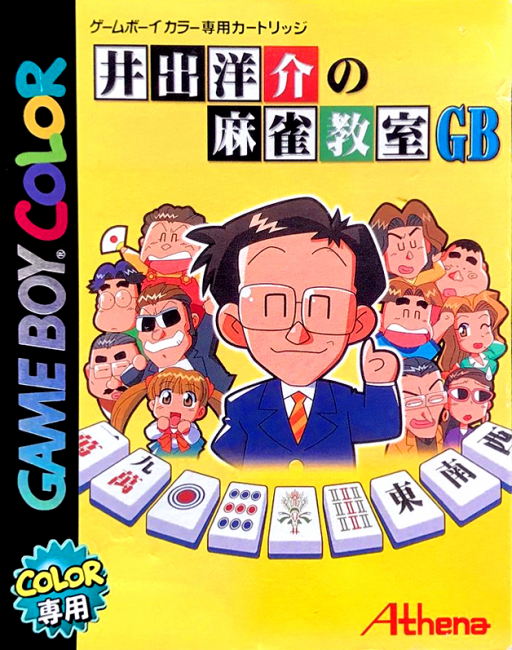
Ide Yousuke no Mahjong Kyoushitsu GB
Ide Yousuke no Mahjong Kyoushitsu GB is a Game Boy Color card and board game released in 2000 developed by Athena Co., Ltd.. It centers on card or board-game rules, rules interaction, and board assessment, with controls, information, and pacing arranged around a color handheld screen, a directional pad, and two main action buttons.
- AI score · out of 10
- 7.4 / 10
About this game
Ide Yousuke no Mahjong Kyoushitsu GB is a Game Boy Color card and board release centered on card or board-game rules, rules interaction, and board assessment. Matches, decks, or board objectives create a repeatable strategy loop, with progress divided into stages, tasks, matches, or growth milestones that make its immediate goals understandable. Its value depends on whether these rules continue to create judgment and room for mastery rather than on campaign length or series recognition. Short campaigns are judged by repeat-challenge value, while longer ones are judged by variety, pacing, and recovery after failure. Card, board, and state readability determine usability, while color choices need to distinguish characters, objects, and routes rather than serve as decoration alone. The main genre-specific friction is that rules terminology, opponent pacing, and text density raise the entry barrier. In addition, battery saves, link cables, cartridge-specific hardware, the unlit display, and regional language can affect the original experience. This description covers only this release and excludes emulator features, modern-port conveniences, and content from other platforms.
Recommended games
Related game recommendations on this platform
Game Boy Color (GBC)
AI review
AI reviews are subjective assessments, not player ratings. See each review for its evidence and limitations.Published date:
Useful teaching connects to matches, but late completion demands are harsh.
This mahjong classroom connects instruction to actual play. Fourteen lessons move from basic terms to scoring and discard decisions, while exhibitions offer adjustable rules and opponent choices for practice. Ide's assistance demonstrably helped a participant finish demanding tournament play, and failed quizzes can be retaken. Observed tile colors, table areas and separate example, scoring and explanation sections give learning information clear positions. However, late calculation and discard questions led one participant to rely mainly on memorized answers. The final tournament condition also requires first place in four consecutive hanchan matches, making completion much more demanding than introductory teaching. It suits Japanese readers willing to study and practice rather than expecting an effortless course-to-championship journey. Check that an old cartridge retains save data before relying on it.
Strengths
- Lessons connect basic terms, scoring and discards to useful actual play.
- Rule and opponent choices, quiz retakes and effective assistance support practice at different stages.
- Observed tile colors and layered lecture layouts give match and learning information clear positions.
Weaknesses
- Difficult late scoring and discard questions can turn learning into memorizing answers.
- Four consecutive first-place hanchan finishes create a harsh final tournament progression requirement.
Who it is for: Japanese readers seeking to move from basic rules to practical discard and scoring knowledge, and willing to use assistance, practice matches and pursue strict tournament conditions.
Play notes: This covers original Japanese GBC software, not PS1. Later lessons and tournaments are demanding; use exhibitions to practice first. Check an old cartridge's data retention rather than assuming its battery remains healthy.
View scoring basis
| Dimension | Review state | Score | Weight |
|---|---|---|---|
| Dimension Lessons, exhibitions and staged tournaments form meaningful layers of goals. Late quizzes that encouraged memorization and a final requirement for four consecutive first-place hanchan finishes substantially raise progression costs. Content works, but completion flows less smoothly than introductory learning; repeated mahjong hands or challenge alone are not the criticism. | Reviewed | 6.7 / 10 | Not provided |
| Dimension A participant confirms that instruction connects terminology, scoring and discards to actual play, while rule and opponent choices let learning be practiced. The core is good with a clear purpose: useful guidance and match practice. The available account does not establish universally balanced AI or benchmark-level tactical instruction. | Reviewed | 7.8 / 10 | Not provided |
| Dimension Observed tile colors, table areas and the lecture's example-result-explanation structure effectively support play and learning. The original source also positively assesses musical variety. Presentation is good and purposeful, bounded to these effects rather than treating static organization as animation or comprehensive audiovisual testing. | Reviewed | 7.2 / 10 | Not provided |
| Dimension Retakes, rule selection, clear answer-selection feedback and demonstrably useful Ide assistance make learning and play convenient, with evidence for persistent data. These are concrete conveniences, not performance assumptions. Check an old cartridge's saving condition; unknown full inputs, save timing and frame rate are not automatic deductions. | Reviewed | 7.7 / 10 | Not provided |
Review sources
Not provided
Core information
- Developer
- Athena
- Publisher
- Athena
- Release date
- 2000
- Platforms
- Game Boy Color (GBC)
- Content kind
- Game
- Release state
- Released
- Region
- Worldwide
- Official website
- Not provided
- Offline minimum players
- Not provided
- Offline maximum players
- Not provided
- Online minimum players
- Not provided
- Online maximum players
- Not provided
- Categories
- Card & Tabletop · Primary genre
- Tags
- Slow Burn2D GraphicsCard PlayShort SessionsTurn-based TacticsBoard and Tabletop Play
- Supported game languages
- Not provided
- Requires base game
- Not provided
- Standalone
- Not provided
- Age ratings
- Not provided
- Play modes
- Not provided
- Perspectives
- Not provided
Release editions
- Game Boy Color (GBC)Worldwide2000
Game gallery
Sources
Not provided