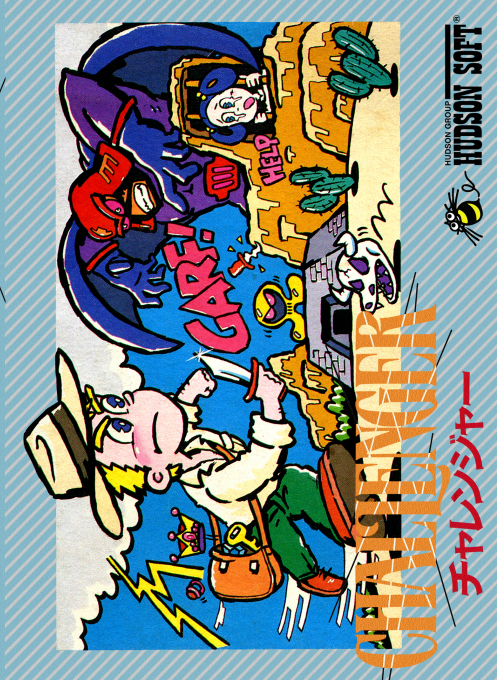
Challenger
The title character, Challenger, is an archaeologist who seeks to rescue the princess, Maria, from the hands of the evil boss, Don Waldorado, in the land called Pleasio Land. The setting of the character as an archaeologist is an homage to the Indiana Jones franchise, while his name may be an allusion to Conan Doyle's Professor Challenger (best known for his appearance in The Lost World). One of Hudson Soft's earliest NES titles, Challenger is an arcade-style game that combines side scrolling, run 'n jump action with overhead, exploratory gameplay. The game consists of two parts. The first level (or "scene") has you racing the clock to get to the front of a train, where a purple-faced villain is holding your significant other (or, perhaps just some anonymous princess). You have at your disposal a trusty throwing knife to take care of enemies. You will also have to dodge obstacles and jump gaps in the train. This section is taken from the earlier Hudson game, Stop the Express. Scene 2 places you in an overhead, maze-like environment, where you once again have to fight the clock. This time though, you have to navigate your way through the area, in search of all the different "keywords", which are placed in different caves. Once you have cleared all the caves, the path will be open to the boss' final lair.
- AI score · out of 10
- 7.7 / 10
About this game
The title character, Challenger, is an archaeologist who seeks to rescue the princess, Maria, from the hands of the evil boss, Don Waldorado, in the land called Pleasio Land. The setting of the character as an archaeologist is an homage to the Indiana Jones franchise, while his name may be an allusion to Conan Doyle's Professor Challenger (best known for his appearance in The Lost World). One of Hudson Soft's earliest NES titles, Challenger is an arcade-style game that combines side scrolling, run 'n jump action with overhead, exploratory gameplay. The game consists of two parts. The first level (or "scene") has you racing the clock to get to the front of a train, where a purple-faced villain is holding your significant other (or, perhaps just some anonymous princess). You have at your disposal a trusty throwing knife to take care of enemies. You will also have to dodge obstacles and jump gaps in the train. This section is taken from the earlier Hudson game, Stop the Express. Scene 2 places you in an overhead, maze-like environment, where you once again have to fight the clock. This time though, you have to navigate your way through the area, in search of all the different "keywords", which are placed in different caves. Once you have cleared all the caves, the path will be open to the boss' final lair.
Recommended games
Related game recommendations on this platform
Famicom / NES
AI review
AI reviews are subjective assessments, not player ratings. See each review for its evidence and limitations.Published date:
Challenger is assessed here as a specific FC/NES release with its documented strengths and practical limits kept in view.
The title character, Challenger, is an archaeologist who seeks to rescue the princess, Maria, from the hands of the evil boss, Don Waldorado, in the land called Pleasio Land. The setting of the character as an archaeologist is an homage to the Indiana Jones franchise, while his name may be an allusion to Conan Doyle's Professor Challenger (best known for his appearance in The Lost World). One of Hudson Soft's earliest NES titles, Challenger is an arcade-style game that combines side scrolling, run 'n jump action with overhead, exploratory gameplay. The game consists of two parts. The first level (or "scene") has you racing the This assessment focuses on the specific FC or NES release and on the play actions, goals, and progression documented for Challenger. Its value comes from how clearly the central rules create decisions and feedback across a session. Pacing is judged by the variety of situations, the learning curve, recovery after failure, and the reason to replay. Presentation is considered through readability, animation, sound, and the consistency of the game's style rather than by modern resolution. Practical limits such as period controls, guidance, saving, or required accessories are included only when they affect this release. Players who enjoy learning compact systems and improving through repeated attempts are the clearest audience, while anyone seeking modern convenience should
Strengths
- The documented central loop gives Challenger a clear identity and a learnable set of goals.
- Progress rewards understanding the rules and applying them more consistently across repeated situations.
Weaknesses
- The original release can create friction through its documented difficulty, guidance, control, or recovery limits.
Who it is for: Players interested in the original FC/NES design and willing to learn its period-specific rules.
Play notes: Check the documented language, saving, accessory, and recovery conditions for this exact release.
View scoring basis
| Dimension | Review state | Score | Weight |
|---|---|---|---|
| Dimension The content pacing score applies the V3 boundary to the documented mechanics, pacing, presentation, and FC release constraints. | Reviewed | 7.5 / 10 | Not provided |
| Dimension The core experience score applies the V3 boundary to the documented mechanics, pacing, presentation, and FC release constraints. | Reviewed | 7.7 / 10 | Not provided |
| Dimension The presentation immersion score applies the V3 boundary to the documented mechanics, pacing, presentation, and FC release constraints. | Reviewed | 8.0 / 10 | Not provided |
| Dimension The technical usability score applies the V3 boundary to the documented mechanics, pacing, presentation, and FC release constraints. | Reviewed | 7.4 / 10 | Not provided |
Review sources
Not provided
Core information
- Developer
- Hudson Soft
- Publisher
- Hudson Soft
- Release date
- 1985
- Platforms
- Famicom / NES
- Content kind
- Game
- Release state
- Released
- Region
- Worldwide
- Official website
- Not provided
- Offline minimum players
- Not provided
- Offline maximum players
- Not provided
- Online minimum players
- Not provided
- Online maximum players
- Not provided
- Categories
- Action · Primary genre
- Tags
- 2D GraphicsLinear LevelsPuzzle SolvingShootingExplorationPlatformingTop-down
- Supported game languages
- Not provided
- Requires base game
- Not provided
- Standalone
- Not provided
- Age ratings
- Not provided
- Play modes
- Not provided
- Perspectives
- Top-downSide view
Release editions
- Famicom / NESWorldwide1985
Game gallery
Sources
Not provided