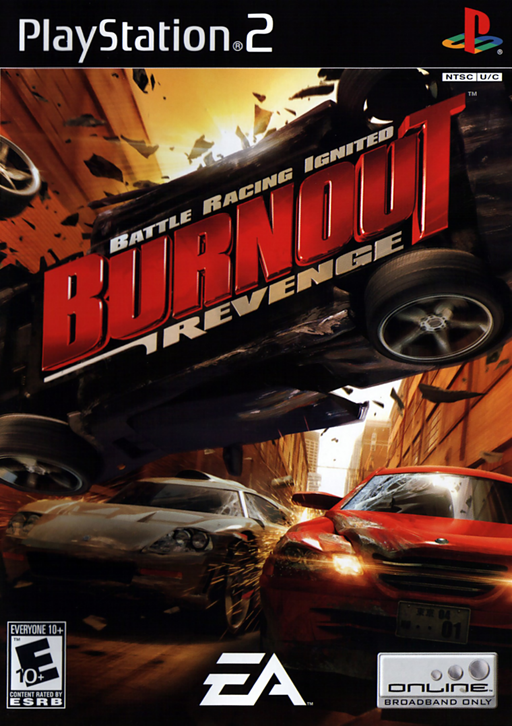
Burnout Revenge
Burnout Revenge is a PlayStation 2 racing game released in 2005 developed by Criterion Games. It centers on driving and route control, vehicle control, and route judgment, with controls and information arranged around the DualShock 2 twin analog sticks, directional pad, shoulder and face buttons, with a dedicated peripheral only where explicitly required.
- AI score · out of 10
- 8.8 / 10
About this game
Burnout Revenge is a PlayStation 2 racing game centered on driving and route control, vehicle control, and route judgment. Tracks raise pressure through corners, rivals, and time targets, with progress divided into stages, tasks, matches, or growth milestones that make immediate goals understandable. Its value depends on whether these rules continue to create judgment and room for mastery rather than on length, sales, or series recognition. Short campaigns are judged by repeat-challenge value, while longer ones are judged by variety, pacing, and recovery after failure. Speed, track boundaries, and vehicle feedback determine driving readability, while 3D scenes, streamed data, cinematics, surround audio, and interlaced television output need to preserve action and state readability together. The genre-specific limitation is that visibility, collisions, steering precision, wheel support, or loading can limit consistency. Platform conditions also include DVD loading, the 8MB Memory Card, analog sticks and pressure-sensitive buttons, Multitap, Network Adapter, dedicated peripherals, and retired online services affect present-day use. This description covers only this platform release and does not import features or conveniences from remasters, emulators, or other console editions.
Recommended games
Related game recommendations on this platform
PlayStation 2

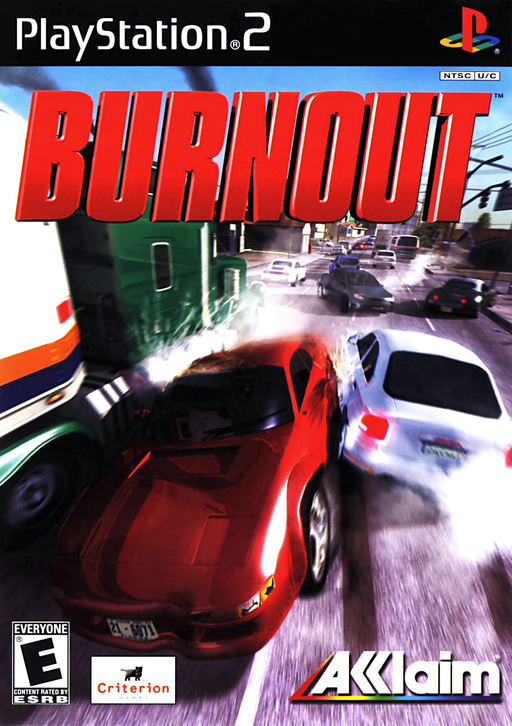
AI review
AI reviews are subjective assessments, not player ratings. See each review for its evidence and limitations.Published date:
Excellent PlayStation 2 racing experience
Burnout Revenge centers on driving and route control, vehicle control, and route judgment. Tracks raise pressure through corners, rivals, and time targets, giving the release understandable goals and a recognizable play rhythm. It arranges controls and information around the DualShock 2 twin analog sticks, directional pad, shoulder and face buttons, with a dedicated peripheral only where explicitly required. Speed, track boundaries, and vehicle feedback determine driving readability, while the main genre limitation is that visibility, collisions, steering precision, wheel support, or loading can limit consistency. The assessment also covers camera behavior, disc loading, Memory Card saves, controllers, language, video standard, accessories, and service status for this release. GameNavo judges four dimensions independently before applying fixed weights and excludes press aggregates, user ratings, sales, popularity, source length, media count, and title recognition. Platform merit is recorded only when a concrete controller, peripheral, disc, or version implementation supports a small adjustment.
Strengths
- driving and route control, and vehicle control provide a readable mechanical foundation.
- Progress is divided into understandable stages, tasks, matches, or growth milestones.
- Visual, audio, and interface feedback support the principal rules and state changes.
Weaknesses
- Visibility, collisions, steering precision, wheel support, or loading can limit consistency.
- DVD loading, the 8MB Memory Card, analog sticks and pressure-sensitive buttons, Multitap, Network Adapter, dedicated peripherals, and retired online services affect present-day use.
Who it is for: Players who enjoy racing games, accept PlayStation 2 control and information conventions, and want to judge this release on its own terms.
Play notes: This review covers the PlayStation 2 release without conveniences from emulators, remasters, or other platforms and does not represent a complete playthrough.
View scoring basis
| Dimension | Review state | Score | Weight |
|---|---|---|---|
| Dimension Tracks raise pressure through corners, rivals, and time targets. This dimension weighs new-goal frequency, the difficulty or progression curve, repetition, and recovery after failure. | Reviewed | 8.8 / 10 | Not provided |
| Dimension Burnout Revenge builds its main loop around driving and route control, vehicle control, and route judgment. The score considers whether input feedback, decision space, and system depth continue to support its goals, while accounting for visibility, collisions, steering precision, wheel support, or loading can limit consistency. | Reviewed | 9.0 / 10 | Not provided |
| Dimension Speed, track boundaries, and vehicle feedback determine driving readability, and this platform specifically asks whether 3D scenes, streamed data, cinematics, surround audio, and interlaced television output need to preserve action and state readability together. Readability and stylistic consistency matter rather than resolution or hardware scale by itself. | Reviewed | 9.1 / 10 | Not provided |
| Dimension Technical usability covers response, camera behavior, loading, saving, controllers, language, video standard, accessories, and service status for this release. DVD loading, the 8MB Memory Card, analog sticks and pressure-sensitive buttons, Multitap, Network Adapter, dedicated peripherals, and retired online services affect present-day use; conveniences from emulators or later platforms receive no credit. | Reviewed | 8.1 / 10 | Not provided |
Review sources
Not provided
Core information
- Developer
- Criterion Games
- Publisher
- Electronic Arts
- Release date
- 2005
- Platforms
- PlayStation 2
- Content kind
- Game
- Release state
- Released
- Region
- Worldwide
- Official website
- Not provided
- Offline minimum players
- Not provided
- Offline maximum players
- Not provided
- Online minimum players
- Not provided
- Online maximum players
- Not provided
- Categories
- Racing · Primary genre
- Tags
- Solo-friendlyShort SessionsFast-pacedReplayableDriving and RacingThird PersonMain Story Under 10 HoursPick-up and PlayWarDodgePlayer versus Player
- Supported game languages
- Not provided
- Requires base game
- Not provided
- Standalone
- Not provided
- Age ratings
- Not provided
- Play modes
- MultiplayerSingle player
- Perspectives
- First personThird person
Release editions
- PlayStation 2Worldwide2005
- Xbox 360Worldwide2006
- Original XboxWorldwide2005
Game gallery
Sources
Not provided