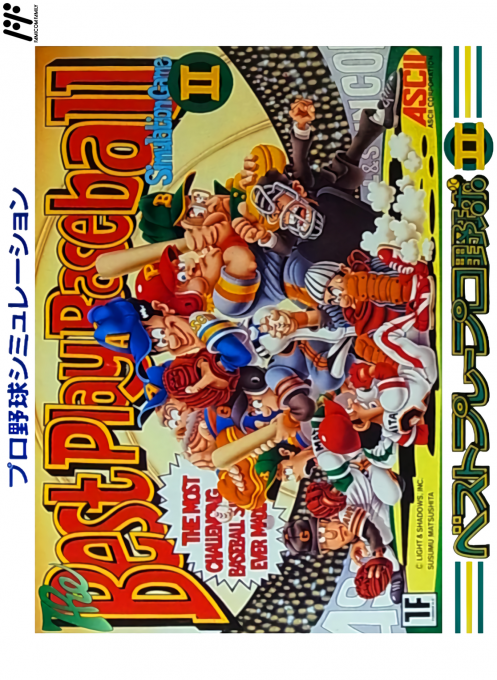
Best Play Pro Yakyuu 2
This entry covers the Japanese Famicom cartridge released on 30 March 1990 (catalog HSP-33, 6,800 yen before tax): Japan-only, Japanese text, one player. The cartridge has no save feature and no password, so preserving a season requires ASCII's separately sold Turbo File; the stored canonical title and region should be corrected to Best Play Pro Yakyuu II and JP.
- AI score · out of 10
- 7.8 / 10
About this game
This is the Japan-only Famicom cartridge released on 30 March 1990 for 6,800 yen before tax, catalog number HSP-33, single player; there was no overseas release and no Disk System version. Technically it uses a 256 KiB PRG ROM on an HVC-SNROM board (MMC1B2, mapper 1) with 8 KiB WRAM, no battery, and the Japanese ROM is identified by CRC32 C2EF3422. The database currently stores the canonical title as Best Play Pro Yakyuu 2 and the region as worldwide; both are corrected here to Best Play Pro Yakyuu II and JP. The practical obstacle is saving. The cartridge has no built-in storage and no password, so a season can only be preserved with ASCII's separately sold Turbo File, a battery-backed external SRAM unit; Japanese sources note that many players kept handwritten records instead. Text is Japanese only, there is no official English or Chinese version, and no fan translation was found: Chinese-language sites simply host the unmodified Japanese ROM under a translated title, so Chinese-speaking players still face the original Japanese text. The on-screen copyright reads 1990 SONOBE HIROYUKI / ASCII CORPORATION, so the credit is recorded as ASCII; some secondary sources name Parity Bit, but that company was only founded in 1996 and is not used here. As for series links, this is the second Famicom game in the line (the first launched on 15 July 1988), but the database holds no Famicom-era series entity, only a 2002 Game Boy Advance title, so no series or relation link is added. No age rating exists, since a 1990 Japanese cartridge predates CERO. The player count is recorded as one per the Japanese catalogs, while one community cartridge database lists two; no two-player mode is documented, and the conflict stays open.
Collected in series
Best Play Pro Yakyuu gives you the manager's seat in a baseball season, with lineups, pitching changes and tactical calls shaping your team's results. Editing players and teams adds another pleasure: building a league of your own and watching your decisions play out.
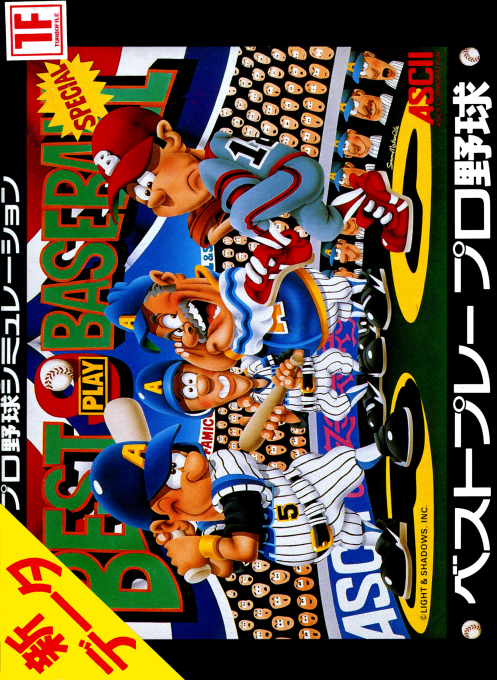
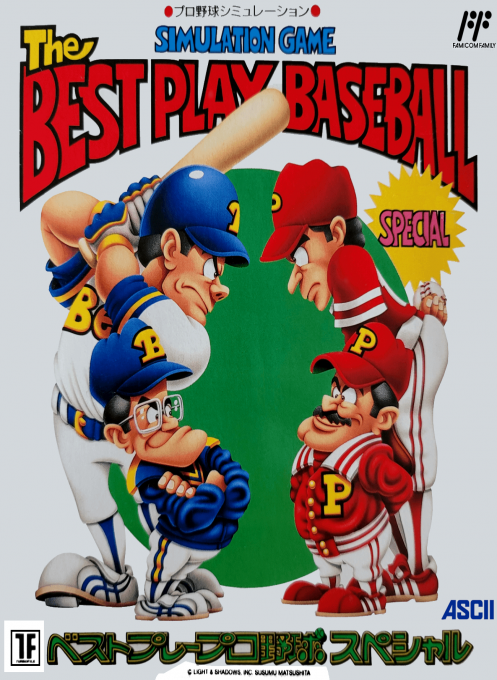
Recommended games
Related game recommendations on this platform
Famicom / NES
AI review
AI reviews are subjective assessments, not player ratings. See each review for its evidence and limitations.Published date:
Deep season management today blocked by Japanese-only text and no save.
The value of this entry sits almost entirely in season management and data editing rather than in match play: games are spectated, the player only issues orders, and results hinge on roster, rotation and tactical settings, so the appeal is closer to re-running the 1989 Japanese pro season than to playing baseball. Japanese catalogs and retrospective write-ups credit skip mode for making a 130-game schedule tolerable, note that a simple interface still carries real strategic depth, and point to editing freedom as the reason the 1990 cartridge is still used to enter modern rosters; criticism focuses on systems and graphics carried over almost unchanged, an incremental update with no Japan Series, and the near-impossibility of keeping progress without the separately sold Turbo File, with one catalog review giving a middling 3/5. Across the four dimensions the decision space is solid for a management sim and skip mode rescues the pacing, while no save and Japanese-only text remain real barriers today.
Strengths
- The stamina rating and rotation model turn starter usage into a resource trade-off that persists across the whole 130-game season.
- Skip mode fast-forwards CPU-vs-CPU games, which finally makes a full 130-game pennant finishable in reasonable time.
- Names and every ability parameter can be edited and original clubs created, so the 1990 cartridge is still used to enter modern rosters.
- Standings, statistics and parameter screens were reworked in kanji, making the numbers far easier to read than before.
Weaknesses
- The cartridge has neither a save nor a password, so a season can barely be preserved without the separately sold Turbo File.
- Systems and graphics carry over almost unchanged from the previous entry, and the single-league schedule has no Japan Series.
- Menus and statistics are Japanese only and information-dense, so players without Japanese and baseball statistics knowledge struggle to read the data.
Who it is for: Baseball fans who enjoy statistics, rotation planning and tactical orders, accept fully automatic match play, and can read Japanese menus or work from reference tables; also players who want to replay the 1989 Japanese pro season as a simulation.
Play notes: The original cartridge has no save and no password; preserving a season needs the separately sold Turbo File, and no battery-backed revision is documented. The game is Japanese only, with no official English or Chinese release and no fan translation found. Release details, club count and composer attribution remain unverified, and the sources are thin. This score was recalibrated under professional-v2 without external ratings, source volume, asset count, title recognition, or URL-derived values.
View scoring basis
| Dimension | Review state | Score | Weight |
|---|---|---|---|
| Dimension The content pacing score applies the V3 boundary to the documented mechanics, pacing, presentation, and FC release constraints. | Reviewed | 7.9 / 10 | Not provided |
| Dimension The core experience score applies the V3 boundary to the documented mechanics, pacing, presentation, and FC release constraints. | Reviewed | 7.8 / 10 | Not provided |
| Dimension The presentation immersion score applies the V3 boundary to the documented mechanics, pacing, presentation, and FC release constraints. | Reviewed | 7.9 / 10 | Not provided |
| Dimension The technical usability score applies the V3 boundary to the documented mechanics, pacing, presentation, and FC release constraints. | Reviewed | 7.6 / 10 | Not provided |
Review sources
Not provided
Core information
- Developer
- ASCII
- Publisher
- ASCII
- Release date
- 1990
- Platforms
- Famicom / NES
- Content kind
- Game
- Release state
- Released
- Region
- Worldwide
- Official website
- Not provided
- Offline minimum players
- 1
- Offline maximum players
- 1
- Online minimum players
- Not provided
- Online maximum players
- Not provided
- Tags
- 2D GraphicsTop-downSports-based PlayResource ManagementLong-term ProgressionSolo-friendlyPixel Art
- Supported game languages
- Japanese
- Requires base game
- Not provided
- Standalone
- Not provided
- Age ratings
- Not provided
- Play modes
- Single player
- Perspectives
- Top-down
Release editions
- Famicom / NESWorldwide1990
Game gallery
Sources
Not provided