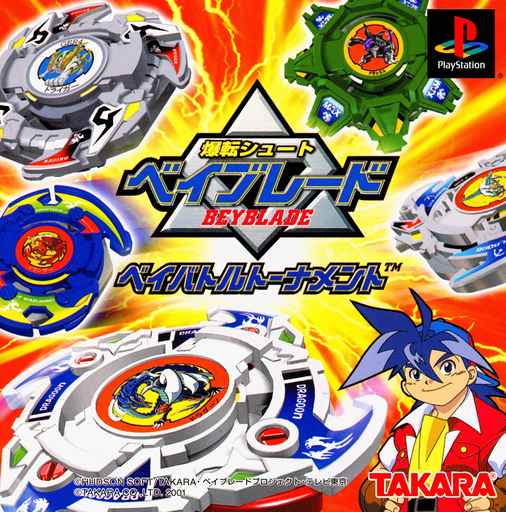
Bakuten Shoot Beyblade - Bey Battle Tournament
Bakuten Shoot Beyblade - Bey Battle Tournament is a PlayStation action game released in 2001 developed by Takara Tomy. It centers on combat encounters, area and route exploration, and character or equipment growth, with controls and information arranged around the directional pad, shoulder and face buttons, plus DualShock twin analog sticks and vibration where supported.
- AI score · out of 10
- 6.5 / 10
About this game
Bakuten Shoot Beyblade - Bey Battle Tournament is a PlayStation action game centered on combat encounters, area and route exploration, and character or equipment growth. Stages build pressure through routes, enemy patterns, and changing objectives, with progress divided into stages, tasks, matches, or growth milestones that make immediate goals understandable. Its value depends on whether these rules continue to create judgment and room for mastery rather than on length, sales, or series recognition. Short campaigns are judged by repeat-challenge value, while longer ones are judged by variety, pacing, and recovery after failure. Animation, hits, camera behavior, and readable hazards determine whether feedback remains dependable, while early 3D graphics, pre-rendered backgrounds, CD audio, and full-motion video need to preserve targets and interface readability on a television. The genre-specific limitation is that camera behavior, collision rules, input mapping, and repeated ground after failure can raise the entry barrier. Platform conditions also include disc loading, Memory Card saves, regional video standards, digital or analog control support, vibration, and dedicated peripherals affect original-hardware use. This description covers only this platform release and does not import features or conveniences from remasters, emulators, or other console editions.
Collected in series
Beyblade games turn customisable battling tops into virtual stadium contests. Across Metal Fusion, Burst and X, assembling a top and choosing how to launch or attack bring each generation’s rivalries to life.
Recommended games
Related game recommendations on this platform
PlayStation
AI review
AI reviews are subjective assessments, not player ratings. See each review for its evidence and limitations.Published date:
Build choices outshine repeated collisions; earning funds and reading gauges create friction.
This tournament's appeal lies in preparation. Attack rings, spin direction and creature parts carry trade-offs, while up to three builds per battle make changing tops more than a cosmetic choice. Defeat, ring-out and outlasting spin give those builds different goals. Bowl slopes and creature combos connect them to combat, but ordinary exchanges remain repetitive collisions rather than matching the assembly phase's variety. Both wins and losses earn points, yet acquiring customization funds makes repeated bouts feel laborious when you want to experiment. The anime opening and familiar cast retain series personality, although the DJ's recurring exclamations make event atmosphere monotonous. Attribute comparisons help with assembly; creature and rotation gauges are less conspicuous during battle, especially on a small television, making important state changes harder to notice.
Strengths
- Parts, spin direction and reserve builds create meaningful choices around different victory routes.
- Points after wins and losses, alongside Free Battle, provide ways to continue experimenting.
- The anime opening, familiar characters and creature summons preserve the tournament's series identity.
Weaknesses
- Ordinary contests revolve around repeated collisions, with less variety than assembly offers.
- Laborious customization funding makes repeated bouts obstruct further build experiments.
- Repeated DJ lines and inconspicuous gauges weaken atmosphere and small-screen battle-state legibility.
Who it is for: Beyblade players who enjoy offensive and defensive part combinations and accept repeating tournaments for customization points, valuing build experiments more than consistently varied real-time exchanges.
Play notes: This assessment covers Japanese PS1 SLPM-86980, with Japanese menus and text. Compare part attributes and watch creature-power and rotation gauges; a small television makes them harder to read. Extra parts obtained through the 2002 sequel's data conversion are outside this assessment.
View scoring basis
| Dimension | Review state | Score | Weight |
|---|---|---|---|
| Dimension Points after both wins and losses, experience and purchasable parts provide continuing goals, while Free Battle offers alternative match selection. Native feedback nevertheless finds earning customization funds laborious. Repeated bouts delay the most appealing build experiments, making progression weak through reward friction rather than a lack of story or sheer duration. | Reviewed | 5.9 / 10 | Not provided |
| Dimension Three victory routes, part trade-offs and reserve tops give preparation genuine choices, while slopes and creature combos connect builds to the contest, supporting good core design. Ordinary exchanges revolve around repeated collisions, however, so moment-to-moment variety does not fully realize the customization's range of decisions. | Reviewed | 7.2 / 10 | Not provided |
| Dimension The anime opening, recognizable cast and creature summons preserve series personality, and protagonist choice helps players enter the tournament. The DJ's repeated few exclamations make vocal presentation monotonous across bouts. The series framing works, but sustained event atmosphere has noticeable shortcomings. | Reviewed | 6.3 / 10 | Not provided |
| Dimension Attribute comparisons make part trade-offs understandable, giving the software useful information organization. Native feedback finds the creature gauge small and the rotation indicator inconspicuous, with readiness particularly hard to notice on a small television. Usability basically works, but legibility friction affects important battle-timing decisions. | Reviewed | 6.2 / 10 | Not provided |
Review sources
Not provided
Core information
- Developer
- Takara Tomy
- Publisher
- Takara Tomy
- Release date
- 2001
- Platforms
- PlayStation
- Content kind
- Game
- Release state
- Released
- Region
- Worldwide
- Official website
- Not provided
- Offline minimum players
- Not provided
- Offline maximum players
- Not provided
- Online minimum players
- Not provided
- Online maximum players
- Not provided
- Categories
- Action · Primary genre
- Tags
- Solo-friendlyExplorationResource ManagementLevel ProgressionReplayableDodgeReal-time CombatPlatformingLinear LevelsFast-paced3D GraphicsThird Person
- Supported game languages
- Not provided
- Requires base game
- Not provided
- Standalone
- Not provided
- Age ratings
- Not provided
- Play modes
- Not provided
- Perspectives
- Not provided
Release editions
- PlayStationWorldwide2001
Game gallery
Sources
Not provided