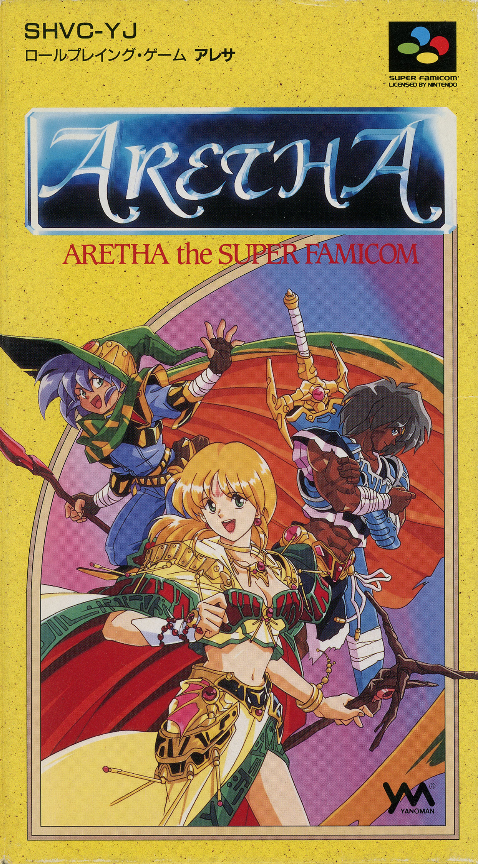
Aretha
Aretha is a Super Famicom role-playing game released in 1993 developed by Japan Art Media. It centers on character or equipment growth, area exploration, and combat and party setup, with controls, information, and pacing arranged around television output, a directional pad, shoulder buttons, and a six-button controller.
- AI score · out of 10
- 6.4 / 10
About this game
Aretha is a Super Famicom role-playing release centered on character or equipment growth, area exploration, and combat and party setup. Story beats, exploration, and progression resources support a longer campaign, with progress divided into stages, tasks, matches, or growth milestones that make its immediate goals understandable. Its value depends on whether these rules continue to create judgment and room for mastery rather than on campaign length or series recognition. Short campaigns are judged by repeat-challenge value, while longer ones are judged by variety, pacing, and recovery after failure. Characters, world building, maps, and music carry most of the atmosphere, while sprite animation, scrolling, color, and chip-based audio jointly carry readability and atmosphere. The main genre-specific friction is that dense text, menu layers, repeated battles, and language dependence can slow progress. In addition, password or battery saves, multiplayer accessories, manual dependence, regional language, and cartridge enhancement chips can affect original-hardware use. This description covers only this release and excludes emulator features, modern-port conveniences, and content from other platforms.
Recommended games
Related game recommendations on this platform
Super Famicom / SNES
AI review
AI reviews are subjective assessments, not player ratings. See each review for its evidence and limitations.Published date:
An inviting party adventure held back by uneven battles and opaque information.
Aretha gives its party a welcoming identity through large portraits, changing companions and music that flows naturally from the field into villages. Battles attack from multiple directions, while casting spells learns further magic and synthesis creates powerful equipment. These ideas encourage experimentation beyond ordinary shopping. Consultation identifies the next objective, and straightforward dungeons keep exploration approachable. Frequent encounters nevertheless stretch the journey, especially when enemies occupy several directions. Accuracy and newcomer strength are uneven, while battles provide neither damage numbers nor useful descriptions of spell and item effects. Limited medicine storage and equipment handling when companions leave add further friction. The adventure suits players drawn to characterful Japanese role-playing games, provided they can tolerate opaque combat information and a relatively slight conclusion.
Strengths
- Directional combat and spell progression
- Helpful objective consultation
- Welcoming portraits and musical transitions
Weaknesses
- Frequent encounters
- Poor combat-effect explanations
- Awkward party and equipment handling
Who it is for: Players who enjoy companion-focused Japanese RPGs and equipment synthesis.
Play notes: Japanese original; medicine capacity and departing companions' equipment require care, and the ending is brief.
View scoring basis
| Dimension | Review state | Score | Weight |
|---|---|---|---|
| Dimension Accessible dungeons and changing companions help progression, but frequent encounters and a thin ending disrupt momentum. | Reviewed | 6.0 / 10 | Not provided |
| Dimension Directional combat, spell learning and equipment synthesis invite experimentation, but uneven accuracy and fragile newcomers weaken tactical consistency. | Reviewed | 6.6 / 10 | Not provided |
| Dimension Large portraits emphasize companions, while seamless village music transitions lend the journey cohesion. | Reviewed | 7.0 / 10 | Not provided |
| Dimension Objective consultation and wall assistance ease navigation, but absent combat explanations, restrictive medicine storage and departing-party equipment handling cause friction. | Reviewed | 5.7 / 10 | Not provided |
Review sources
Not provided
Core information
- Developer
- Japan Art Media
- Publisher
- Yanoman
- Release date
- 1993
- Platforms
- Super Famicom / SNES
- Content kind
- Game
- Release state
- Released
- Region
- Worldwide
- Official website
- Not provided
- Offline minimum players
- Not provided
- Offline maximum players
- Not provided
- Online minimum players
- Not provided
- Online maximum players
- Not provided
- Categories
- Role-Playing · Primary genre
- Tags
- 2D GraphicsLong-term ProgressionLevel ProgressionFantasyExplorationStory-drivenTurn-based CombatSolo-friendlyMain Story 20–50 HoursTop-down
- Supported game languages
- Not provided
- Requires base game
- Not provided
- Standalone
- Not provided
- Age ratings
- Not provided
- Play modes
- Not provided
- Perspectives
- Not provided
Release editions
- Super Famicom / SNESWorldwide1993
Game gallery
Sources
Not provided