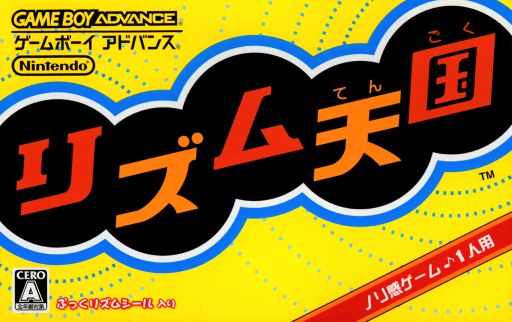
Rhythm Tengoku
A rhythm-action game like no other from the same team that created WarioWare. Rhythm Tengoku contains 48 minigames that put your rhythm to the test in a variety of crazy scenarios. Rhythm Tengoku was developed by Nintendo R&D1 and released exclusively in Japan for the GBA in 2006 and in arcades with Sega's help in 2007.
- AI score · out of 10
- 9.2 / 10
About this game
A rhythm-action game like no other from the same team that created WarioWare. Rhythm Tengoku contains 48 minigames that put your rhythm to the test in a variety of crazy scenarios. Rhythm Tengoku was developed by Nintendo R&D1 and released exclusively in Japan for the GBA in 2006 and in arcades with Sega's help in 2007. Being developed by the same studio responsible for the WarioWare games, Rhythm Tengoku mixes the mini-game based gameplay with rhythm game elements, featuring unusually high-quality music for a GBA game. The game started development in 2004. A 2002 prototype for a GBA drum sequencer was incorporated into Rhythm Tengoku as well: the player can freely drum within the Sound Test or take on 19 drum lessons. (Source) The game contains eight stages with five rhythm games and one remix of the previous five each, adding up to 48 different mini-games total. Each game can be completed without hitting every note perfectly, although doing so will unlock various rhythm-related bonus games and modes, such as a drum set where you have to mimic what the drummer does. Much like the Wario Ware series of games, Rhythm Tengoku is all about following your senses and trying to be aware of various cues in the visuals and audio. This emphasis on sense instead of language makes it quite easy for anyone to pick up and play, even though the game is entirely in Japanese (and consequently only available in the Asian region or through an import website). For example, one of the game's levels has you rapping with a computer-controlled character. He'll speak a colour-coded Japanese phrase, and the player must press 'A' in different rhythms. Although the game explains what rhythms to do for which phrase, non-Japanese speaking players can watch hand movements on-screen to figure it out without the need for language. Occasionally, challenges will crop up, asking you to complete a level without any mistakes. Doing so earns you a certificate for that level, and a pink heart with a 'P' on it appears in that level's description.
Recommended games
Related game recommendations on this platform
Game Boy Advance
AI review
AI reviews are subjective assessments, not player ratings. See each review for its evidence and limitations.Published date:
Immediate rhythm feedback built for brief practice
Rhythm Tengoku centers on beat recognition, timed inputs, and sustained performance. Songs and difficulty tiers support short repeated practice, giving the handheld release a recognizable rhythm and a clear set of player goals. Music, input prompts, and synchronized performance carry the appeal, and the best parts connect readable objectives with steady mechanical feedback. Small prompts and handheld controls constrain precision at higher levels, which is the main reason the original cartridge can feel less approachable today. This GameNavo assessment uses the release description, classification, media record, and retained source evidence. It does not import user ratings, press aggregates, emulator conveniences, or features belonging to console versions and later remakes.
Strengths
- The central loop connects beat recognition, timed inputs, and sustained performance with readable goals.
- Progress has a clear structure and introduces recognizable stage or system changes.
- Presentation supports the rules with useful visual and audio feedback.
Weaknesses
- Small prompts and handheld controls constrain precision at higher levels.
- The original GBA release lacks modern conveniences such as rewind, save states, and expanded tutorials.
Who it is for: Players who enjoy music and rhythm games, accept period-specific handheld controls, and want to understand the original release on its own terms.
Play notes: This assessment is based on documented release evidence rather than a full playthrough; language, link hardware, and cartridge save condition may affect use.
View scoring basis
| Dimension | Review state | Score | Weight |
|---|---|---|---|
| Dimension The content-and-pacing score weighs progression, repetition, recovery after failure, and meaningful replay value. The judgment is specific to this release and does not reward a longer description or a larger media library. | Reviewed | 9.3 / 10 | Not provided |
| Dimension The core-experience score evaluates the rules, control feedback, and room for mastery in this specific GBA release. It excludes title recognition, source volume, asset count, URL-derived values, and external review averages. | Reviewed | 9.2 / 10 | Not provided |
| Dimension The presentation score considers the actual GBA visuals, sound, readability, atmosphere, and narrative expression. Hardware-aware strengths receive credit, while limitations of this release remain part of the result. | Reviewed | 9.2 / 10 | Not provided |
| Dimension The technical-usability score covers responsiveness, interface clarity, saving, language barriers, and accessory requirements. Emulator conveniences are not credited to the original release, and release-specific friction remains reflected in the score. | Reviewed | 9.0 / 10 | Not provided |
Review sources
Not provided
Core information
- Developer
- Nintendo
- Publisher
- Nintendo
- Release date
- 2006
- Platforms
- Game Boy Advance
- Content kind
- Game
- Release state
- Released
- Region
- Worldwide
- Official website
- Not provided
- Offline minimum players
- Not provided
- Offline maximum players
- Not provided
- Online minimum players
- Not provided
- Online maximum players
- Not provided
- Categories
- Music & Dance · Primary genre
- Tags
- Pick-up and Play2D GraphicsHumorousReplayableLow Entry BarrierRhythm-based PlayMusic PerformanceShort Sessions
- Supported game languages
- Not provided
- Requires base game
- Not provided
- Standalone
- Not provided
- Age ratings
- Not provided
- Play modes
- Single playerMultiplayer
- Perspectives
- Side viewFirst person
Release editions
- Game Boy AdvanceWorldwide2006
Game gallery
Sources
Not provided