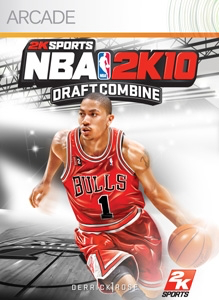
NBA 2K10 Draft Combine
NBA 2K10 Draft Combine is a Xbox 360 simulation game released in 2009 developed by Visual Concepts. It centers on competitive sport controls, system learning, and repeated adjustment and feedback, with controls and information arranged around the Xbox 360 wired or wireless controller's twin sticks, analog triggers, directional pad, and face buttons.
- AI score · out of 10
- 6.5 / 10
About this game
NBA 2K10 Draft Combine is a Xbox 360 simulation game centered on competitive sport controls, system learning, and repeated adjustment and feedback. Schedules, changing values, or staged goals encourage repeated adjustment, with progress divided into stages, tasks, matches, or growth milestones that make immediate goals understandable. Its value depends on whether these rules continue to create judgment and room for mastery rather than on length, sales, or series recognition. Short campaigns are judged by repeat-challenge value, while longer ones are judged by variety, pacing, and recovery after failure. Interface clarity and state feedback matter more than spectacle, while HD video, DVD streaming, surround audio, HDD installs, and television-distance interfaces need to keep action, state, and text readable. The genre-specific limitation is that explanations, dense menus, real-time systems, or accessory dependencies can add friction. Platform conditions also include disc and HDD installation, storage devices, controller batteries, video connections, resolution and frame rate, Kinect space and calibration, and retired online services affect the current release. This description covers only this platform release and does not import features or conveniences from remasters, emulators, or other console editions.
Recommended games
Related game recommendations on this platform
Xbox 360



AI review
AI reviews are subjective assessments, not player ratings. See each review for its evidence and limitations.Published date:
Creating a prospect and practicing roles provides focused basketball, but imperfect grading and insufficient teaching make effort and beginner progress less reliably rewarding.
Creating a prospect and practicing roles provides focused basketball, but imperfect grading and insufficient teaching make effort and beginner progress less reliably rewarding. A custom prospect earns skills through drills, games and teammate grading. Role-based rewards give possessions purpose, but defensive blame and teammate mistakes sometimes disrupt fair feedback and make improvement less consistently satisfying. Drills and fixed games form clear short goals and alternative builds invite experiments, but this remains focused practice rather than a complete season. Movement and on-court chatter suit individual tryouts, while limited venue and character variation provides less sustained drama than organized league competition. Practice permits learning the inputs, but inadequate guidance leaves beginners to discover positional duties and makes accessibility depend heavily on prior basketball familiarity. Players interested in practicing individual basketball roles and building a prospect within a compact experience rather than a full league season.
Strengths
- A custom prospect earns skills through drills, games and teammate grading.
- Movement and on-court chatter suit individual tryouts, while limited venue and character variation provides less sustained drama than organized league competition.
Weaknesses
- Switching defense can produce unfair blame, and beginners receive insufficient role and input teaching.
Who it is for: Players interested in practicing individual basketball roles and building a prospect within a compact experience rather than a full league season.
Play notes: Only retained local drills and matches are assessed; uploading a prospect into NBA 2K10 is not assumed to remain functional.
View scoring basis
| Dimension | Review state | Score | Weight |
|---|---|---|---|
| Dimension Drills and fixed games form clear short goals and alternative builds invite experiments, but this remains focused practice rather than a complete season. | Reviewed | 6.2 / 10 | Not provided |
| Dimension Role-based rewards give possessions purpose, but defensive blame and teammate mistakes sometimes disrupt fair feedback and make improvement less consistently satisfying. | Reviewed | 6.9 / 10 | Not provided |
| Dimension Movement and on-court chatter suit individual tryouts, while limited venue and character variation provides less sustained drama than organized league competition. | Reviewed | 6.4 / 10 | Not provided |
| Dimension Practice permits learning the inputs, but inadequate guidance leaves beginners to discover positional duties and makes accessibility depend heavily on prior basketball familiarity. | Reviewed | 5.9 / 10 | Not provided |
Review sources
Not provided
Core information
- Developer
- Visual Concepts
- Publisher
- 2K
- Release date
- 2009
- Platforms
- Xbox 360
- Content kind
- Game
- Release state
- Released
- Region
- Worldwide
- Official website
- Not provided
- Offline minimum players
- Not provided
- Offline maximum players
- Not provided
- Online minimum players
- Not provided
- Online maximum players
- Not provided
- Categories
- Sports · Primary genre
- Tags
- Resource ManagementThird Person3D GraphicsSlow BurnCozyLife SimulationReplayableSolo-friendlySports-based PlayMain Story 20–50 HoursLong-term Progression
- Supported game languages
- Not provided
- Requires base game
- Not provided
- Standalone
- Not provided
- Age ratings
- Not provided
- Play modes
- Single player
- Perspectives
- Third person
Release editions
- Xbox 360Worldwide2009
Game gallery
Sources
Not provided