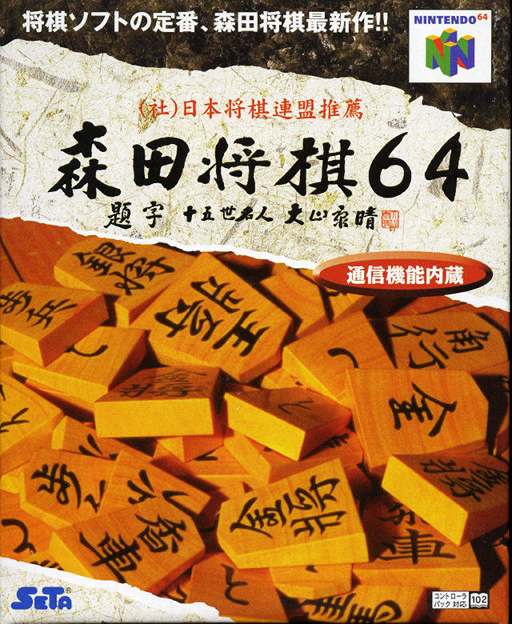
Morita Shougi 64
Morita Shougi 64 is a Nintendo 64 strategy game released in 1998 developed by SETA Corporation. It centers on battlefield assessment, unit or resource management, and turn or phase decisions, with controls, information, and pacing arranged around the analog stick, directional pad, A/B buttons, C buttons, and Z trigger.
- AI score · out of 10
- 7.0 / 10
About this game
Morita Shougi 64 is a Nintendo 64 strategy game centered on battlefield assessment, unit or resource management, and turn or phase decisions. Missions add map constraints, new rules, and tougher opposition, with progress divided into stages, tasks, matches, or growth milestones that make its immediate goals understandable. Its value depends on whether these rules continue to create judgment and room for mastery rather than on length, sales, or series recognition. Short campaigns are judged by repeat-challenge value, while longer ones are judged by variety, pacing, and recovery after failure. Maps, unit states, and action feedback determine whether complex situations remain readable, while 3D scenes, fog, textures, and cartridge audio need to preserve target readability within limited memory and television output. The genre-specific limitation is that tutorial depth, dense menus, pointer precision, and long scenarios increase the learning curve. Platform conditions also include camera control, stick precision, Controller Pak saves, Rumble Pak support, Expansion Pak requirements, and four-player setup can affect original-hardware use. This description covers only this platform release and does not import features from other editions.
Recommended games
Related game recommendations on this platform
Nintendo 64
AI review
AI reviews are subjective assessments, not player ratings. See each review for its evidence and limitations.Published date:
Varied offline practice with lengthy highest-level thinking
Ordinary games, position research, mating puzzles and a grading test offer several ways to practice in one environment. Six computer levels and handicap settings help players choose suitable opposition, while competent short mating sequences make careless endgame play risky. The observed opening repertoire is relatively concentrated, however, and the strongest setting can spend considerable time thinking. A lower level is often the more practical choice for an uninterrupted session. Multiple-choice assistance and repeated test games also mean the displayed grade is practice feedback rather than a strict certificate of ability. Configurable boards, spoken moves and music make the environment comfortable, with a historical-drama-style opening and mascot transitions adding personality. Its present value lies in retained offline activities, not promises of the former network or formal certification service.
Strengths
- Several offline practice and research modes
- Adjustable difficulty, handicaps and presentation
- Charming thematic transitions
Weaknesses
- Lengthy highest-level computer thinking
- Retries weaken grading rigor
Who it is for: Offline shogi learners and position researchers who accept waiting
Play notes: Do not assume former network or formal certification services; treat grades as practice feedback
View scoring basis
| Dimension | Review state | Score | Weight |
|---|---|---|---|
| Dimension Games, research and tests provide varied practice, while retries reduce the grading result's representativeness. | Reviewed | 7.6 / 10 | Not provided |
| Dimension Adjustable opposition and tactical finishing support worthwhile games, with a relatively concentrated observed opening repertoire. | Reviewed | 7.2 / 10 | Not provided |
| Dimension The opening and small menu animations lend the shogi environment personality. | Reviewed | 6.8 / 10 | Not provided |
| Dimension Display and audio settings are convenient, but long highest-level thinking substantially slows games; lowering the level mitigates waiting. | Reviewed | 5.8 / 10 | Not provided |
Review sources
Not provided
Core information
- Developer
- SETA
- Publisher
- SETA
- Release date
- 1998
- Platforms
- Nintendo 64
- Content kind
- Game
- Release state
- Released
- Region
- Worldwide
- Official website
- Not provided
- Offline minimum players
- Not provided
- Offline maximum players
- Not provided
- Online minimum players
- Not provided
- Online maximum players
- Not provided
- Categories
- Strategy & Tactics · Primary genre
- Tags
- Main Story 20–50 HoursSolo-friendlySlow BurnResource ManagementLong-term Progression3D GraphicsReplayableTurn-based TacticsTop-downCommand-based Combat
- Supported game languages
- Not provided
- Requires base game
- Not provided
- Standalone
- Not provided
- Age ratings
- Not provided
- Play modes
- Not provided
- Perspectives
- Not provided
Release editions
- Nintendo 64Worldwide1998
Game gallery
Sources
Not provided