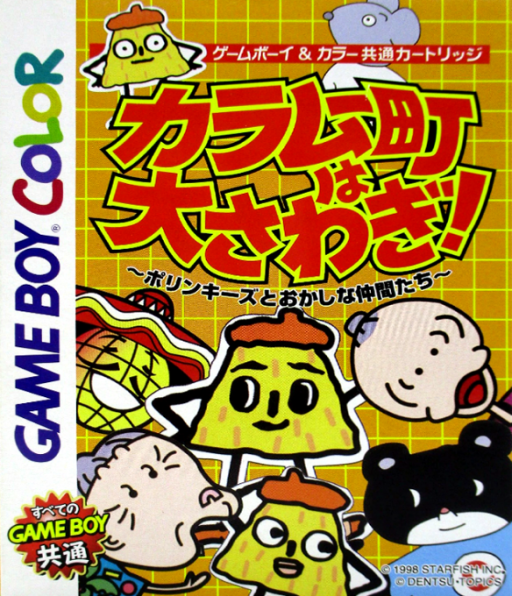
Karamuchou wa Oosawagi! - Polinkies to Okashina Nakama-tachi
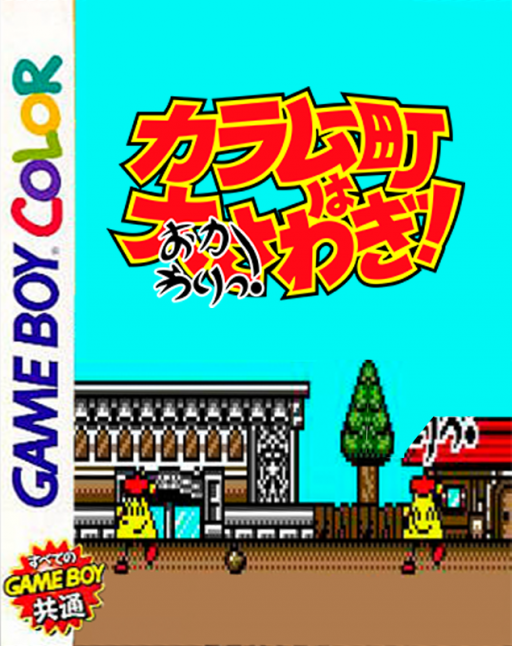
Karamuchou wa Oosawagi! - Polinkies to Okashina Nakama-tachi is a Game Boy Color puzzle game released in 1998 developed by Starfish. It centers on puzzle, maze, or device solving, rule recognition, and spatial or logical judgment, with controls, information, and pacing arranged around a color handheld screen, a directional pad, and two main action buttons.
- AI score · out of 10
- 6.9 / 10
About this game
Karamuchou wa Oosawagi! - Polinkies to Okashina Nakama-tachi is a Game Boy Color puzzle release centered on puzzle, maze, or device solving, rule recognition, and spatial or logical judgment. Compact stages add conditions and tighter constraints over time, with progress divided into stages, tasks, matches, or growth milestones that make its immediate goals understandable. Its value depends on whether these rules continue to create judgment and room for mastery rather than on campaign length or series recognition. Short campaigns are judged by repeat-challenge value, while longer ones are judged by variety, pacing, and recovery after failure. Graphics, audio cues, and state feedback need to support decisions directly, while color choices need to distinguish characters, objects, and routes rather than serve as decoration alone. The main genre-specific friction is that limited explanations, repetition, or abrupt difficulty can stall progress. In addition, battery saves, link cables, cartridge-specific hardware, the unlit display, and regional language can affect the original experience. This description covers only this release and excludes emulator features, modern-port conveniences, and content from other platforms.
Recommended games
Related game recommendations on this platform
Game Boy Color (GBC)
AI review
AI reviews are subjective assessments, not player ratings. See each review for its evidence and limitations.Published date:
Puzzle attempts, scores and collection form a good loop, but unclear scenery weakens the mascots' appeal.
Karamuchou wa Oosawagi! sends snack mascots after three keys and an exit. The objective is straightforward, but solving stages is challenging. Without a time limit, players can consult a map and plan items and routes. Mistakes restart the stage, while hints halve the completion score. World-end chest keys encourage returning for legendary snacks; selectable cleared stages, score-linked stickers and memory or rapid-pressing side games extend collection goals. Color characters resemble their advertisements, but scenery and usable gimmicks can be hard to distinguish, and some abilities weaken character identity. Explicit controls, progress loading and data confirmations make management convenient, with background-removing hints mitigating ambiguity. It suits patient puzzle solvers and collectors; predecessor players still need to relearn the reversed A/B actions.
Strengths
- Untimed planning and score-costing hints create clear puzzle choices.
- World rewards, return searches, score-linked stickers and side games connect collection goals.
- Maps, save loading and confirmed data management provide useful support.
Weaknesses
- Poor separation of scenery and usable gimmicks can mislead platform reading.
- Some item abilities fit their characters poorly.
Who it is for: Players who enjoy action puzzles, repeated solution attempts and sticker collection, and are willing to use maps or hints.
Play notes: This is the original 1998 GB-compatible color game, not Okawari's replacement stages. Hints halve the completion score; predecessor players should note the reversed A/B actions.
View scoring basis
| Dimension | Review state | Score | Weight |
|---|---|---|---|
| Dimension World-end rewards and hidden chests connect completion to return searches. Selectable cleared stages and score-linked stickers give repeat attempts a purpose, while side games vary the task. Progression and collection are well organized. | Reviewed | 7.4 / 10 | Not provided |
| Dimension The three-key objective is clear, with untimed stages allowing item and route planning and a defined restart after mistakes. Maps, retry and score-costing hints provide useful choices, producing a good puzzle-and-action loop. | Reviewed | 7.0 / 10 | Not provided |
| Dimension Color characters resemble the adverts and offer recognizable mascot appeal. However, weak separation of scenery and gimmicks misleads spatial reading, and some abilities fit their characters poorly. Presentation is underwhelming. | Reviewed | 5.7 / 10 | Not provided |
| Dimension Explicit controls, identifiable progress, confirmed data management, maps and stage-recovery commands provide good usability support. Hints mitigate visual ambiguity, although predecessor players need to relearn the A/B actions. | Reviewed | 7.1 / 10 | Not provided |
Review sources
Not provided
Core information
- Developer
- Starfish
- Publisher
- Starfish
- Release date
- 1998
- Platforms
- Game Boy Color (GBC)
- Content kind
- Game
- Release state
- Released
- Region
- Worldwide
- Official website
- Not provided
- Offline minimum players
- Not provided
- Offline maximum players
- Not provided
- Online minimum players
- Not provided
- Online maximum players
- Not provided
- Categories
- Puzzle · Primary genre
- Tags
- Pick-up and PlayShort SessionsReplayableLow Entry BarrierSlow Burn2D GraphicsMain Story Under 10 HoursFixed CameraPuzzle SolvingSolo-friendly
- Supported game languages
- Not provided
- Requires base game
- Not provided
- Standalone
- Not provided
- Age ratings
- Not provided
- Play modes
- Not provided
- Perspectives
- Not provided
Release editions
- Game Boy Color (GBC)Worldwide1998
Game gallery
Sources
Not provided