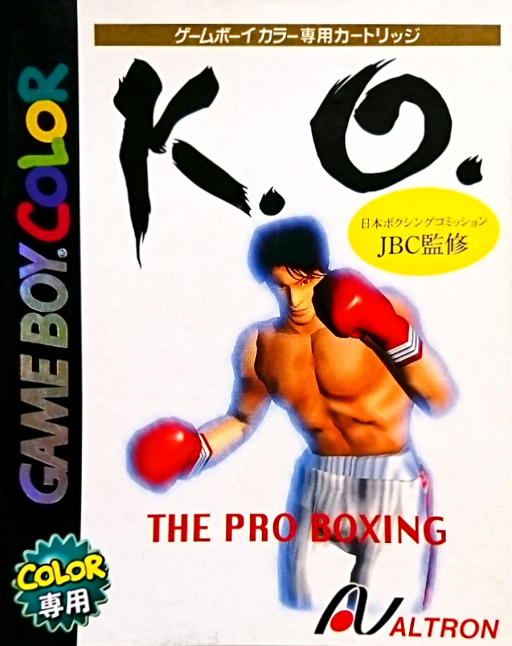
K.O. - The Pro Boxing
K.O. - The Pro Boxing is a Game Boy Color fighting game released in 2000 developed by Altron. It centers on move inputs, offense-defense reads, and character matchups, with controls, information, and pacing arranged around a color handheld screen, a directional pad, and two main action buttons.
- AI score · out of 10
- 6.6 / 10
About this game
K.O. - The Pro Boxing is a Game Boy Color fighting release centered on move inputs, offense-defense reads, and character matchups. Short bouts use character differences and rising difficulty for variety, with progress divided into stages, tasks, matches, or growth milestones that make its immediate goals understandable. Its value depends on whether these rules continue to create judgment and room for mastery rather than on campaign length or series recognition. Short campaigns are judged by repeat-challenge value, while longer ones are judged by variety, pacing, and recovery after failure. Animation, hit feedback, and readable arenas create match tension, while color choices need to distinguish characters, objects, and routes rather than serve as decoration alone. The main genre-specific friction is that button mapping, move recognition, and cpu behavior can affect match balance. In addition, battery saves, link cables, cartridge-specific hardware, the unlit display, and regional language can affect the original experience. This description covers only this release and excludes emulator features, modern-port conveniences, and content from other platforms.
Recommended games
Related game recommendations on this platform
Game Boy Color (GBC)
AI review
AI reviews are subjective assessments, not player ratings. See each review for its evidence and limitations.Published date:
Useful training trade-offs meet a prolonged retirement phase after championship success.
K.O. connects boxer development with direct match actions. Training involves attribute gains and losses, while growth type changes which strengths are practical to pursue. Punches, uppercuts, hooks, body blows and high or low guards offer different tools, although the documented power build succeeded through persistent attacks, leaving defense less necessary on that route. Career closure is the bigger problem: an early world title can leave a long wait for retirement, retaining the title prevents retiring, and deliberate losing can cause dismissal. The training screen separates schedule, portrait and attribute bars, while a belt display celebrates the title. Training acceleration and cancellation make preparation manageable. It suits players interested in development and punch choices who accept that winning the championship does not finish the career.
Strengths
- Training trade-offs and growth direction influence the build taken into matches.
- Separate schedule and numeric/bar attributes communicate development clearly.
- Training acceleration and cancellation accompany explicit match-action commands.
Weaknesses
- The successful power build makes some defensive tools less necessary on that route.
- Early championship success leaves prolonged retirement management, with risky losing shortcuts.
Who it is for: Players who like developing a boxer before using varied match actions and are willing to manage retirement after the world-title milestone.
Play notes: This covers the original Japanese 2000 GBC game, with Japanese text. A accelerates training and B cancels; championship success still leaves retirement to manage, and consecutive deliberate losses may cause dismissal. Current cartridge save reliability was not checked.
View scoring basis
| Dimension | Review state | Score | Weight |
|---|---|---|---|
| Dimension Training toward a world title provides a clear goal, but early success can leave a prolonged retirement phase, while remaining champion prevents its conclusion. Deliberate losing risks dismissal. Late progression is weak for this evidenced mismatch between reaching the main milestone and finishing the career, not merely for spanning many years. | Reviewed | 5.4 / 10 | Not provided |
| Dimension Training trade-offs connect character building to a good range of match actions. The successful attack-heavy power build nevertheless leaves defensive tools less necessary in that reported route. This bounds the demonstrated tactical payoff without claiming every build or opponent makes defense irrelevant. | Reviewed | 7.0 / 10 | Not provided |
| Dimension The training layout separates schedule, boxer and attributes, with numbers and bars complementing one another; the belt screen gives the title a celebratory identity. Static presentation is good for communicating preparation and achievement. These frames do not establish match animation or sound quality. | Reviewed | 7.0 / 10 | Not provided |
| Dimension Training acceleration and cancellation, plus explicit movement, guard and punch commands, support good basic usability. Players can manage preparation time and learn concrete actions rather than rely on unexplained attributes. Directional combinations need practice; present-day cartridge saving and hardware response have not been tested. | Reviewed | 7.3 / 10 | Not provided |
Review sources
Not provided
Core information
- Developer
- Altron
- Publisher
- Altron
- Release date
- 2000
- Platforms
- Game Boy Color (GBC)
- Content kind
- Game
- Release state
- Released
- Region
- Worldwide
- Official website
- Not provided
- Offline minimum players
- Not provided
- Offline maximum players
- Not provided
- Online minimum players
- Not provided
- Online maximum players
- Not provided
- Categories
- Sports · Primary genre
- Tags
- Class BuildsSolo-friendlyCombosFast-pacedLevel Progression2D GraphicsReal-time CombatMelee CombatSports-based PlayShort SessionsLong-term ProgressionReplayable
- Supported game languages
- Not provided
- Requires base game
- Not provided
- Standalone
- Not provided
- Age ratings
- Not provided
- Play modes
- Not provided
- Perspectives
- Not provided
Release editions
- Game Boy Color (GBC)Worldwide2000
Game gallery
Sources
Not provided