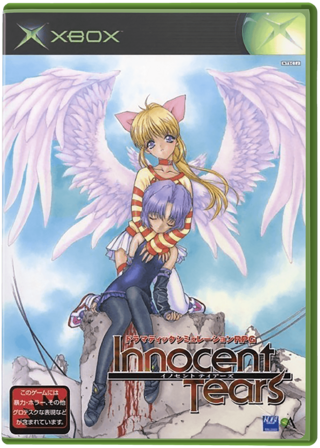
Innocent Tears
Innocent Tears is a Xbox role-playing game released in 2002 developed by Global A Entertainment. It centers on combat encounters, area and route exploration, and character progression, with controls and information arranged around the Duke or Controller S twin sticks, analog triggers, directional pad, and face buttons.
- AI score · out of 10
- 5.9 / 10
About this game
Innocent Tears is a Xbox role-playing game centered on combat encounters, area and route exploration, and character progression. Story beats, exploration, and progression resources support a longer campaign, with progress divided into stages, tasks, matches, or growth milestones that make immediate goals understandable. Its value depends on whether these rules continue to create judgment and room for mastery rather than on length, sales, or series recognition. Short campaigns are judged by repeat-challenge value, while longer ones are judged by variety, pacing, and recovery after failure. Characters, world building, environments, and music carry most of the atmosphere, while standard or progressive-scan video, widescreen support, HDD caching, and Dolby Digital audio need to preserve action, state, and text readability together. The genre-specific limitation is that dense text, menu layers, repeated battles, loading, or language dependence can slow progress. Platform conditions also include disc loading, the internal HDD and cache, memory units, regional language, display modes, legacy controller ports, and retired Xbox Live services affect present-day use. This description covers only this platform release and does not import features or conveniences from remasters, emulators, or other console editions.
Recommended games
Related game recommendations on this platform
Original Xbox
AI review
AI reviews are subjective assessments, not player ratings. See each review for its evidence and limitations.Published date:
Distinctive characters and voices outshine an uneven tactical challenge, progression and battlefield readability.
Innocent Tears mixes conversations in ruined Tokyo with grid combat. Character illustrations and principal voices give it personality. AP, flanking and height offer choices, but protagonist growth lets most encounters stop testing them; occasional fights reward tactics. Visit order and party composition alter dialogue, and map colors indicate remaining story opportunities. Unproductive revisits and unresolved threads nevertheless weaken exploration rewards. Battles proceed briskly, while the Japanese release's difficult-to-read three-dimensional field burdens unit arrangement. Battlefield detail and uneven sound are less compelling than the character art. Surreal storytelling can entertain, although causal and moral cohesion are limited. It suits players drawn to strange character stories who tolerate inconsistent tactical demands and progression friction, rather than those seeking sustained strategic challenge or clear narrative closure.
Strengths
- Character art, ruined-city contrast and principal voices create a distinctive atmosphere.
- AP, flanking and height offer tactical choices with rewards in some encounters.
- Visit order and party composition vary dialogue.
Weaknesses
- Protagonist growth reduces sustained tactical demands in most battles.
- Revisits may not advance events, with unclear closure for some threads.
- Native Japanese three-dimensional battlefield readability is weak.
- Battlefield detail and sound are less consistent than character presentation.
Who it is for: Players who enjoy surreal character stories, distinctive illustrations and bounded tactical choices, and tolerate progression and readability friction.
Play notes: This covers the original 2002 Japanese Xbox software; Japanese reading matters, and an original copy plus compatible console is needed. The fan translation is not bundled and has separate console-modification and compatibility conditions. Adult dialogue and violent themes occur.
View scoring basis
| Dimension | Review state | Score | Weight |
|---|---|---|---|
| Dimension Visit-order variations and brisk battles offer rewards. Yet unproductive revisits and unresolved threads interrupt progression and closure. Surrealism can appeal, but causal cohesion still limits satisfaction. Content and pacing remain weak. | Reviewed | 5.4 / 10 | Not provided |
| Dimension Flanking, height and AP trade-offs matter, with a tactical exception. However, protagonist growth lets most encounters stop testing those choices. Early difficulty does not remove the limited sustained differentiation. The core is weak, not devoid of useful rules. | Reviewed | 5.7 / 10 | Not provided |
| Dimension Character art, ruined-city contrast and principal voices create a distinctive atmosphere. Presentation is good, although uneven battlefield detail and sound limit sustained impact. Its strongest expression lies in characters, not combat spectacle. | Reviewed | 7.1 / 10 | Not provided |
| Dimension Map colors provide basic progress information, and brisk battles reduce pacing friction. Native Japanese battlefield visibility still interferes with unit arrangement, leaving usability weak. Play requires an original copy and compatible console; patch conveniences are not base-game features. | Reviewed | 5.8 / 10 | Not provided |
Review sources
Not provided
Core information
- Developer
- Global A
- Publisher
- Kobi
- Release date
- 2002
- Platforms
- Original Xbox
- Content kind
- Game
- Release state
- Released
- Region
- Worldwide
- Official website
- Not provided
- Offline minimum players
- Not provided
- Offline maximum players
- Not provided
- Online minimum players
- Not provided
- Online maximum players
- Not provided
- Tags
- FantasyMain Story 20–50 Hours3D GraphicsTurn-based CombatLevel ProgressionThird PersonStory-drivenExplorationLong-term ProgressionSolo-friendlyReal-time Combat
- Supported game languages
- Not provided
- Requires base game
- Not provided
- Standalone
- Not provided
- Age ratings
- Not provided
- Play modes
- Not provided
- Perspectives
- Not provided
Release editions
- Original XboxWorldwide2002
Game gallery
Sources
Not provided